

90 years of Grey
Bombers owe existence to Winnipeg's first trip to Grey Cup
Advertisement
Read this article for free:
or
Already have an account? Log in here »
To continue reading, please subscribe:

Digital Subscription
One year of digital access for only $205*
- Enjoy unlimited reading on winnipegfreepress.com
- Read the E-Edition, our digital replica newspaper
- Access News Break, our award-winning app
- Play interactive puzzles
*First annual payment billed as $205.00 + GST for one year. This annual subscription will automatically renew at $233.00 + GST every 52 weeks (10% off the regular annual price of $259.35). Offer available to new and qualified returning subscribers only. Cancel any time.
To continue reading, please subscribe:
Add Free Press access to your Brandon Sun subscription for only an additional
$1 for the first 4 weeks*
- Enjoy unlimited reading on winnipegfreepress.com
- Read the E-Edition, our digital replica newspaper
- Access News Break, our award-winning app
- Play interactive puzzles
*Your next Brandon Sun subscription payment will increase by $1.00 and you will be charged $17.95 plus GST for four weeks. After four weeks, your payment will increase to $24.95 plus GST every four weeks.
Read unlimited articles for free today:
or
Already have an account? Log in here »
Hey there, time traveller!
This article was published 29/11/2015 (3878 days ago), so information in it may no longer be current.
Today’s Grey Cup contest will be played in Winnipeg 90 years after the very first Winnipegbased team, the Tammany Tigers, vied for the national championship.
The roots of the Tigers extend to September 1915 and a group of young men who played lacrosse and rugby at the Mulvey School field in Wolseley. Most had previously played on intermediate and senior teams, but the First World War wreaked havoc on sports leagues as many of their member teams, especially those affiliated with universities, ceased operations.
Reduced to playing informal games and teaching younger children to play, they decided to create their own sports club called the Tammany Tigers Athletic Association. They signed up enough area youth to field both a junior (under-16) and juvenile (under-18) rugby football team that year.

The hopes of having an over-21 senior team were dashed when some of the club’s older members enlisted. Among them were two of the key founders, the Mitchell brothers of Lenore Street, who went by the nicknames Tote and Sport. Sport was killed in action and Tote lost an arm at the Battle of Vimy Ridge. Other senior team prospects either never made it home or came back too injured to play.
The Tigers soon began racking up championships, winning both the junior and juvenile rugby football leagues in 1916, 1917 and 1919. That success attracted more recruits and in 1920 they were finally able to field a team of senior men in the Manitoba Rugby Football Union. Over the next couple of years they branched out into senior league lacrosse, baseball, hockey and track and field.
In 1925, the club was celebrating its 10th anniversary and they had a major goal in mind: despite winning 22 league championships in various sports and at various age levels, the senior rugby football title still eluded them.
That year, the league consisted of four teams: the Tammany Tigers, University of Manitoba Varsity, Winnipeg Victorias and St. John’s College. Each played six regular-season games, with a potential for two more in the playoffs.
History shows the Tigers squad described as not being the greatest team ever fielded, but it was young — average age 23 — gritty and fought hard in every position. The eldest player was coach Harold Roth, 30, who also played middle wing. The best-known member of the squad was flying wing Dick Buckingham, 23, who was already on his way to becoming a Hall of Fame lacrosse player. With lightning speed and carrying 190 pounds, Dick was a hard man to take down. The captain of the squad was Johnny Liang, a wiry 150-pounder who could turn on a dime and leap over the tallest of scrums.
The season opened on Sept. 19, 1925, at River Park, the league’s only venue, with the Tigers playing the defending western Canadian champions and six-time city champions Winnipeg Victorias. The Vics were out for revenge after missing out on an entry into the previous year’s Grey Cup game.
The Tigers started the season with back-to-back wins over the Vics, then blanked Varsity 11-0. It seemed they might steamroll the league, but then suffered back-to-back losses: a 6-5 squeaker against Varsity and a surprise upset delivered by St. John’s. The final game of the year was another win over the Vics, which put the Tigers at the top of the standings and gave them a bye into the city final.
The Manitoba Rugby Football Union’s championship game took place on Thanksgiving Day at River Park in front of a record crowd of 3,000 fans. The Tigers faced Varsity, who, despite a slow start, finished the season on a winning streak.
The final score was a repeat of their first regularseason matchup, 11-0 in favour of the Tigers. Despite the lopsided score, a Winnipeg Tribune reporter wrote “there was not a fan who didn’t get their money’s worth,” noting it was a hard-fought defensive battle that might just have been one of the best rugby football matches played in the city.
The Tigers left for Regina on Nov. 13 to play for the Western Canadian Rugby Union championship the next day. The Roughriders were an unknown entity, even to their own fans. No senior league materialized in their city that year, so the only game they played was a challenge against the winner of the Saskatoon league. The Riders trounced the Quakers 30-0 and ended up provincial champions.
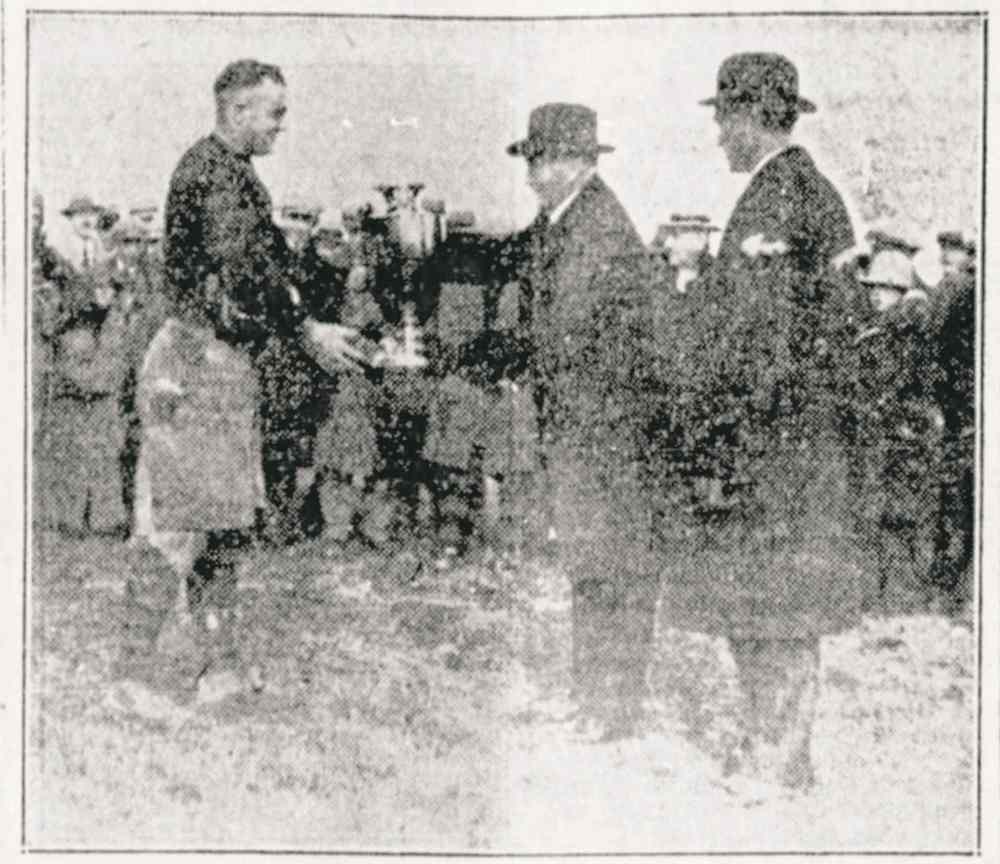
The Tigers beat the Roughriders 11-1 thanks to Dick Buckingham’s 50-yard dash to score the game’s only touchdown. For their efforts, they were awarded the Hugo Ross Trophy, donated by the Winnipeg realtor and rugby supporter the year before he died in the sinking of the Titanic.
The Tigers wasted no time applying to the Canadian Rugby Union to play the Ottawa Senators, champions of the Interprovincial Rugby Union, nicknamed the “Big Four,” for the Grey Cup.
The odds were certainly stacked against the Tigers.
Western teams had gone east on three previous occasions and the accumulated score was 101-1 in favour of the East. This was blamed in part on the fact that the final was played under eastern rules, but the larger issue was that the community owned teams of the Big Four — Toronto, Ottawa, Hamilton and Montreal — were more established and better-funded.
Local media were hopeful but realistic about the Tigers’ chances. A Tribune reporter noted it would be the best team the West had sent out and that, “If the eastern team wins, it will be by a close score, say the experts around this neck of the woods, and if they do win, they will know they have been in a game of rugby.”
Ottawa media reported the Senators were not taking the past record of the East for granted and were practising just as hard as they would for any other big game. The Ottawa Citizen ran scouting reports and detailed player features on some of the Tigers stars to give fans a taste of what to expect.
After three weeks of intense training, the Tigers were seen off by a couple hundred fans at the CPR Depot on the morning of Dec. 2. They arrived in Ottawa two days later, a little more than 24 hours before the game. Enough time to get in a final practice and good night’s sleep.
Game day for the 13th Grey Cup was Saturday, Dec. 5. The Canadian Press reported, “the city (of Ottawa) is agog with football chatter, and despite the weather, a big throng is expected to turn out for the contest.”
The Senators came out strong right from the start while the Tigers looked unsure of themselves. Ten minutes in and the home team scored its first touchdown, followed by another in the second quarter. Despite being down 13–0, the Tigers collected themselves at half time and stopped the Sens on a number of key drives in the third. They also earned their only point of the game, a rouge by outside wing Charlie Counsell. What momentum they had built up, however, deflated in the fourth quarter thanks to a pair of fumbles Ottawa turned into touchdowns.
At the final whistle, the Ottawa Senators won the Grey Cup by a score of 24-1 in front of 5,000-plus fans at Lansdowne Field. A report by The Canadian Press summarized: “To rugby students, it was a disappointment. The westerners undoubtedly had the individual ability and showed prowess that was well worthy of commendation, but as a team they could not cope with the machine-like smoothness of the winners.”

As a consolation, that same night the Senators organization treated the Tigers to a banquet and tickets to watch the local NHL team play the Pittsburgh Pirates.
Despite the loss there was one member of the Tigers who must have felt a great deal of pride: manager Tote Mitchell. When he and late brother Sport co-founded the Tammany Tigers Athletic Association on the Mulvey School field a decade earlier, he likely didn’t imagine playing in a Grey Cup final.
One of the lessons Tote took away from Ottawa was if western teams were ever going to compete at a national level, they had to emulate the Big Four with one community-owned senior team per city.
He advocated for such a change and in 1930, the Tigers were one of the senior teams that folded into the Winnipeg Football Club, today affectionately known as the Blue Bombers.
Christian Cassidy writes about local history at his blog, West End Dumplings.