

Northern health care system failed infant who died two months after birth: inquest
Advertisement
Read this article for free:
or
Already have an account? Log in here »
To continue reading, please subscribe:

Digital Subscription
One year of digital access for only $205*
- Enjoy unlimited reading on winnipegfreepress.com
- Read the E-Edition, our digital replica newspaper
- Access News Break, our award-winning app
- Play interactive puzzles
*First annual payment billed as $205.00 + GST for one year. This annual subscription will automatically renew at $233.00 + GST every 52 weeks (10% off the regular annual price of $259.35). Offer available to new and qualified returning subscribers only. Cancel any time.
To continue reading, please subscribe:
Add Free Press access to your Brandon Sun subscription for only an additional
$1 for the first 4 weeks*
- Enjoy unlimited reading on winnipegfreepress.com
- Read the E-Edition, our digital replica newspaper
- Access News Break, our award-winning app
- Play interactive puzzles
*Your next Brandon Sun subscription payment will increase by $1.00 and you will be charged $17.95 plus GST for four weeks. After four weeks, your payment will increase to $24.95 plus GST every four weeks.
Read unlimited articles for free today:
or
Already have an account? Log in here »
Hey there, time traveller!
This article was published 22/12/2015 (3914 days ago), so information in it may no longer be current.
The province’s northern health care system failed infant Drianna Ross and her parents every step of the way from the local nursing station to the Thompson hospital, an inquest concludes.
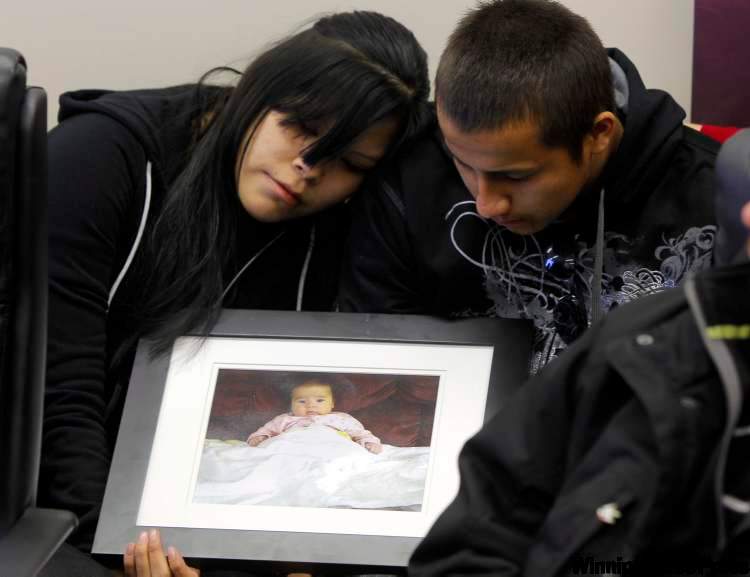
Drianna, of God’s Lake First Nation, was two months old when she died at the Thompson General Hospital in November 2011.
“The medical system failed Erna Hastings, Paul Ross and Drianna Ross,” said provincial court judge Don Slough in an inquest report released Tuesday.
Slough reserved his toughest comments for the baby’s medical care at the hospital, where Drianna was flown 18 hours before her death.
“Although mistakes were made in Drianna Ross’s care while she was at the nursing station, the critical events occurred during her time in Thompson General Hospital,” Slough wrote.
Northern Manitoba nursing stations have been frequently come under fire, most recently after a scathing audit by federal auditor general Michael Ferguson was released earlier this year, stating Health Canada didn’t take into account the health care needs of its communities when allocating resources, and has no real understanding of whether its nursing stations can provide essential health services because it has never assessed their capacity.
The death in 2011 made national headlines.
In the days leading up to her death, Drianna’s parents took her to the local nursing station at God’s Lake Narrows several times without once seeing a doctor. A nurse prescribed Tylenol to bring down her fever.
God’s Lake Narrows is adjacent to God’s Lake First Nation, 550 kilometres northeast of Winnipeg.
An autopsy showed her infection was caused by methicillin-resistant staphyloccus aureus, a superbug in remote communities with crowded homes and cramped facilities, the judge said.
At the nursing station, an inexperienced nurse treated the baby and when it was decided to fly her to Thompson, 250 kilometres away, the nursing station’s practice of using paperwork, not electronic files, meant critical information was not passed on to the hospital.
At the hospital, the baby was seen by a pediatrician who diagnosed pneumonia and prescribed antibiotics that don’t work on MRSA. Ross was left in the care of another inexperienced nurse and “the seriousness of her condition was not recognized in a timely way,” Slough wrote.
Slough listed nine recommendations in his 41-page report. They suggest changes to the way nursing stations and hospitals treat northern patients. Slough noted the health care facilities in the north were understaffed, overworked and, in nursing stations especially, lacked necessary equipment and computers.
Slough noted the Thompson hospital has made “significant changes” in the years since Drianna died.
“There is no doubt that the provision of health care in the north is challenging,” the judge concluded. “Without exception, I found all the individuals who gave evidence were committed to making things better so that a repetition of this tragedy can be prevented.”
That said, the judge noted, “As we move forward, there must be consultation and respect for the needs and wishes of First Nations impacted by the deficiencies in services.” (Federal and provincial) co-operation must expand its scope, with the goal that residents of some of Manitoba’s most disadvantaged communities have the quality health care that is the right of all Canadians,” Slough concluded.
Slough reserved some of his most poignant remarks for Drianna and her parents. He described the baby as a “normal happy baby with two devoted parents.”
Of Drianna’s parents, Slough noted: “Numerous witnesses described the outstanding care Drianna’s parents provided. When she got sick, they fought for her with all the energy and tenacity they possessed. Drianna fought her illness with the same tenacity but because the seriousness of her condition was not recognized in a timely way, she died.”
Health Minister Sharon Blady apologized to Drianna’s family for the timing of the release of the inquest report, noting another Christmas will pass without their daughter.

Blady said she accepts all the recommendations from the inquest report and insisted Manitoba Health is already taking steps to strengthen northern health care. “A lot of it comes down to recruiting and retaining, but I want to make sure that whether it’s in the northern health authority or across the province, I want consistency,” Blady said.
The minister said she’s reaching out to her federal counterpart to close gaps in health care provided by the province and Ottawa for indigenous Manitobans.
“It should not matter where you live. Every child deserves the same care. While geography might place a challenge in some of these cases, we have to address that,” Blady said.
alexandra.paul@freepress.mb.ca
— with files from Bartley Kives