

Old forest stand gives glimpse into past
View of historical climate conditions
Advertisement
Read this article for free:
or
Already have an account? Log in here »
To continue reading, please subscribe:
Monthly Digital Subscription
$1 per week for 24 weeks*
- Enjoy unlimited reading on winnipegfreepress.com
- Read the E-Edition, our digital replica newspaper
- Access News Break, our award-winning app
- Play interactive puzzles
*Billed as $4.00 plus GST every four weeks. After 24 weeks, price increases to the regular rate of $19.95 plus GST every four weeks. Offer available to new and qualified returning subscribers only. Cancel any time.
Monthly Digital Subscription
$4.99/week*
- Enjoy unlimited reading on winnipegfreepress.com
- Read the E-Edition, our digital replica newspaper
- Access News Break, our award-winning app
- Play interactive puzzles
*Billed as $19.95 plus GST every four weeks. Cancel any time.
To continue reading, please subscribe:
Add Free Press access to your Brandon Sun subscription for only an additional
$1 for the first 4 weeks*
- Enjoy unlimited reading on winnipegfreepress.com
- Read the E-Edition, our digital replica newspaper
- Access News Break, our award-winning app
- Play interactive puzzles
*Your next Brandon Sun subscription payment will increase by $1.00 and you will be charged $17.95 plus GST for four weeks. After four weeks, your payment will increase to $24.95 plus GST every four weeks.
Read unlimited articles for free today:
or
Already have an account? Log in here »
Hey there, time traveller!
This article was published 26/12/2015 (3790 days ago), so information in it may no longer be current.
A forest stand believed to be the oldest in southern Manitoba is being protected and turned into a “natural laboratory.”
The stand near Delta Marsh grows alongside a former channel — an oxbow, to be precise — of the Assiniboine River that emptied into Lake Manitoba (and not the Red River) 3,000 years ago.
Trees in the forest stand, dubbed the Oxbow Woods, were cored by the Geological Survey of Canada to provide an age. The core rings date the trees to about 1850.
That predates European settlement of the area. The first farm was started there in 1873.
“There’s not a lot of old forest on the Prairies to study,” said Gordon Goldsborough, University of Manitoba aquatic biologist, who heads the research.
“The only place you find trees on the Prairies is where it’s wet enough, and that’s typically along rivers. Any of those forests have probably been cut, either for lumber, or for fuel back in the days of wood stoves.”
The reason the Oxbow Woods survived is probably because the forest is surrounded on three sides by water — swampy troughs left by the Assiniboine River paleochannel. The water likely discouraged settlers from going in and cutting the forest, said Goldsborough, co-author of the recently published book Delta: A Prairie Marsh and its People.
Goldsborough has divided the Oxbow Woods into two 2.5-acre plots for study purposes, a north and south plot. The south plot was once owned by Colin Inkster, the provincial sheriff for whom Winnipeg’s Inkster Boulevard is named. Inkster died from smoke inhalation at his hunting lodge in Delta Marsh in September 1934.
The north plot contains about 650 trees, and the south plot about 500. The stand doesn’t have great diversity, mostly burr oak, Manitoba maple, green ash, balsam poplar, willows and wild plum.
The trees provide a record of climate and climate change by the breadth of their rings, as well as flooding. For example, the trees produced very narrow rings in 1915 and 1976, indicative of severe drought in those years.
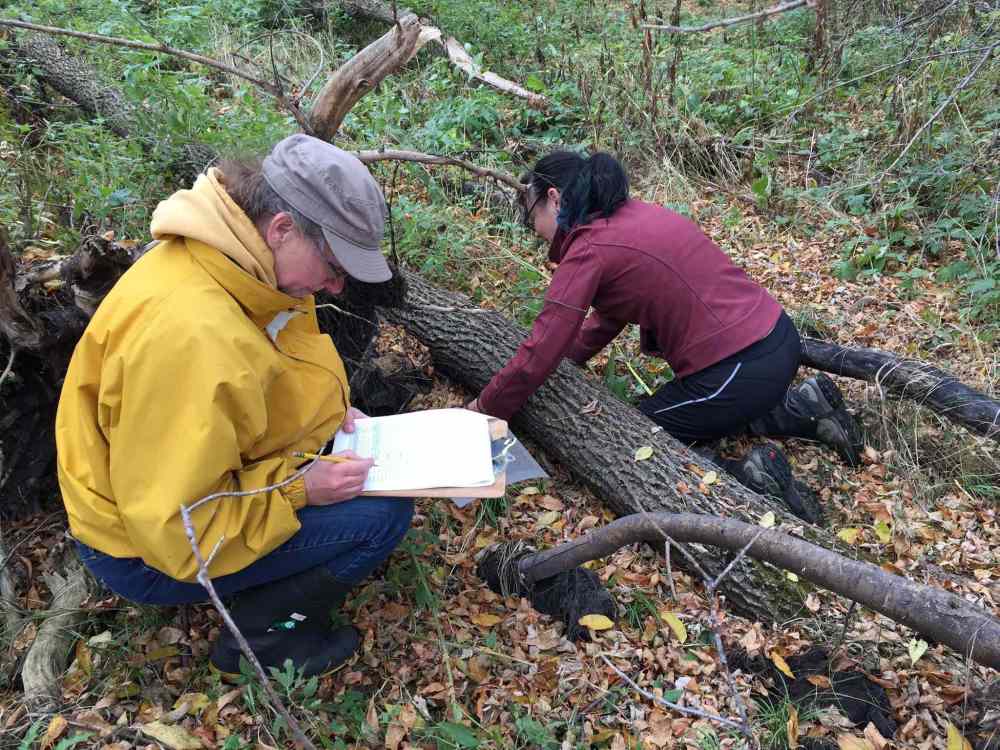
Each tree has been marked with an aluminum tag. Goldsborough and U of M students return every five years to count tree mortality and put a tape measure around tree trunks to measure growth.
Arborists Glenn Peterson, of the Manitoba Forestry Association, and Ken Fosty applauded the forest preservation. Fosty agreed the stands are likely the oldest in southern Manitoba, although there are individual trees that are older and equally old stands farther north. “It’s like a little island of trees isolated from the rest of the prairie,” Fosty said. Those types of trees also have thick barks that can withstand a Prairie fire, and that may also contribute to their longevity, he said.

Peterson said there are some tree stands in the Sandilands Provincial Forest that are a century old, and there are individual burr oak trees 200 to 300 years old.
“It’s a good natural laboratory,” he said. It could show tree growth has quickened versus the past, or it might show changes took place when the Portage Diversion was built, re-connecting the Assiniboine River to Lake Manitoba, he said.
Peterson added the variety of trees in the Oxbow Woods are river-bottom forest that can survive having their roots submerged for short periods.
Goldsborough has been keeping record on the forest since 2000 and measures the trees every five years, along with tree mortality. He plans to continue and hopes the trees will be preserved and studied for the next 100 years, if they live that long. “The value gets better the longer (the research program) runs,” he said.
bill.redekop@freepress.mb.ca
History
Updated on Saturday, December 26, 2015 12:08 PM CST: Replaces picture
Updated on Saturday, December 26, 2015 12:11 PM CST: Adds pdf.