

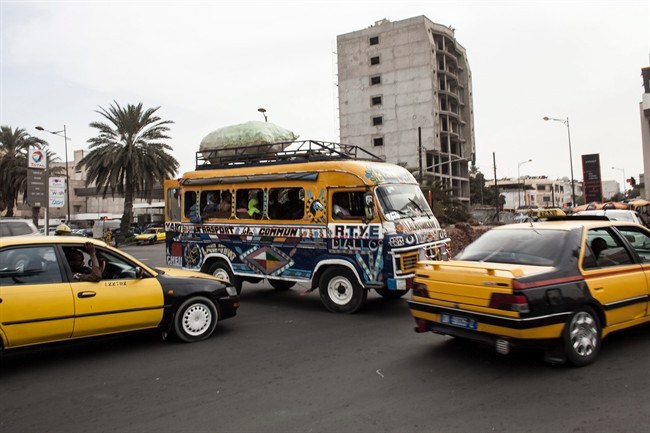
Senegal to phase out its car rapides, colorful modes of transport that are speeding canvases
Advertisement
Read this article for free:
or
Already have an account? Log in here »
To continue reading, please subscribe:
Digital Subscription
One year of digital access for only $1.44 a week*
- Enjoy unlimited reading on winnipegfreepress.com
- Read the E-Edition, our digital replica newspaper
- Access News Break, our award-winning app
- Play interactive puzzles
*Billed as $5.77 plus GST every four weeks. After 52 weeks, price increases to the regular rate of $19.95 plus GST every four weeks. Offer available to new and qualified returning subscribers only. Cancel any time.
To continue reading, please subscribe:
Add Free Press access to your Brandon Sun subscription for only an additional
$1 for the first 4 weeks*
- Enjoy unlimited reading on winnipegfreepress.com
- Read the E-Edition, our digital replica newspaper
- Access News Break, our award-winning app
- Play interactive puzzles
*Your next Brandon Sun subscription payment will increase by $1.00 and you will be charged $17.95 plus GST for four weeks. After four weeks, your payment will increase to $24.95 plus GST every four weeks.
Read unlimited articles for free today:
or
Already have an account? Log in here »
Hey there, time traveller!
This article was published 27/12/2015 (3951 days ago), so information in it may no longer be current.
DAKAR, Senegal – Bill Amahdou dips his brush into a tin of white paint sitting on the sandy road, and effortlessly outlines a Senegalese flag on a truck’s back flap. He then paints an eye within an orange heart next to the flag. Disparate images blending together in bright harmony on vehicles that are symbolic of Senegal: car rapides, or fast buses.
For 17 years Amahdou, 37, has made his distinctive mark on these vehicles that are moving art, whizzing through the streets of Dakar, people often hanging off the sides. The car rapides have for decades been colorful emblems of Senegal with rattling doors, some nearly falling off, and travelling at dangerous speeds.
But city authorities have announced they will stop licensing the car rapides by 2018, and instead will register newer mini-buses which are safer and have more seating.
Until then, Amahdou says he will continue to use the cars as his canvases.
“We get a car rapide every few days,” Amahdou says, putting in an ear bud. He says he sometimes listens to Tracy Chapman, like his father used to when he was building the business.
“He didn’t want me to do this work, but I am so happy here,” he said, smiling.
Amahdou and cousin, 31-year-old, Kalidou Diallo, known as Neyoo, swiftly move around the vehicle that will carry cargo instead of people. The front is a lively blend of symbols in green, orange, blue, red and white with the word: Alhamdoulillah, or Praise God.
“All the vehicles get eyes,” said Neyoo, “just like a human.” The painted vehicles represent their owners, who request animals, flags and symbols of their religious followings. Many others leave the designs to the artists.
They charge about $60 to paint the baggage car. Painting one that carries people costs about $120.
Taxi driver Fallou Ndiaye, 61, came to the corner near Dakar’s Grand Mosque to have Neyoo paint his license number on the door of his vehicle.
“They are the best, that’s why I come here,” he said. A former car rapide driver, he says he’s happy to see them go. “Too many fights about money, and they get into too many accidents.”
Phasing out the vehicles is the safest and most professional thing to do, given that the average age of the vehicles is 25 years, with some rumbling on the roads after 40 years, said Cheikh Oumar Gaye, director of operations for the Executive Council of Urban Transport in Dakar.
But many passengers are worried they won’t be able to afford the 33 cents to 60 cents fares for the buses. A trip in a car rapide costs 8 cents to 25 cents. And the routes for the buses are not as vast and they don’t run as early or late as the car rapides, Dakar residents said.
In the meantime, the artists say they have plenty of work.
Pape Omar Pouye helped paint the car rapide that this year was displayed in Paris at the Museum of Man. He has moved on to painting signs for stores, billboards and advertisements.
“Car rapides are a mirror of Dakar,” he said. “It will be a lost canvas, but we will find more.”