

MPI releases data on top 5 worst intersections in Winnipeg
Advertisement
Read this article for free:
or
Already have an account? Log in here »
To continue reading, please subscribe:
Monthly Digital Subscription
$0 for the first 4 weeks*
- Enjoy unlimited reading on winnipegfreepress.com
- Read the E-Edition, our digital replica newspaper
- Access News Break, our award-winning app
- Play interactive puzzles
*No charge for 4 weeks then price increases to the regular rate of $19.00 plus GST every four weeks. Offer available to new and qualified returning subscribers only. Cancel any time.
Monthly Digital Subscription
$4.75/week*
- Enjoy unlimited reading on winnipegfreepress.com
- Read the E-Edition, our digital replica newspaper
- Access News Break, our award-winning app
- Play interactive puzzles
*Billed as $19 plus GST every four weeks. Cancel any time.
To continue reading, please subscribe:
Add Free Press access to your Brandon Sun subscription for only an additional
$1 for the first 4 weeks*
*Your next subscription payment will increase by $1.00 and you will be charged $16.99 plus GST for four weeks. After four weeks, your payment will increase to $23.99 plus GST every four weeks.
Read unlimited articles for free today:
or
Already have an account? Log in here »
Hey there, time traveller!
This article was published 14/01/2016 (3638 days ago), so information in it may no longer be current.
Winnipeg’s top five intersections for collisions are in the spotlight.
Winnipeg police, MPI, the city and CAA Manitoba are teaming up on a two-year pilot program to increase motorists’ awareness at these dangerous intersections.
MPI released the locations Thursday in announcing the partnership.
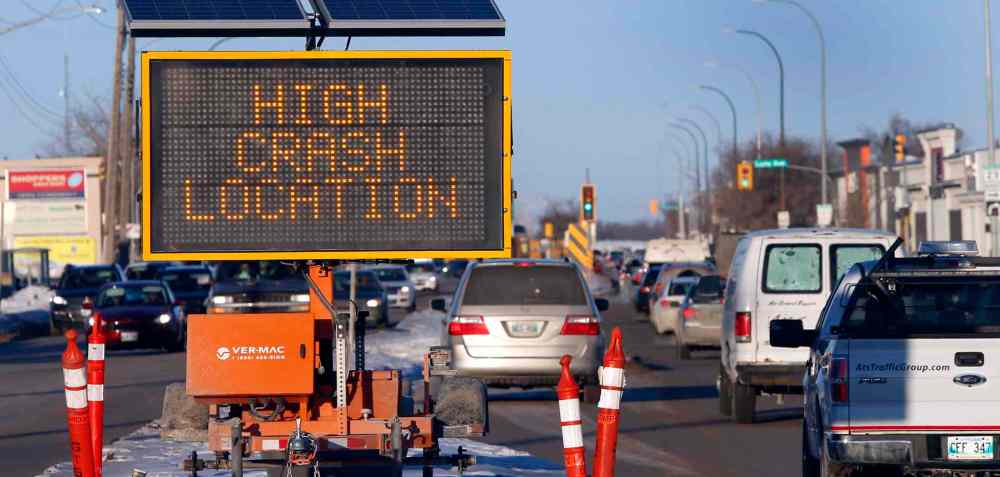
Almost 10,000 collisions have taken place at the five perilous places identified through collision data collected from 2005 to 2014.
The No. 1 intersection for collisions is at Leila Avenue and McPhillips Street, with 2,326, followed by Kenaston Boulevard and McGillvray Boulevard with 2,298 collisions.
The other three are Kenaston Boulevard and Grant Avenue with 1,747 crashes, Lagimodière Boulevard and Regent Avenue with 1,700 collisions, and Bishop Grandin Boulevard and St. Mary’s Road with 1,546 collisions.
“These five intersections entail multiple lanes, turning lanes and a high volume of traffic, all of which requires a driver’s utmost attention,” Winnipeg police Const. Eric Hofley said.
The new awareness program began Thursday at three intersections, including Kenaston/McGillivray, Bishop Grandin/St. Mary’s and Leila/McPhillips, with signs at the intersections and dedicated police enforcement.
Special enforcement by the police will be in place for the first year of the project at the Kenaston/McGillivray and Bishop Grandin/St. Mary’s intersections. A release from MPI said the special enforcement will be funded by MPI.
“The Winnipeg Police Service is happy to partner with Manitoba Public Insurance,” Staff Sgt. Rob Riffel of the central traffic unit said in the release. “This initiative fits perfectly into the service’s strategic objectives by strengthening pro-active policing through smart-policing initiatives; focusing efforts to improve traffic safety through enforcement and education, and using an evidence based and collective impact approach to increase public road safety and reduce insurance costs for the public.
New signs at all approaches to those intersections will alert motorists that they are approaching a high-collision intersection with a secondary message of “Don’t Follow Too Close.”

“Road safety research also demonstrates that road safety education and awareness efforts are most effective when accompanied by visible enforcement,” said Ward Keith, MPI’s vice-president of business development and communications and chief product officer. “That’s why we are pleased that the Winnipeg Police Service and CAA Manitoba are joining this initiative to help keep motorists safe.”
Rear-end collisions accounted for more than half of total collisions at the five intersections, the data showed.
“We all know how long it takes to break a bad habit, and that’s why we’re pleased this two-year pilot project will remind motorists to practise safe driving every day,” said CAA Manitoba president and CEO Mike Mager in a statement. “CAA Manitoba is proud to help educate our members and the public about safe driving behaviours. We all have a part to play in reducing the number of accidents at these busy intersections.”
Keith said many collisions, particularly rear-end collisions, can be prevented by driving to conditions, entering busy intersections with caution, and not following too close by practising the three- to four-second rule when following the vehicle ahead of you.
“This distance allows sufficient time to stop and avoid a collision.” Keith said.
History
Updated on Thursday, January 14, 2016 6:13 PM CST: Photo swap