

Weak loonie doesn’t put Canadian NHL teams at disadvantage: Bettman
Advertisement
Read this article for free:
or
Already have an account? Log in here »
To continue reading, please subscribe:

Digital Subscription
One year of digital access for only $205*
- Enjoy unlimited reading on winnipegfreepress.com
- Read the E-Edition, our digital replica newspaper
- Access News Break, our award-winning app
- Play interactive puzzles
*First annual payment billed as $205.00 + GST for one year. This annual subscription will automatically renew at $233.00 + GST every 52 weeks (10% off the regular annual price of $259.35). Offer available to new and qualified returning subscribers only. Cancel any time.
To continue reading, please subscribe:
Add Free Press access to your Brandon Sun subscription for only an additional
$1 for the first 4 weeks*
- Enjoy unlimited reading on winnipegfreepress.com
- Read the E-Edition, our digital replica newspaper
- Access News Break, our award-winning app
- Play interactive puzzles
*Your next Brandon Sun subscription payment will increase by $1.00 and you will be charged $17.95 plus GST for four weeks. After four weeks, your payment will increase to $24.95 plus GST every four weeks.
Read unlimited articles for free today:
or
Already have an account? Log in here »
Hey there, time traveller!
This article was published 31/01/2016 (3854 days ago), so information in it may no longer be current.
NASHVILLE — Those in Canada who watch the foreign-exchange markets and worry about their NHL teams would be better off spending their energy elsewhere, league commissioner Gary Bettman said Sunday.
The fluctuations of the low dollar, which has sagged considerably since the season began, have caused hand-wringing about small-market teams north of the border.
The league has said its salary-cap maximum may rise to more than US$74 million next season but that’s likely to be revised downward slightly due to the relative decrease in value of the Canadian dollar, but it’s no crisis for the Winnipeg Jets or other small-market Canadian teams, Bettman said..
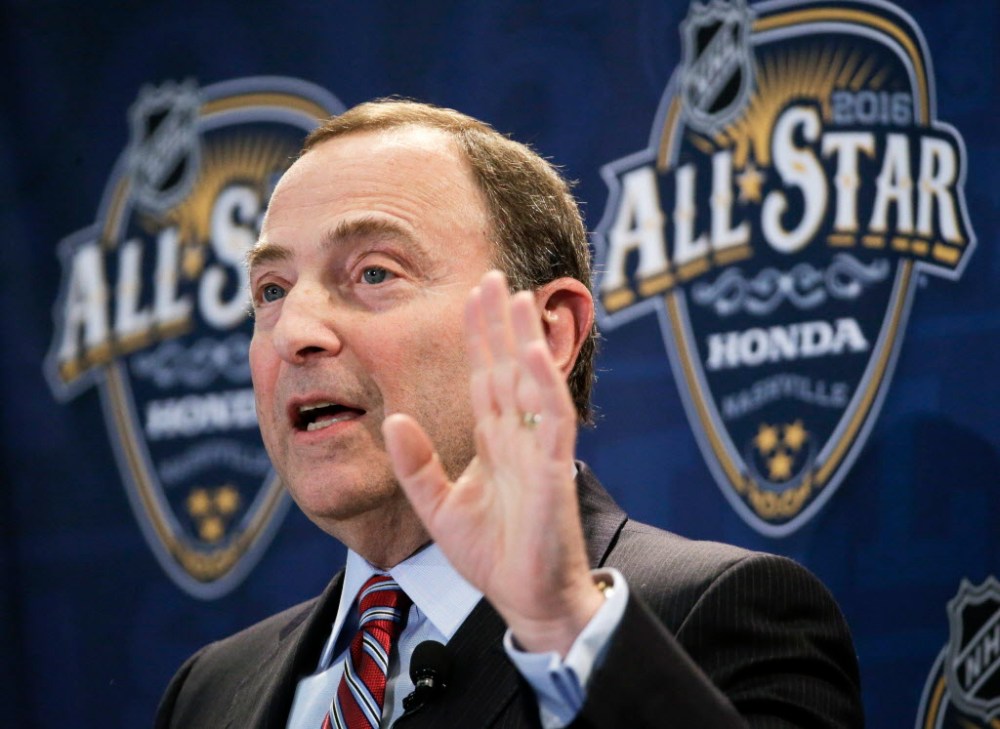
“I hear “small markets” and “small Canadian markets” and “non-traditional markets,” and I don’t believe in those labels,” Bettman told the Free Press in an interview Sunday at Bridgestone Arena, site of the weekend’s all-star festivities.
“When you’re in a market and you’ve got good ownership and a good facility and fan support, you make it work.
“Winnipeg is blessed to have great ownership with Mark Chipman and David Thomson and the building is terrific. It’s fun to be there. I was just there about two weeks ago. And the fans are awesome.
“So the benefit is that we have a system that works with the variations of the Canadian dollar. It’s one of the reasons it was designed the way it was.
The NHL’s complicated CBA and revenue formulas mitigate much of the currency swings, up or down, he said.
“Because we do the computations — the cap, revenue sharing, all that stuff — in U.S. dollars, it wasn’t that we were pro-U.S. and anti-Canadian, it was that we wanted to account for the fluctuations,” he said.
“And there have been points in the last five or six years where the Canadian dollar was over par and there have been points like now.
“But it’s not as low as it was when I took over in the early ’90’s, when I think it was as low as 65 (cents). The system accounts for it.
“And it’s created a mechanism where all teams can afford to be competitive, and that was the design. It was hard to get the system, but the league wouldn’t have been able to grow and be as healthy as it is for the players and the fans and everyone if we didn’t have the system.”
Bettman said again Sunday his faith is unwavering in the Jets’ franchise, now more than four years past its 2011 relocation from Atlanta.
“Absolutely. And the construction going on around the MTS Centre, those plans, the fan support, the vibrancy of the building, when you go to a game, there are great fans in Winnipeg and there always have been,” he said. “What’s really great is that we have a well-run, well-owned, well-managed team.”
It’s well known Bettman championed the relocation of a team back to Canada once the Atlanta story was on a dead-end street.
What was his tipping point for the move back to Winnipeg?
“The answer to that question starts with the fact that people focus on some revisionist history,” Bettman said. “Some have suggested that we originally wanted to move the Jets to a bigger U.S. market. That’s revisionist history. What happened was that nobody, for whatever reason, wanted to own the Jets anymore in Winnipeg, particularly because there was no prospect of a new building.
“I never like leaving a place. My history in terms of the things we work hard for and fight for has been to try to stay where we are.
“When MTS was built and Mark Chipman came to me after the 2005 collective bargaining agreement, he said, ‘With what you’ve achieved in the system, we can be competitive, we have the building and I want to start talking to you about the possibility of coming back to Winnipeg.
“That was the catalyst for it.”
Bettman invested much of his own credibility and loyalty in the transfer of the franchise, citing frequently he was happy to right a historical wrong.
“The wrong is the reason the club moved,” he said. “It was a place we didn’t want to leave. So the fact that whoever’s wrong it was, that we could bring a team back to the great fans of Winnipeg, we wanted to do it. And when the stars aligned, and they didn’t just align by chance, they aligned because things happened, whether it was the political will to invest in a new arena downtown, whether or not it was with Mark Chipman and then David Thomson deciding this was what they were going to do, whether or not it was the continued passion of the fans that was visible.
“All of these things aligned to make it a reality. Mark was extraordinarily aggressive in his pursuit, so that when we decided Atlanta had to be moved, he was the first phone call.”
Bettman and the NHL’s next show of support and loyalty to Chipman, Thomson and Winnipeg will be scheduling an outdoor regular-season game at Investors Group Field in 2016-17, though the commissioner said Sunday he’s got no official announcements yet.
He said the novelty and attraction of such outdoor games is not wearing off in the NHL.
“If you’ve never been to one and all you do is watch them on TV, you tune in, look at the venue and it’s another game,” Bettman said.
“When you finally go to one, you will understand there is an emotional connection to the game that’s passionate and exciting and communal in the broadest sense of the word because instead of 15,000 or 20,000, there’s 60,000, give or take, depending where you’re playing.
“It’s a celebration of the sport.”
In conversation with Gary Bettman
In an interview with the Free Press Sunday in Nashville, NHL commissioner Gary Bettman spoke about a few issues other than the Jets and Winnipeg. Here are some highlights:
FP: Teams in Canada aren’t doing very well on the ice this season. Do you have any concerns there, and is any of that related to the Canadian-dollar issues, do you think?
Bettman: “No. Team performance goes through cycles. There are people, particularly if you write north of the 49th parallel, who think we’re almost two leagues. We’re not.
“Last year, seven teams made the playoffs that didn’t the year before. I think for the last 10 years, the change every year has been about five. What you have is a sport that is super-competitive. Every game matters. Teams go cycles, they are managed and run different ways. But the beauty of the system I just mentioned is everybody can afford to compete. So you just have to make decisions. I don’t think it’s a U.S. thing or a Canadian thing. I think it’s part of the mix when you have incredible competitive balance.
“And it’s hard to win. A microcosm of that: How do you explain the start the Montreal Canadiens have had and what they’ve done since? It has nothing to do with the Canadian dollar or the fact they’re in Canada. It’s why we play the games. It’s why you can’t just prognosticate on paper and statistics. It’s why there’s an emotional, human element to playing the games every night.”
***
FP: Three-on-three overtime has brought decided games up from 44 to 64 per cent or so. Is that enough of a bump and do you ever see ties coming back into the equation?
Bettman: “No (ties). By the way, fans love the shootout. All the research we do is that it’s overwhelming. It can have critics. It can have coaches and GMs who want to pull their hair out and it can have media critics, but when we poll the fans, overwhelmingly they like it. The fact there are fewer (shootouts), fans weren’t pushing for that so hard. They were fine with the way it was, but we’ve managed to introduce an element to the game that’s fun and exciting and entertaining.
“That’s a 50 per cent increase, actually. It’s fine. I knew it would be higher than the 44, so whether it was 60 or 65 or 70 per cent, we knew it would reduce the number of shootouts, which has made them more special.
“I think we’re in a good place.”
***
FP: Monday (Feb. 1), the NHL is re-launching its mobile app, a new website look and a NHL.TV in place of NHL Game Centre Live. Why would you do this in the middle of a season?

Bettman: “Why not? Because we think we can. (Major League Baseball’s) MLBAM has gone through an extraordinary effort and they’ve had great co-operation from Neulion. And they believe that let’s not wait. Technology, millennials, people who are connected operate in real time.
“We’re doing this because we think we can. This is a highwire act, but this is an organization we have confidence in and it’s a terrific partnership. So my own view of this is I think we can do this and I think fans are going to be thrilled. And it’s not static. Whatever we’re doing (today), we’re going to improve upon. And then when we get to next season, there will be even more. So why wait when we think we’re capable of it now?”
tim.campbell@freepress.mb.ca
Related Articles
Jets face high-flying Stars tonight





Advertisement Advertise With Us
Advertisement Advertise With Us