

Light beyond the darkness
Memoir shares woman's experience coping with her mother's dementia

Advertisement
Read this article for free:
or
Already have an account? Log in here »
To continue reading, please subscribe:
Monthly Digital Subscription
$1 per week for 24 weeks*
- Enjoy unlimited reading on winnipegfreepress.com
- Read the E-Edition, our digital replica newspaper
- Access News Break, our award-winning app
- Play interactive puzzles
*Billed as $4.00 plus GST every four weeks. After 24 weeks, price increases to the regular rate of $19.95 plus GST every four weeks. Offer available to new and qualified returning subscribers only. Cancel any time.
Monthly Digital Subscription
$4.99/week*
- Enjoy unlimited reading on winnipegfreepress.com
- Read the E-Edition, our digital replica newspaper
- Access News Break, our award-winning app
- Play interactive puzzles
*Billed as $19.95 plus GST every four weeks. Cancel any time.
To continue reading, please subscribe:
Add Free Press access to your Brandon Sun subscription for only an additional
$1 for the first 4 weeks*
- Enjoy unlimited reading on winnipegfreepress.com
- Read the E-Edition, our digital replica newspaper
- Access News Break, our award-winning app
- Play interactive puzzles
*Your next Brandon Sun subscription payment will increase by $1.00 and you will be charged $17.95 plus GST for four weeks. After four weeks, your payment will increase to $24.95 plus GST every four weeks.
Read unlimited articles for free today:
or
Already have an account? Log in here »
Hey there, time traveller!
This article was published 17/02/2016 (3735 days ago), so information in it may no longer be current.
Elizabeth Murray had begun the task of cleaning out her mother’s home when she found the notes. They were everywhere, crammed into every cupboard, every drawer. Some were scrawled on lined notebook paper. Others were written on scrap pieces ripped from flyers and newspapers, or crumpled envelopes, or snaking down the margins of letters and documents.
And there, in her mother’s handwriting, were cutting condemnations of how spiteful Elizabeth was. Liz was out to get her. Liz had orchestrated the confiscation of her driver’s licence with a Dr. Kalansky, who gave her the suspicious diagnosis of “debenture.”
The notes were a devastating discovery, one that prompted Murray, 54, to write and self-publish her memoir Holding on to Mamie: My Mother, Dementia and Me. She began writing it in 2008, the year her mother, Ellen May Murray, a.k.a. Mamie, died at 87. It was released in late 2015.
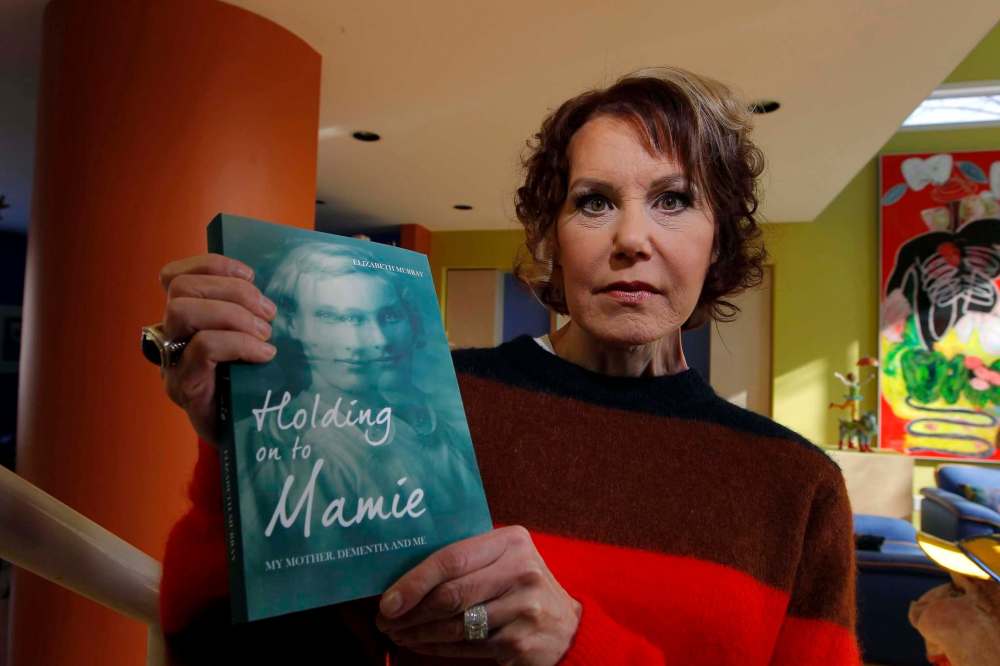
The contents of the notes weren’t exactly a surprise. For two years before her mother’s death, dementia had radically changed Mamie. She had become increasingly paranoid and convinced her daughter — her primary caregiver — was up to her “dirty tricks,” holding up the notes she’d written herself as empirical evidence.
“Reading them was just as bad,” Murray tells me. “It was like having that experience again and again.”
When her mother began acting unusual in the 1990s, Murray was preoccupied with her own health problems. At 33, she was diagnosed with tongue cancer, a left-field blow for a non-smoker and a non-drinker.
A third of her tongue and all the lymph nodes in the right side of her neck were removed. Her son, Davis, was just 16 months old, and her father had just died. “I needed my mom,” she says.
She says it was hard to recognize what was happening, at least initially. Her mother became more irascible and difficult — but then, she had always been fiercely independent and determined. “I didn’t see it at first,” Murray says. “And, of course, you don’t really want to see it.”
Murray didn’t know much about dementia until it came into her life. “I thought of it as forgetfulness, a more gentle fading away,” she says. “I wasn’t aware of the darker side, the anger, the hostility. That part took me completely by surprise. That’s what made me bewildered and ashamed for so long. I didn’t understand that was symptomatic of the disease. It’s not something we talk about enough.”
Of course, Murray’s story is just one story. More than 22,000 Manitobans have some form of dementia, and that number is expected to climb to 40,700 over the next 25 years. As well, 43 per cent of Manitobans have a family member or close friend with Alzheimer’s disease or another form of dementia.
And yet, for a disease so common, it’s also incredibly isolating — for both the person living with it, of course, but also for the person providing care. Murray was reticent to open up about her experience as the primary caregiver of someone who really didn’t want her around. Her husband, Jeff, was one of her few emotional supports.
“I wish I had pursued a support group with the Alzheimer Society,” she says. “I know now that they do terrific work with family support groups. It wasn’t something that I was open to at the time because I didn’t want to admit it, initially. Even with my friends, I didn’t talk about it much for a long time because she was just so nasty. It was so hard not to take it personally. It wasn’t something that was easy to share with people.”
It’s hard, too, to have a candid conversation about the frustration caregivers experience without feeling guilty — especially with someone who hasn’t been there. Murray says she’s fortunate to have a supportive partner, which is something not all caregivers have. After her own 18-month cancer treatment, Murray made the difficult choice not to return to practising law — fearing a recurrence, she wanted to spend as much time with her young son as possible.
But, as Murray says, one doesn’t need to have cancer to know the stress and exhaustion associated with caring for an ailing parent. Many family caregivers are trying to balance full-time work while shouldering their own household duties.
According to stats compiled by Alzheimer Manitoba, family caregivers spent 444 million unpaid hours per year looking after someone with dementia in 2011. That translates to $11 billion in lost income and 227,760 lost full-time equivalent employees in the workforce.
‘I wasn’t aware of the darker side, the anger, the hostility. That part took me completely by surprise’– Elizabeth Murray
By 2040, family caregivers will be putting in 1.2 billion unpaid hours per year.
Sit with that for a moment: 1.2 billion unpaid hours, doing some of the most difficult labour imaginable.
We have to take good care of our caregivers, whether it’s something as individual as providing a safe space for a caregiver to vent, or something as systemic as creating workplace policies that make it easier for caregivers to balance their lives. Too many people soldier on alone. That’s part of the reason Murray wanted to tell her story, to let others in her position know they aren’t alone.

Murray included her mother’s notes in her book, understanding, later, they were more than an expression of anger. “They were really her attempt to hold on to herself.” They offer insight into her mother’s mind, forever changed by a disease she herself didn’t understand. “We don’t often have a chance to hear from the person themselves, in their words,” Murray says. “This was her reality.”
Through writing, Murray found what she was looking for: proof, somewhere, she and her mother had a loving relationship.
“I’m now in a good place,” she says. “I can think of the good times we had — that sounds very trite, but I can feel our relationship for what it was. Ultimately, we always had each other’s backs.”
jen.zoratti@freepress.mb.ca
Twitter: @JenZoratti
Jen Zoratti is a columnist and feature writer working in the Arts & Life department, as well as the author of the weekly newsletter NEXT. A National Newspaper Award finalist for arts and entertainment writing, Jen is a graduate of the Creative Communications program at RRC Polytech and was a music writer before joining the Free Press in 2013. Read more about Jen.
Every piece of reporting Jen produces is reviewed by an editing team before it is posted online or published in print – part of the Free Press‘s tradition, since 1872, of producing reliable independent journalism. Read more about Free Press’s history and mandate, and learn how our newsroom operates.
Our newsroom depends on a growing audience of readers to power our journalism. If you are not a paid reader, please consider becoming a subscriber.
Our newsroom depends on its audience of readers to power our journalism. Thank you for your support.
Jen Zoratti is a columnist and feature writer working in the Arts & Life department, as well as the author of the weekly newsletter NEXT. A National Newspaper Award finalist for arts and entertainment writing, Jen is a graduate of the Creative Communications program at RRC Polytech and was a music writer before joining the Free Press in 2013. Read more about Jen.
Every piece of reporting Jen produces is reviewed by an editing team before it is posted online or published in print – part of the Free Press‘s tradition, since 1872, of producing reliable independent journalism. Read more about Free Press’s history and mandate, and learn how our newsroom operates.
Our newsroom depends on a growing audience of readers to power our journalism. If you are not a paid reader, please consider becoming a subscriber.
Our newsroom depends on its audience of readers to power our journalism. Thank you for your support.
Advertisement Advertise With Us
Advertisement Advertise With Us