

Early arrival of icebergs near Newfoundland coast set off social media buzz
Advertisement
Read this article for free:
or
Already have an account? Log in here »
To continue reading, please subscribe:

Digital Subscription
One year of digital access for only $205*
- Enjoy unlimited reading on winnipegfreepress.com
- Read the E-Edition, our digital replica newspaper
- Access News Break, our award-winning app
- Play interactive puzzles
*First annual payment billed as $205.00 + GST for one year. This annual subscription will automatically renew at $233.00 + GST every 52 weeks (10% off the regular annual price of $259.35). Offer available to new and qualified returning subscribers only. Cancel any time.
To continue reading, please subscribe:
Add Free Press access to your Brandon Sun subscription for only an additional
$1 for the first 4 weeks*
- Enjoy unlimited reading on winnipegfreepress.com
- Read the E-Edition, our digital replica newspaper
- Access News Break, our award-winning app
- Play interactive puzzles
*Your next Brandon Sun subscription payment will increase by $1.00 and you will be charged $17.95 plus GST for four weeks. After four weeks, your payment will increase to $24.95 plus GST every four weeks.
Read unlimited articles for free today:
or
Already have an account? Log in here »
Hey there, time traveller!
This article was published 29/02/2016 (3867 days ago), so information in it may no longer be current.
ST. JOHN’S, N.L. – Nature’s frozen carvings drift through Iceberg Alley each spring and summer but early arrivals near Newfoundland’s eastern shores have already lit up social media.
Eric Abbott did a double take in mid-January when he first saw a giant slab off Elliston, N.L.
Since then, his photos of it and another water-sculpted berg off the pretty coastal town of Bonavista have drawn admirers from around the province and beyond.
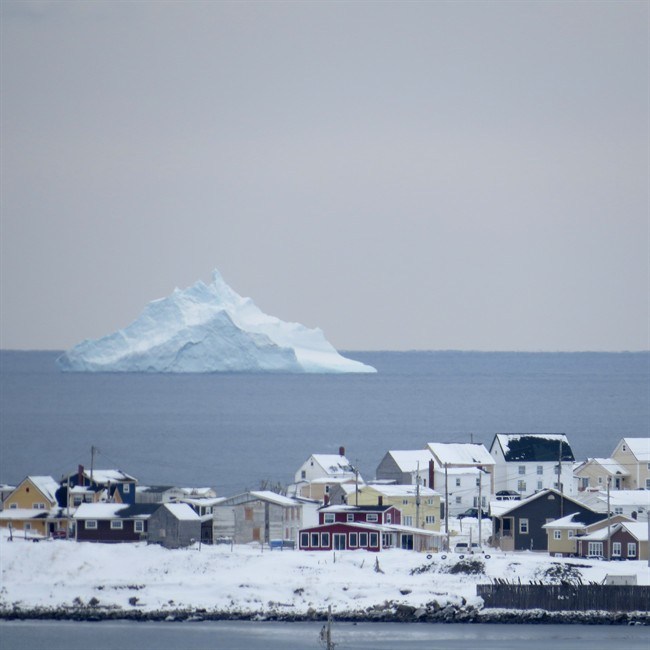
“Most of the time I’ve seen them in March or April,” he said in an interview. “There’s people saying ‘Eric, you think they’ll be there in March month?’ I say: ‘My darling, the one in Elliston is grounded, it’s only shifting back and forth. I allow it’ll be there in August.'”
Many Newfoundlanders who posted photos of an iceberg spotted in mid-February off Signal Hill in St. John’s said it’s the earliest they can remember big ice showing up.
Byron Briggs, superintendent of Atlantic region ice operations for the Canadian Coast Guard, said it’s not unusual to have icebergs off Newfoundland’s east coast this time of year.
“The difference being this time, some of them are close enough to shore for people to see. In 2014 there were definitely more bergs than there are now, but most of them were about 100 miles off.”
Only ships out to sea would have caught a glimpse, Briggs said in an interview. Icebergs have to be within about 20 kilometres of shore to be visible from land, he added.
Gabrielle McGrath, commander of the United States Coast Guard International Ice Patrol, has done recent surveillance flights over the region. The patrol was formed after the Titanic disaster in 1912, and works with Canadian partners to track icebergs in North Atlantic shipping lanes.
More than 20 bergs have so far been spotted in those lanes and many more originating from Greenland glaciers are heading south, McGrath said in an interview.
“It’s hard to give a prediction exactly, but I think there is a potential to have a decent amount of icebergs this year.”
McGrath said an interesting weather pattern of cold and warm spells combined with storm systems help explain a few things.
“Some of the bergs have been pushed onshore maybe a little earlier than they would in the past.”
Icebergs photographed close to Newfoundland and Labrador coastlines in past years have reached 45 metres in height while long, flat tabular giants have been estimated at five kilometres in length or more. Waves mould them into spectacular shapes that resemble cathedrals, pyramids and glass archways streaked with blue — and sometimes running with waterfalls.
They are believed to be at least 12,000-year-old specimens of pure water.
Cecil Stockley, owner and operator of Iceberg Man tours in Twillingate on Newfoundland’s northeast coast, takes groups out starting in May. In recent years he has hosted visitors from across North and Central America and as far away as Russia, China and Japan.
“They come looking for icebergs.”
To avoid disappointment, Stockley urges tourists to check in with local operators before they make the trip.
The luckiest visitors see a natural wonder that never fails to amaze him.
“It’s the history they can reveal,” he said. “It’s the raw beauty.”
If you go:
For tips on travel to Newfoundland and Labrador go to http://www.newfoundlandlabrador.com/
Follow @suebailey on Twitter.