

Seven Oaks battle up to interpretation
Advertisement
Read this article for free:
or
Already have an account? Log in here »
To continue reading, please subscribe:
Digital Subscription
One year of digital access for only $1.44 a week*
- Enjoy unlimited reading on winnipegfreepress.com
- Read the E-Edition, our digital replica newspaper
- Access News Break, our award-winning app
- Play interactive puzzles
*Billed as $5.77 plus GST every four weeks. After 52 weeks, price increases to the regular rate of $19.95 plus GST every four weeks. Offer available to new and qualified returning subscribers only. Cancel any time.
To continue reading, please subscribe:
Add Free Press access to your Brandon Sun subscription for only an additional
$1 for the first 4 weeks*
- Enjoy unlimited reading on winnipegfreepress.com
- Read the E-Edition, our digital replica newspaper
- Access News Break, our award-winning app
- Play interactive puzzles
*Your next Brandon Sun subscription payment will increase by $1.00 and you will be charged $17.95 plus GST for four weeks. After four weeks, your payment will increase to $24.95 plus GST every four weeks.
Read unlimited articles for free today:
or
Already have an account? Log in here »
Hey there, time traveller!
This article was published 12/06/2016 (3638 days ago), so information in it may no longer be current.
It used to be called the Seven Oaks Massacre. Now it is the Battle of Seven Oaks. Neither name is really satisfactory.
“Massacre” was the term used at the time by the Hudson’s Bay Co. and its supporters to describe the catastrophe at Seven Oaks (also known as Frog Plain), near where the corner of Winnipeg’s Main Street and Rupertsland Boulevard is today.
HBC governor Robert Semple and 20 of his men were gunned down by Cuthbert Grant and a party of about 60 Métis and First Nations men on June 19, 1816. One man on the Metis side was killed (or perhaps two — accounts at the time differed).
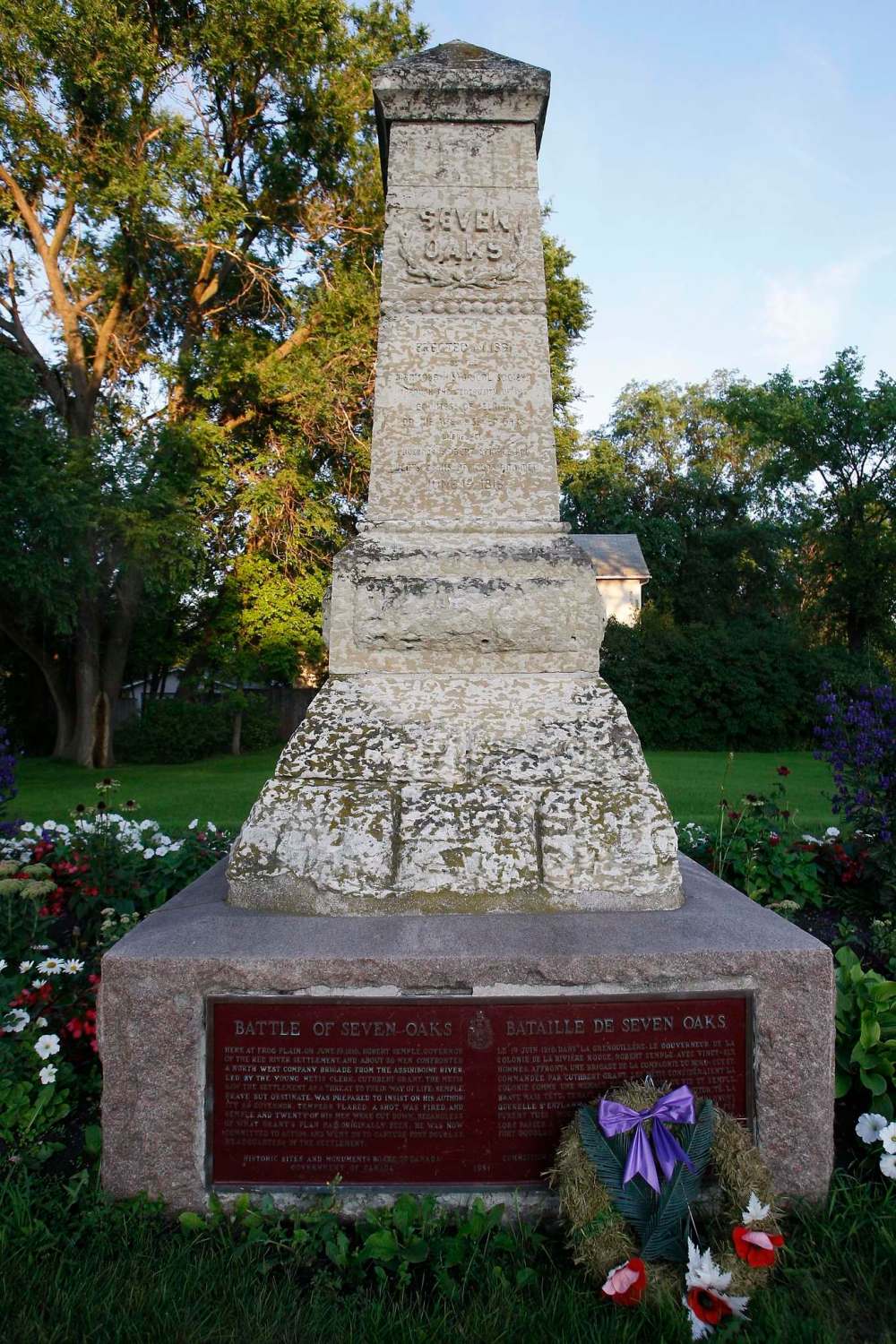
The body count suggests a massacre, but since Semple and his party had armed themselves and sallied forth from Fort Douglas to confront Grant’s armed and mounted group, they were not the innocent, defenceless victims the term might suggest.
It’s also a little odd to call it a battle. The shooting lasted about 15 minutes. In most wars, that would be considered a skirmish. The shouting about the rights and wrongs of the event, however, has continued for 200 years.
Each generation of Manitobans has to come up with its own version of the story. Was it mainly an act of Métis resistance against European encroachment on their land? Was it a defence of the Scottish refugees rescued by philanthropist Thomas Douglas, the Earl of Selkirk, and resettled on his land at Red River? Was it mainly a chapter in the long and brutal commercial struggle between the Hudson’s Bay Co. and its fur trade rival, the North West Company?
The Seven Oaks monument at Rupertsland and Main has been renovated at the instigation of students at Governor Semple School. The landscaping is much improved. New descriptive panels tell the Seven Oaks story as it was understood by students who went through Governor Semple School between 2007 and 2012. The renovated monument will be inaugurated June 19 by Parks Canada on the 200th anniversary of the incident.

In this generous and forgiving version, the participants are not to blame for what happened. “Both groups were expecting trouble but neither was looking for a fight,” the display says, though that might be hard to prove from the conduct of the two groups.
The Métis and the settlers, the panels explain, were caught up in the struggle between HBC and NWC. “It was not really their fight, but it was almost impossible to remain neutral. They were each trying to protect their homes and livelihoods, both of which were threatened by this corporate warfare.”
When the next generation comes to write its version, this interpretation may be questioned. Corporate warfare was clearly a large part of the story but did some corporate master order Robert Semple to march 28 clerks and traders out of the relative safety of Fort Douglas against a party of 60 armed and mounted buffalo hunters? Did the NWC order Grant’s group to continue shooting until it had killed 21 HBC men?
Manitobans consider themselves a peaceable people, though the province’s murder rate tells a different story. A closer look at the historical record might show a pattern of violence extending across the centuries.
The next generation of students might usefully ask whether Seven Oaks was an exceptional breach of Manitobans’ usual good manners or a typical bit of Manitoba violence. They might also ask if Seven Oaks was a massacre, a battle, a skirmish, or a shootout.