

Several Winnipeg Transit mechanics doubled their 2015 salary thanks to overtime
Pay hike a result of staff shortages, problematic diesel engines, union says
Advertisement
Read this article for free:
or
Already have an account? Log in here »
To continue reading, please subscribe:

Digital Subscription
One year of digital access for only $205*
- Enjoy unlimited reading on winnipegfreepress.com
- Read the E-Edition, our digital replica newspaper
- Access News Break, our award-winning app
- Play interactive puzzles
*First annual payment billed as $205.00 + GST for one year. This annual subscription will automatically renew at $233.00 + GST every 52 weeks (10% off the regular annual price of $259.35). Offer available to new and qualified returning subscribers only. Cancel any time.
To continue reading, please subscribe:
Add Free Press access to your Brandon Sun subscription for only an additional
$1 for the first 4 weeks*
- Enjoy unlimited reading on winnipegfreepress.com
- Read the E-Edition, our digital replica newspaper
- Access News Break, our award-winning app
- Play interactive puzzles
*Your next Brandon Sun subscription payment will increase by $1.00 and you will be charged $17.95 plus GST for four weeks. After four weeks, your payment will increase to $24.95 plus GST every four weeks.
Read unlimited articles for free today:
or
Already have an account? Log in here »
Hey there, time traveller!
This article was published 22/07/2016 (3683 days ago), so information in it may no longer be current.
A staff shortage in the maintenance division of Winnipeg Transit has resulted in several employees working so much overtime that their income rivals that of the department head.
Several transit mechanics and other unionized staff were able to double their salaries, and more, in 2014 and 2015 — from what the union that represents them said was the result of staff shortages and dealing with the problematic diesel engines that scuttled Transit’s schedule last fall.
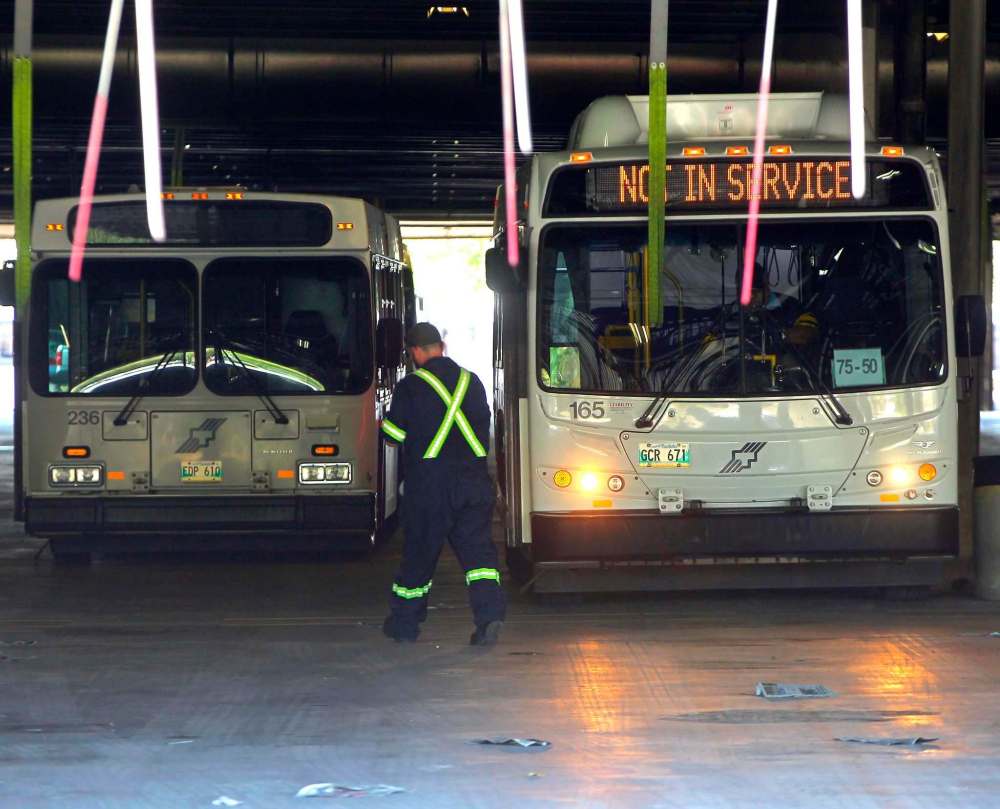
One mechanic, two years removed from being an apprentice, worked so much overtime last year that he became Transit’s second-highest wage earner, taking home a few thousand dollars less than Transit director Dave Wardrop.
“The whole place is being run on overtime and it shouldn’t be,” said John Callahan, president of ATU Local 1505, which represents transit mechanics, bus drivers and other unionized staff at Winnipeg Transit.
Callahan said while Winnipeg Transit has sent the troublesome buses to a local Cummins subsidiary for repairs, its own maintenance staff have also been involved in trying to fix the vehicles and that’s behind the large amounts of overtime accumulated by maintenance staff.
Request for an interview with Winnipeg Transit director Dave Wardrop were denied by city hall, which did respond to a series of e-mail questions on the overtime issue. The answers seemed to indicate the overtime was the result of a staff shortage: Transit budgeted for 118.5 full time equivalent (FTE) mechanics for 2016 but currently employ 56 FTE mechanics and 30 FTE apprentices.
Transit’s overtime bill in 2015 totalled $4.3 million, of which work related to the Cummins engines was five per cent of that, about $214,000. Cummins-related overtime in 2014 accounted for 6.5 per cent of the department’s OT costs.
Working some overtime has been part of a unionized transit employee’s regular workload for several years. The lower union wages, compared to other Transit authorities and to industry standards, has made it difficult for Winnipeg Transit to hire enough mechanics and keep them. As a result, overtime has been common.
The Free Press reviewed the City of Winnipeg’s annual Compensation Disclosure Reports from 2015 to 2007, which lists the salaries of civic staff earning $50,000 or more every year, and compared those figures with Transit wage rates in the collective agreement with the Amalgamated Transit Union. The review found that overtime for many transit employees took a big increase in 2014 and again in 2015 – a period of time which co-incides with Winnipeg Transit’s problems with the Cummins diesel engines on the New Flyer buses.
var embedDeltas={“100″:1245,”200″:955,”300″:887,”400″:827,”500″:810,”600″:793,”700″:793,”800″:776,”900″:776,”1000”:776},chart=document.getElementById(“datawrapper-chart-WP2gm”),chartWidth=chart.offsetWidth,applyDelta=embedDeltas[Math.min(1000, Math.max(100*(Math.floor(chartWidth/100)), 100))]||0,newHeight=applyDelta;chart.style.height=newHeight+”px”;
Transit’s overtime costs in 2014 were 11 per cent higher than those in 2013; and the 2015 OT bill was 17 per cent higher than 2013 costs.
While overtime costs have been a constant concern with the Winnipeg Police Service, it’s never been raised as an issue by the civic administration for Winnipeg Transit, where the Free Press review discovered the overtime racked up by some unionized staff in 2014 and 2015 was nothing short of phenomenal. Transit director Dave Wardrop was the department’s highest paid employee in 2015, at $173,710, and the next top earner was a bus mechanic, identified in the compensation disclosure report as R. Wilson, whose take home pay last year was $162,517 – Wilson’s pay grade according to the collective agreement was $59,666.
Wilson had been an apprentice in 2013, when he earned less than $57,000 but he more than doubled his income in 2014, when his take-home pay was more than $137,000. He increased that again in 2015, when he earned over $162,000.
Wilson wasn’t alone in working a lot of overtime in 2015. E. Gopez, an electronics bus technician, took home $133,701; his regular pay rate was $68,476.
L. Funk, a mechanic like Wilson, earned $109,377 in 2015; his pay rate was $68,854. Funk’s take home pay in 2013 was $50,000 but he more than doubled that in 2014 through overtime and did better than that again last year.
It wasn’t just the higher-paid skilled trades taking home the big pay cheques, it also trickled down to the less skilled workers like mechanic helpers, some of whom were able to boost their pay through overtime by 50 to 70 per cent or more over their regular pay.
“I can’t blame them,” Callahan said of the mechanics and other unionized staff taking home big cheques courtesy of overtime. Transit has always been short-staffed, he said, adding that has compounded the overtime problem.
“Everyone is over-taxed in the maintenance area,” Callahan said.
When asked to explain how Wilson and other maintenance staff were able to earn so much overtime, a civic spokeswoman said it “wasn’t able to discuss specific details pertaining to salaries listed in the compensation disclosure document.”
Timeline: Problematic diesel engines plague Winnipeg Transit
Callahan said the overtime issue isn’t going away as long as the staff shortage continues. While transit said the problem with the Cummins diesel engines appear to be resolved, Callahan said it isn’t true.
“The fix is to replace the parts, which also keep breaking down. That’s not a solution,” Callahan said. “They’re paying Cummins to take out the defective parts over and over again.”
Callahan’s assertion appears supported by a recent initiative from Transit to contract out warranty repair work on the troublesome engines. The city recently issued a formal request for proposals for bidders on the warranty work. Transit plans to give the winning bid sole responsibility for engine and emission repairs on 159 buses, and possibly more later. The contract is for one year with options for three, one-year renewals. The city is requiring the contractor guarantee that no more than six per cent (9-10 buses) of the vehicles be kept off the road at any one time for repairs. The bid closed August 8.
Callahan said the city has been relying on a local Cummins subsidiary to swap out the defective parts. The costs related to that work have been so high, he said, the city now needs to put the work out to tender.
Wardrop told the public works committee in April that Transit didn’t have enough mechanics or space in its garage to do all the repair work and it had to give that work to Cummins, even though that carried a big price tag.
Transit said it paid Cummins $21,206 in 2014 to deal with the emission control problems but that price jumped to $519,000 in 2015.

Callahan said Transit’s inability to hire and retain its own mechanics is resulting in unnecessary overtime costs and payments to Cummins for its repair services. Cummins charges $125 an hour for its repair services, he said, plus additional charges for shop supplies, while transit mechanics earn about $32 an hour. Callahan said it would be cheaper if the city hired more mechanics and avoided the overtime rates. He conceded there are space concerns at the current garage, where mechanics work one regular shift but hiring more would enable Transit to put on a second shift.
“The garage is open 24/7. With more mechanics, more work could be done in-house at a much lower rate than contracting out to an outside firm.”
Callahan said hiring more mechanics would only be a short-term solution, adding the city should stop buying New Flyer buses with the troublesome engines until Cummins demonstrates it has solved the technical issues. Callahan said many transit authorities across North America are replacing diesel buses with engines powered by compressed natural gas. He said Winnipeg Transit should increase its effort to reach out to those transit agencies to buy their older buses, which don’t have the emission problems.
Access denied
The Winnipeg Free Press submitted written questions to city hall concerning Transit over-time, costs pertaining to repair work on the troublesome Cummins engines, and requests for an interview with transit director Dave Wardrop. A civic spokeswoman provided the answers to the emailed questions but denied an interview with Wardrop.
WFP: The dollar value of overtime incurred in 2015, 2014 and 2013, for both union and non-union members?
City: All overtime is for unionized staff.
2015: $4,309,673
2014: $4,121,168
2013: $3,690,707
WFP: What percentage was OT costs in 2015 and 2016 in relation to all budgeted salary for the year?
City: 2013: 5.4%
2015: 5.7%
WFP: What percentage of OT for 2015 and 2014 was attributed to work associated with the Cummins engines and their problematic emission control systems?
City: 2014: $267,457
2015: $214,174
WFP: How much was Cummins, or any of its subsidiaries, paid for repair work in 2015 and 2014 to fix the troubled engines and the emission control systems?
City: 2014: $21,206.60 (parts and labour)
2015: $518,709.12 (parts and labour)
WFP: As per Bid Opportunity No. 315-2016, I’m requesting an interview with Transit director Dave Wardrop or another Transit official to explain why it’s necessary to contract out the work specified in this bid opportunity; and, why that work can’t be done by Transit staff?
City: We are unable to accommodate your interview request. Transit staff are capable of undertaking this work, however, new emission control systems have increased workloads beyond traditional resourcing levels. Issuing the bid opportunity provides the city with competitive terms to resource the increase in demand until the long term maintenance requirements of the new emission control systems are better understood.
WFP: What is the budgeted number of mechanics for transit for 2016 and how many are on staff as of this date; please provide breakdown between red-ticket mechanics and apprentices?
City: Red Seal: 56 FTEs
Apprentice: 30 FTEs
Budget: 118.5 FTEs
We continue to actively recruit for qualified candidates.
WFP: What was the budgeted number of mechanics for transit in 2015?
City: 106.15 FTEs


Advertisement Advertise With Us
Advertisement Advertise With Us