

Police say chopper worth the cash
Advertisement
Read this article for free:
or
Already have an account? Log in here »
To continue reading, please subscribe:

Digital Subscription
One year of digital access for only $205*
- Enjoy unlimited reading on winnipegfreepress.com
- Read the E-Edition, our digital replica newspaper
- Access News Break, our award-winning app
- Play interactive puzzles
*First annual payment billed as $205.00 + GST for one year. This annual subscription will automatically renew at $233.00 + GST every 52 weeks (10% off the regular annual price of $259.35). Offer available to new and qualified returning subscribers only. Cancel any time.
To continue reading, please subscribe:
Add Free Press access to your Brandon Sun subscription for only an additional
$1 for the first 4 weeks*
- Enjoy unlimited reading on winnipegfreepress.com
- Read the E-Edition, our digital replica newspaper
- Access News Break, our award-winning app
- Play interactive puzzles
*Your next Brandon Sun subscription payment will increase by $1.00 and you will be charged $17.95 plus GST for four weeks. After four weeks, your payment will increase to $24.95 plus GST every four weeks.
Read unlimited articles for free today:
or
Already have an account? Log in here »
Hey there, time traveller!
This article was published 11/08/2016 (3684 days ago), so information in it may no longer be current.
The cost of keeping the Winnipeg Police Service helicopter in the air has been steadily increasing – but the members in the unit believe it’s been money well spent.
Patrol Sgt. Rob Duttchen, the unit supervisor for Air1, said the team understands that politicians will decide the fate of the helicopter unit, but police are satisfied the work they do is making Winnipeg safer.
Duttchen said airborne policing is more expensive than traditional police work but it has advantages. The politicians, he said, have to decide if those benefits are worth the cost.
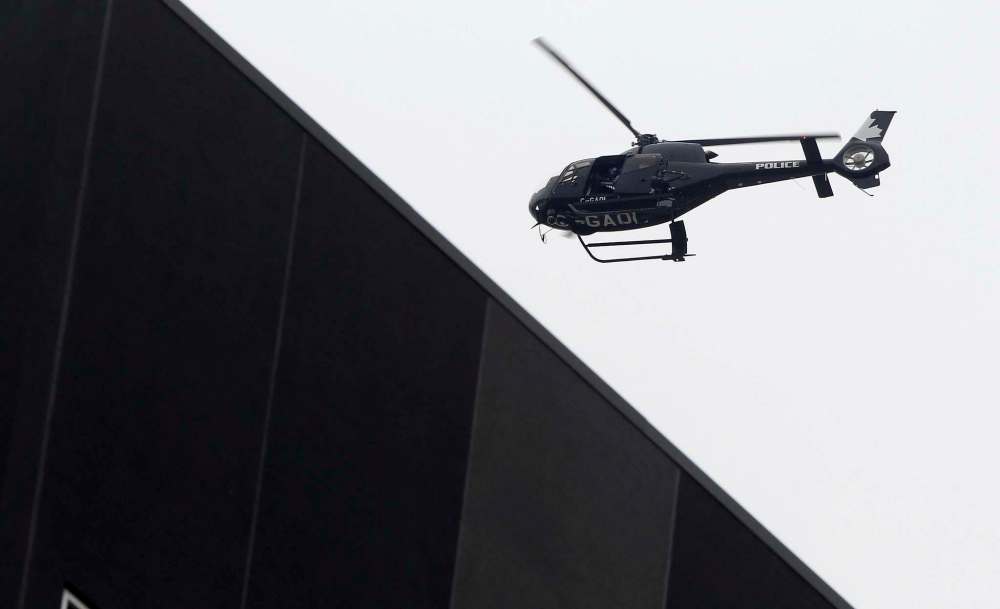
“One of the things we pride ourselves on is the ability to de-escalate situations and pre-warn officers on the ground of situations prior to their arrival on scene or allowing them to disengage in a pursuit and maintain visual observation of that,” Duttchen said. “That de-escalates a situation and creates an environment, as a rule, that becomes substantially safer for the motoring public as well as officers on the ground and the suspect.”
The WPS released its annual report on Air1 this week, which showed that the helicopter spent just over 1,000 hours in the air, attended 2,161 incidents and was instrumental in the apprehension or identification of 347 people, 112 of whom were taken into police custody.
It also cost the province $1.8 million, an annual increase of around $600,000 since 2011.
The future of Air1 was put in doubt earlier this year when the former NDP government announced it wanted an independent operational review to ensure taxpayers are getting good value from the airborne unit. The Pallister government committed to ensuring the review takes place.
The helicopter — an EC120B from Eurocopter Canada — was publicly unveiled in December 2010 and cost the Winnipeg Police Service $3.5 million. It also receives funding from the City of Winnipeg, but the province covers the operating cost each year.
There has been a great deal of discussion on the spiralling cost increases of policing, both locally and across the country, and the wrangling over the WPS budget this year dominated headlines. In addition to the helicopter, the WPS spent $343,000 on a military-like armoured vehicle and $200,000 on military-style assault rifles for general patrol officers. The WPS is quickly establishing a reputation among its critics as a police force that likes to have shiny, expensive toys but some among the public and politicians aren’t convinced those assets are improving the police or are needed.
University of Manitoba criminologist Frank Cormier said it’s difficult to determine the merit of Air1 from the annual report, adding that simply being busy isn’t the equivalent of making a difference.
Cormier said the police, public and politicians need to analyze why the helicopter was wanted in the first place and if its use has met those objectives, adding one has to question why Air1 was dispatched to deal with many of the incidents identified the report — dealing with a shoplifter, a panhandler, domestic disturbances, suicides – the report doesn’t provide that information.
“It’s very hard to know when you see the kind of calls it’s going on and it’s hard to make sense of how and why the helicopter was wanted or needed,” Cormier said. “Without being able to dig down into the details of what happened in these incidents, can one ever say here’s the number of times where it was ‘we were really, really glad we had a helicopter otherwise things would have been much worse than they turned out,’ because that’s what you want to see.”
Cormier said a proper independent operational review is necessary to determine if Air1 is making a difference when compared to the cost of providing the service.

“It’s impossible to know whether this thing is worthwhile unless we can enumerate, quantify and qualify the difference a helicopter can make,” Cormier said. “Only then can you say, ‘this is value for money, this is worth doing.’”
Duttchen said he has no doubt of the unit’s value and looks forward to the operational review.
“The reality with aerial support, to our unit’s way of thinking, is the question is not, is aerial support a useful asset – it’s can we afford aerial support,” Duttchen said. “That’s why we do the quantitative and qualitative analysis and that’s why we welcome the operational review.
“Ultimately, politicians and public policy makers determine whether the cost renders enough of a benefit but what we do delivers good service and when we’ve done that, we can say in good conscience if there’s just not enough money to go around we understand that, that there isn’t an unlimited pot but let’s have that discussion in an informed context.”
aldo.santin@freepress.mb.ca
Related Articles
Smile... police chopper has a camera again
Advertisement Advertise With Us
Advertisement Advertise With Us