

Passionate local group seeks to ensure healthier relationships

Advertisement
Read this article for free:
or
Already have an account? Log in here »
To continue reading, please subscribe:
Digital Subscription
One year of digital access for only $1.44 a week*
- Enjoy unlimited reading on winnipegfreepress.com
- Read the E-Edition, our digital replica newspaper
- Access News Break, our award-winning app
- Play interactive puzzles
*Billed as $5.77 plus GST every four weeks. After 52 weeks, price increases to the regular rate of $19.95 plus GST every four weeks. Offer available to new and qualified returning subscribers only. Cancel any time.
To continue reading, please subscribe:
Add Free Press access to your Brandon Sun subscription for only an additional
$1 for the first 4 weeks*
- Enjoy unlimited reading on winnipegfreepress.com
- Read the E-Edition, our digital replica newspaper
- Access News Break, our award-winning app
- Play interactive puzzles
*Your next Brandon Sun subscription payment will increase by $1.00 and you will be charged $17.95 plus GST for four weeks. After four weeks, your payment will increase to $24.95 plus GST every four weeks.
Read unlimited articles for free today:
or
Already have an account? Log in here »
Hey there, time traveller!
This article was published 17/08/2016 (3575 days ago), so information in it may no longer be current.
Every Thursday night since last November, a group of young people has met in the second-floor classroom at the Downtown Y. They range in age from 14 to 20, and they come from all different backgrounds and neighbourhoods, but they are united but a singular vision: to empower girls and women, and affect real change in their community.
They are members of the Winnipeg council of Strong Girls, Strong World, a two-year partnership between Plan International Canada and YMCA-YWCA Canada, funded by Status of Women Canada. These councils exist in 10 centres across the country, from Prince George, B.C. to Iqaluit, Nunavut, and each has the been tasked with executing a project that addresses an issue concerning young women and girls. The projects are led by the girls themselves, and are as diverse as the communities they come from. The Winnipeg participants include youth who identify as non-binary, defined as people who don’t exclusively identify with one gender. The Quebec chapter is focusing its energy on sexism and social media, while Hamilton-Muskoka is working on a Girl’s Guide to Civic Engagement.
Here in Winnipeg, Strong Girls, Strong World decided to look at a pervasive issue in this province: intimate partner violence. They’ve been working hard over the past several months, learning all they can about the issue as well as its contributing factors, including gender-based violence, poverty, racism, colonization and the ways in which violent behaviours are both normalized and passed down through generations. They’ve taken classes in everything from self defense to conflict resolution. They’ve talked to community leaders and activists. They’ve build friendships and gained self-confidence.
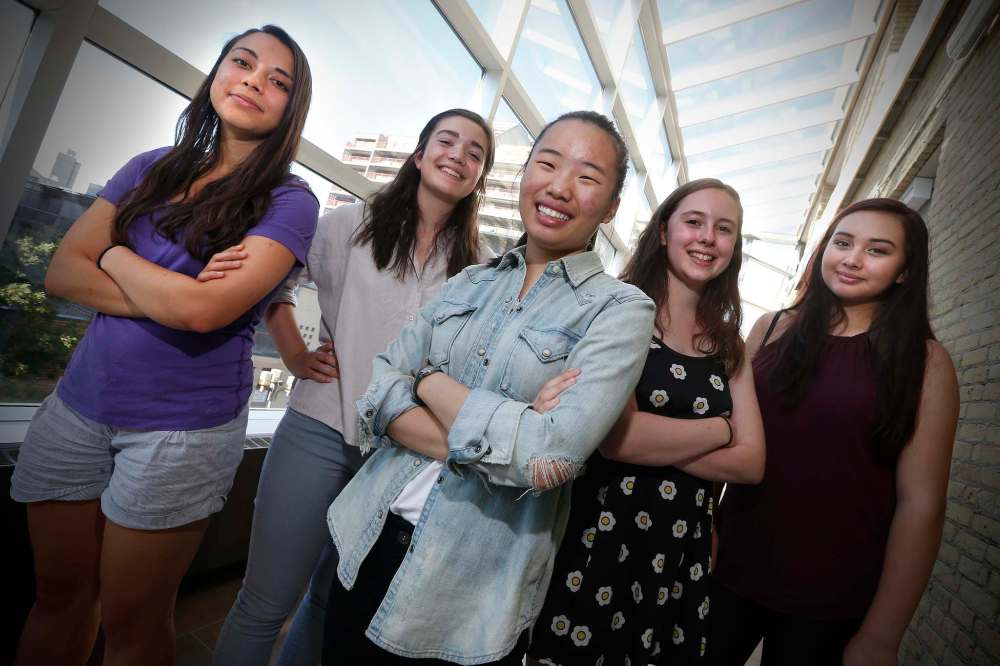
And on Thursday, they will share what they’ve learned with the community at Eckhardt Gramatté Hall at the University of Winnipeg at 5:30 p.m. Their presentation will focus on healthy relationships — what that means, what they look like, and how to build them — and will be adapted into a teaching tool that can be used by schools and community organizations. Everyone is welcome to attend.
When I meet with five of the council’s members earlier in the week, they are readying their presentation. The passion in the room is palpable. This matters to them. They know the statistics: Manitoba and Saskatchewan continue to have the highest rates of intimate partner violence in the country. According to a 2011 Statistics Canada report, half of all female Canadian murder victims were killed by a current or former partner. And it’s an issue that affects young women, too; in 2014, Statistics Canada found that “a current dating partner was most often the perpetrator among youth aged 15 to 19 years (51%) and young adults aged 20 to 24 years (44%) victimized by an intimate partner.”
The group wants to do something about those numbers, and they believe education is critical. Sex Ed, as it exists today, tends to focus on the biology of the act, as well as how to prevent pregnancy and STDs. What’s too often missing is vital information about relationships, and what makes them healthy. Our young people need to be learning about consent, boundaries, self-care, conflict resolution and how to identify abusive behaviour.
“It’s important to know what a healthy relationship is, and that’s something they don’t teach us in school,” says Brianna Jonnie, 14. “I believe this group has been helping educate us, and then we’re able to create this teaching tool to present to others to help them deal with unhealthy relationships and knowing what resources they can use to build up confidence and courage to leave those.”
“You don’t think it’ll happen to you, until it does,” says Nicole Kaneski, 14. “The sad reality is that it keeps happening, and it’s happening to a lot of women in particular. And that’s just sad, and scary, and I don’t like it. I don’t like living in fear of walking outside because I don’t know what’s going to happen to me or my body. That’s not OK.”
As part of their research, the group spent time unpacking unhealthy relationship behaviours that have been normalized by popular culture — such as the idea that stalking, predatory and obsessive behaviour is somehow romantic.
Ivy Desbiolles, 17, says researching consent made her reflect on some of the behaviour she used to consider normal. “Like at school, when people were annoying you, and the teacher would say, ‘Oh, they like you, you should see it as a compliment.’ Back then, I didn’t see anything wrong with that. Now, I look back and I think it’s so wrong to tell people that. I think it’s important to be having these discussions. That’s why our project is so important.”
Pamela Campos, 20, says that although intimate partner violence affects her age group, “it’s an ongoing problem we ignore because people don’t take this age group seriously.” As she correctly points out, these formative years are important; the behaviors our young people learn now will carry over into their relationships going forward.

Nicole adds that young people desperately want to have these conversations, but are often dismissed by adults. “People don’t want to talk to us about issues that are deemed more serious because they feel like don’t have the same level of insight or understanding. But we do. We have opinions, we have feelings, and this stuff affects us.”
Establishing healthy relationships doesn’t just apply to romantic ones. Soomin Han, 17, says that through working on this project, she gained a lot of insight into herself and how she relates to other people. “I have a better relationship with myself, now, because of these meetings.”
This is what empowerment looks like. Strong girls, strong world indeed.
Twitter: @JenZoratti
Jen Zoratti is a columnist and feature writer working in the Arts & Life department, as well as the author of the weekly newsletter NEXT. A National Newspaper Award finalist for arts and entertainment writing, Jen is a graduate of the Creative Communications program at RRC Polytech and was a music writer before joining the Free Press in 2013. Read more about Jen.
Every piece of reporting Jen produces is reviewed by an editing team before it is posted online or published in print – part of the Free Press‘s tradition, since 1872, of producing reliable independent journalism. Read more about Free Press’s history and mandate, and learn how our newsroom operates.
Our newsroom depends on a growing audience of readers to power our journalism. If you are not a paid reader, please consider becoming a subscriber.
Our newsroom depends on its audience of readers to power our journalism. Thank you for your support.
Jen Zoratti is a columnist and feature writer working in the Arts & Life department, as well as the author of the weekly newsletter NEXT. A National Newspaper Award finalist for arts and entertainment writing, Jen is a graduate of the Creative Communications program at RRC Polytech and was a music writer before joining the Free Press in 2013. Read more about Jen.
Every piece of reporting Jen produces is reviewed by an editing team before it is posted online or published in print – part of the Free Press‘s tradition, since 1872, of producing reliable independent journalism. Read more about Free Press’s history and mandate, and learn how our newsroom operates.
Our newsroom depends on a growing audience of readers to power our journalism. If you are not a paid reader, please consider becoming a subscriber.
Our newsroom depends on its audience of readers to power our journalism. Thank you for your support.
Advertisement Advertise With Us
Advertisement Advertise With Us
History
Updated on Sunday, August 21, 2016 2:56 PM CDT: Corrects spelling of Nicole Kaneski.