

Defence minister dismisses Pallister’s fighter jet concerns
Advertisement
Read this article for free:
or
Already have an account? Log in here »
To continue reading, please subscribe:

Digital Subscription
One year of digital access for only $205*
- Enjoy unlimited reading on winnipegfreepress.com
- Read the E-Edition, our digital replica newspaper
- Access News Break, our award-winning app
- Play interactive puzzles
*First annual payment billed as $205.00 + GST for one year. This annual subscription will automatically renew at $233.00 + GST every 52 weeks (10% off the regular annual price of $259.35). Offer available to new and qualified returning subscribers only. Cancel any time.
To continue reading, please subscribe:
Add Free Press access to your Brandon Sun subscription for only an additional
$1 for the first 4 weeks*
- Enjoy unlimited reading on winnipegfreepress.com
- Read the E-Edition, our digital replica newspaper
- Access News Break, our award-winning app
- Play interactive puzzles
*Your next Brandon Sun subscription payment will increase by $1.00 and you will be charged $17.95 plus GST for four weeks. After four weeks, your payment will increase to $24.95 plus GST every four weeks.
Read unlimited articles for free today:
or
Already have an account? Log in here »
Hey there, time traveller!
This article was published 23/11/2016 (3601 days ago), so information in it may no longer be current.
OTTAWA — Canada’s defence minister says Manitoba’s concerns that Ottawa’s decision to negotiate the purchase of 18 fighter jets from Boeing will negatively affect the province are misplaced.
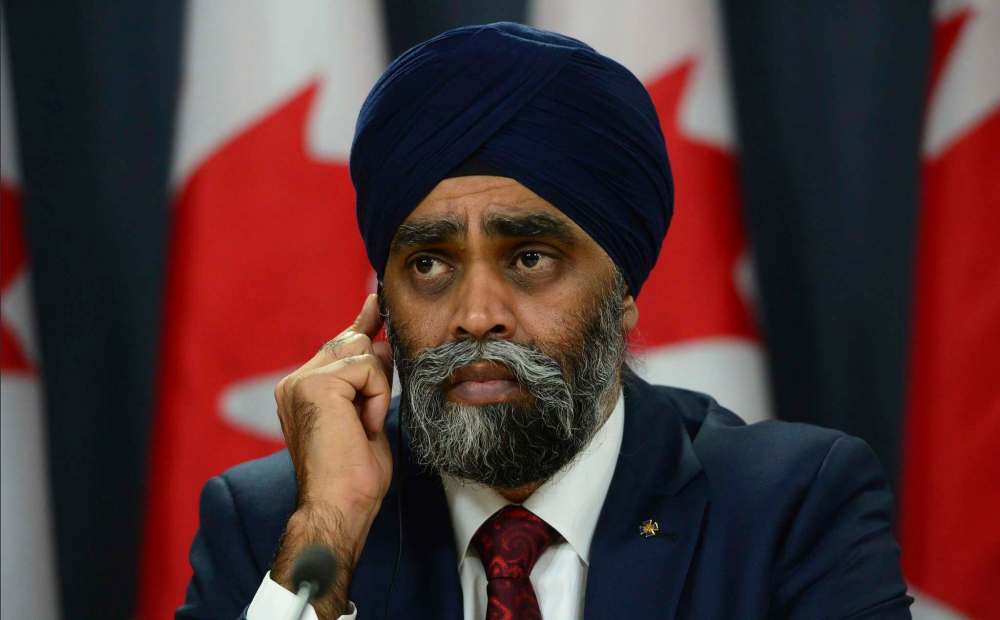
Harjit Sajjan told the Free Press Wednesday “it was surprising” to hear Premier Brian Pallister say the government’s plans would have “a severe negative impact” on Manitoba.
“This is very good news for Winnipeg,” Sajjan said.
Pallister’s comments came after the federal government announced Tuesday a multi-pronged process to replace Canada’s aging fleet of CF-18 fighter jets. It includes negotiating with Boeing to buy 18 of that company’s Super Hornet fighter jets as an interim stop gap measure, launching an “open and transparent” competition for new fighter planes to permanently replace all of the CF-18s, and maintaining Canada’s role in the Joint Strike Fighter program developing F-35 fighter jets. There will also have to be investments made in the CF-18s to extend their lifespan even longer.
Gen. Jonathan Vance, chief of defence staff, said Canada’s CF-18s are already in such poor shape Canada can’t meet its commitments to NATO or the North American Aerospace Defence Command. The Liberal government decided since the competition for new planes could take up to five years, Canada needs to buy some new planes immediately.
The Super Hornets, an upgraded version of the CF-18s, are the government’s first choice for the first planes, although how much it will pay is still to be determined, and it is receiving heavy criticism for the sole-source contracting.
Sajjan, however, said Manitoba will be happy with the result.
“This is very good news for Winnipeg given that Boeing has a substantial footprint in Winnipeg,” said Sajjan.
There are no specific contracts in place yet but Sajjan said Boeing will put industrial benefits in Canada and since three-quarters of Boeing’s Canadian workforce is in Winnipeg, the city’s aerospace sector will be positively affected.
The existing contracts with Magellan Aerospace on the F-35s are not in jeopardy because Canada isn’t pulling out of that program. Also, Sajjan said since Canada has to upgrade its existing CF-18s, CFB Winnipeg stands to benefit from that.
Manitoba has quite the sore spot when it comes to federal defence fighter jet contracts, given the politically motivated decision of the former government of Brian Mulroney in the 1980s to award a 20-year contract for maintenance on the CF-18 fleet to Quebec-based Canadair, despite a lower and superior bid by Winnipeg’s Bristol Aerospace.
The Winnipeg division of Magellan Aerospace is the largest Canadian structural supplier to Lockheed Martin’s F-35 Joint Strike Fighter. It has invested tens of millions of dollars in a production facility specifically to produce horizontal tail assemblies for the conventional take-off and landing variant of the F-35.

Sajjan said Wednesday Canada’s participation in the F-35 program is not tied to procurement, but Scott McCrady, Magellan’s corporate F-35 program director and the chairman of the Canadian JSF Industrial Group, has said in the past that future work will become uncertain if the Canadian government decides not to buy the F-35.
Pallister is set to meet Tuesday with local aerospace officials and plans to raise his concerns directly with Ottawa as well.
“Manitoba’s government remains concerned about the potential impact of yesterday’s federal announcement on our province’s aerospace industry as well as the lack of dialogue with local industry regarding the decision,” Pallister said in a statement. “This has created significant uncertainty within an industry that is vital to Manitoba’s economy.”
— with files from Martin Cash and Larry Kusch
mia.rabson@freepress.mb.ca
Related Articles
Premier tempers tone against Liberals over jets

Advertisement Advertise With Us
Advertisement Advertise With Us
History
Updated on Wednesday, November 23, 2016 5:54 PM CST: edited