

Pallister needs to adjust dicey deficit-slaying strategy

Advertisement
Read this article for free:
or
Already have an account? Log in here »
To continue reading, please subscribe:

Digital Subscription
One year of digital access for only $205*
- Enjoy unlimited reading on winnipegfreepress.com
- Read the E-Edition, our digital replica newspaper
- Access News Break, our award-winning app
- Play interactive puzzles
*First annual payment billed as $205.00 + GST for one year. This annual subscription will automatically renew at $233.00 + GST every 52 weeks (10% off the regular annual price of $259.35). Offer available to new and qualified returning subscribers only. Cancel any time.
To continue reading, please subscribe:
Add Free Press access to your Brandon Sun subscription for only an additional
$1 for the first 4 weeks*
- Enjoy unlimited reading on winnipegfreepress.com
- Read the E-Edition, our digital replica newspaper
- Access News Break, our award-winning app
- Play interactive puzzles
*Your next Brandon Sun subscription payment will increase by $1.00 and you will be charged $17.95 plus GST for four weeks. After four weeks, your payment will increase to $24.95 plus GST every four weeks.
Read unlimited articles for free today:
or
Already have an account? Log in here »
Hey there, time traveller!
This article was published 30/11/2016 (3586 days ago), so information in it may no longer be current.
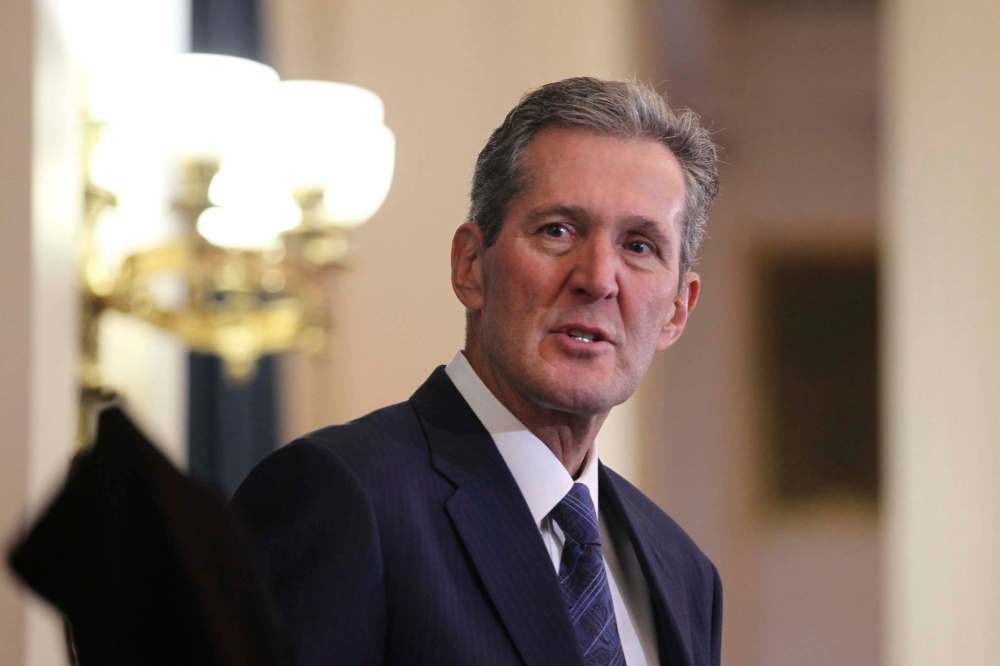
Premier Brian Pallister is about to engage in some pretty risky fiscal business.
He is possessed by an almost religious fervour to eliminate the budget deficit. A financial planner before he became a politician, Pallister is clearly losing sleep about the nearly $900-million shortfall he inherited from the previous NDP government. However, notwithstanding his decision to declare a holy war against the deficit, the premier has had trouble coming up with salient strategies to bring the budget back into surplus.
Pallister has put a moratorium on a wide range of capital projects and cancelled a handful of others. The premier has made sure no new projects are going ahead until his government gets a handle on the deficit.
The government has also made significant reductions in infrastructure spending. Pallister has capped total infrastructure spending at $1 billion per year, a substantial amount but much less than the former NDP government had been spending, and forecast would be spent, over the next four years.
There have been other tangential decisions — a pledge to eliminate significant numbers of provincial boards and commissions, the cancellation of a new downtown headquarters for Manitoba Liquor & Lotteries — that have been newsworthy but will not lead to much in the way of savings.
Last week, however, Pallister signalled his intention to raise the stakes — and the level of risk — in his campaign against the deficit. In the speech from the throne to open the legislative session, the Tory government included a perplexing reference to bringing forth legislation to freeze or possibly roll back public-sector wages. Then, on Monday, Pallister elaborated on the cryptic pledge, indicating he wanted to negotiate wage concessions with public-sector unions.
The premier is not wrong to seek concessions from public-sector workers. However, raising the possibility of legislation, and then backtracking to suggest negotiation is the preferred path to concessions, seems to be an odd way of getting what he wants.
Notwithstanding the initial awkwardness, Pallister has a fairly strong argument for concessions. Demands for government services continue to go up, but tax revenues are not keeping pace. Simply put, the province’s ability to pay annual wage increases is severely impaired. And so, Pallister was quite correct when he said this week, “Something has got to give.” But what exactly is it that “has to give?”
Pallister has argued unless the deficit is eliminated, debt will grow along with the likelihood of another credit rating downgrade, making it more expensive for the province to borrow. Of all his faults, one cannot accuse Pallister of exaggerating the threat posed by this scenario; unless something is done, Manitoba could very well find itself in a debt crisis.
However, Pallister is also fundamentally opposed to any kind of tax increase. He believes Manitoba is already taxed too much — a highly debatable point — and so any suggestion government need ramp up tax rates is off the table. In fact, he remains committed to reducing the provincial sales tax by one point back to seven per cent.
A credit rating downgrade, which increases the cost of borrowing, would be very harmful to government. So, too, is a fiscal strategy that dampens economic growth.
There will be a negative economic impact from the cuts to infrastructure spending, still considered the most potent form of economic stimulus. A dollar invested in highway and bridge construction tends to bring three to four dollars of economic activity. So, a $50-million cut in highway investment over a four-year term could eliminate $200 million of economic activity.

Now, to that decision, we may have to add wage concessions. For the tens of thousands of Manitobans who toil for the province, a freeze or rollback on pay will put a chill on their spending plans. Less spending means fewer sales for business and less sales and income tax revenue for government.
Pallister has always viewed the province’s structural deficit and burgeoning debt as a vicious cycle that would ultimately undermine the entire government. He is not wrong. But at some point, he must also acknowledge a deficit-elimination strategy that only focuses on expenditures could have the same impact.
If Pallister is concerned about credit rating agencies, he should know they only care about the bottom line. If he is unable to reduce or eliminate the deficit by controlling expenditures, they will not take mercy on him because he took a fiscally conservative approach. If the province continues to be mired in deficit financing for whatever reason, the bond raters will frown, and investors will turn on Manitoba.
Pallister was elected in part on his fervent commitment to slaying the deficit. However, unless he broadens his approach to deficit control, he may find he has done nothing more than dig a deep hole a little bit deeper.
dan.lett@freepress.mb.ca
Dan Lett is a columnist for the Free Press, providing opinion and commentary on politics in Winnipeg and beyond. Born and raised in Toronto, Dan joined the Free Press in 1986. Read more about Dan.
Dan’s columns are built on facts and reactions, but offer his personal views through arguments and analysis. The Free Press’ editing team reviews Dan’s columns before they are posted online or published in print — part of the our tradition, since 1872, of producing reliable independent journalism. Read more about Free Press’s history and mandate, and learn how our newsroom operates.
Our newsroom depends on a growing audience of readers to power our journalism. If you are not a paid reader, please consider becoming a subscriber.
Our newsroom depends on its audience of readers to power our journalism. Thank you for your support.
Dan Lett is a columnist for the Free Press, providing opinion and commentary on politics in Winnipeg and beyond. Born and raised in Toronto, Dan joined the Free Press in 1986. Read more about Dan.
Dan’s columns are built on facts and reactions, but offer his personal views through arguments and analysis. The Free Press’ editing team reviews Dan’s columns before they are posted online or published in print — part of the our tradition, since 1872, of producing reliable independent journalism. Read more about Free Press’s history and mandate, and learn how our newsroom operates.
Our newsroom depends on a growing audience of readers to power our journalism. If you are not a paid reader, please consider becoming a subscriber.
Our newsroom depends on its audience of readers to power our journalism. Thank you for your support.
Related Articles
Wage freezes start at home

Advertisement Advertise With Us
Advertisement Advertise With Us