

Viola Desmond inspired racial equality across nation
Advertisement
Read this article for free:
or
Already have an account? Log in here »
To continue reading, please subscribe:
Digital Subscription
One year of digital access for only $1.44 a week*
- Enjoy unlimited reading on winnipegfreepress.com
- Read the E-Edition, our digital replica newspaper
- Access News Break, our award-winning app
- Play interactive puzzles
*Billed as $5.77 plus GST every four weeks. After 52 weeks, price increases to the regular rate of $19.95 plus GST every four weeks. Offer available to new and qualified returning subscribers only. Cancel any time.
To continue reading, please subscribe:
Add Free Press access to your Brandon Sun subscription for only an additional
$1 for the first 4 weeks*
- Enjoy unlimited reading on winnipegfreepress.com
- Read the E-Edition, our digital replica newspaper
- Access News Break, our award-winning app
- Play interactive puzzles
*Your next Brandon Sun subscription payment will increase by $1.00 and you will be charged $17.95 plus GST for four weeks. After four weeks, your payment will increase to $24.95 plus GST every four weeks.
Read unlimited articles for free today:
or
Already have an account? Log in here »
Hey there, time traveller!
This article was published 08/12/2016 (3463 days ago), so information in it may no longer be current.
IN 1946, Viola Desmond refused to move from the whites-only section of the movie theatre. In 2018, her face will be printed on the Canadian $10 bill.
Desmond was chosen Thursday as the winner of the Bank of Canada’s bank note-able Canadian woman campaign, and will be the first woman — other than the Queen — to be pictured on a banknote. She was chosen over four other women, including poet E. Pauline Johnson, Elsie MacGill, who received an electrical engineering degree from the University of Toronto in 1927, Quebec suffragette Idola Saint-Jean and 1928 Olympic track and field medallist Fanny Rosenfeld.
who was Viola Desmond?
Desmond was an African-Canadian business woman from Halifax. She was born in 1914, and died when she was 50 years old in 1965. Most well-known for her refusal to leave a racially segregated movie theatre in New Glasgow, N.S., Desmond is recognized as a Canadian civil rights icon.
Desmond was trained as a teacher, but decided to attend beauty school after she became fed up with the absence of beauty products for black women. After attending the Field Beauty Culture School in Montreal, she continued her training in Atlantic City and New York. Finally, she opened Vi’s Studio of Beauty Culture in Halifax, where she sold her own line of beauty products that catered to black women. After that, she opened Desmond’s School of Beauty Culture, where students from across Eastern Canada went to study.
What happened in the theatre?
Desmond was travelling through Nova Scotia on business in November 1946. She encountered car trouble, and while her car was being fixed, she decided to see a movie at the Roseland Theatre in New Glasgow.
Desmond bought her ticket and went to sit on the main floor of the Roseland, where an usher promptly told her she was not allowed. The main-floor ticket, according to the usher, was more expensive. So Desmond went back to the ticket booth to pay the difference for a main-floor ticket. The cashier told her the theatre would not sell main-floor tickets to black people. Theatre staff told her she could only sit on the balcony, which was reserved for blacks.
After having offered to pay the difference for the main-floor ticket, Desmond decided to sit on the main floor anyway. She refused to leave, at which point theatre staff called for police assistance. Police dragged Desmond out of the theatre, jailed her overnight and charged her for not paying the difference of tax between a main-floor ticket and a balcony ticket — a roughly one-cent difference.
What happened at trial?
Desmond went to trial and had to pay a $26 fine. She wasn’t made aware of her legal rights, and as a result never sought legal counsel.
“They didn’t make it an issue of race,” said Canadian Museum for Human Rights curator Travis Tomchuk. “It was a lot more vague and fluid because Canadian laws didn’t explicitly say where black people could and couldn’t go like they did in the states.”
Tomchuk said even in the black community Desmond lacked support at the time of her trial.
“At the time, there were folks in the black community who just thought (the trial) was going to cause trouble,” said Tomchuk. “It sounds like her husband was one of those people. I think their marriage deteriorated after the trial.”
The Nova Scotia government granted her a posthumous pardon in 2010.

What does Desmond’s story mean to our nation?
“Viola Desmond was a pretty incredible person in a lot of ways,” said Tomchuk. “She’s an important symbol of resistance to white supremacy. Also, this was 1946. She had her own business, a line of products and she was travelling around in a car on her own. As a feminist role model she is quite important.”
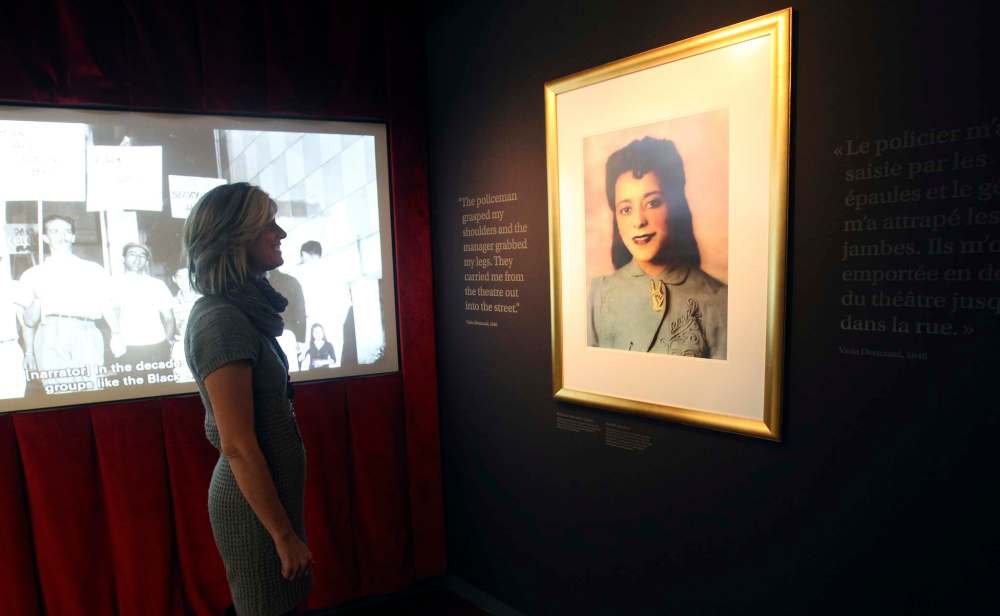
Desmond is often referred to as “the Canadian Rosa Parks,” but Desmond refused to move from her theatre seat in Halifax nine years before Parks stayed put at the front of the bus in Alabama. Desmond represents a crucial time in the human rights and freedoms movement in Canada, and her story continues to inspire racial equality.
Desmond and her story are commemorated in an exhibit at the human rights museum.
Twitter: @rebeccadaahl
Advertisement Advertise With Us
Advertisement Advertise With Us