

Less than half of Winnipeg’s dog owners have licensed their pets
Advertisement
Read this article for free:
or
Already have an account? Log in here »
To continue reading, please subscribe:

Digital Subscription
One year of digital access for only $205*
- Enjoy unlimited reading on winnipegfreepress.com
- Read the E-Edition, our digital replica newspaper
- Access News Break, our award-winning app
- Play interactive puzzles
*First annual payment billed as $205.00 + GST for one year. This annual subscription will automatically renew at $233.00 + GST every 52 weeks (10% off the regular annual price of $259.35). Offer available to new and qualified returning subscribers only. Cancel any time.
To continue reading, please subscribe:
Add Free Press access to your Brandon Sun subscription for only an additional
$1 for the first 4 weeks*
- Enjoy unlimited reading on winnipegfreepress.com
- Read the E-Edition, our digital replica newspaper
- Access News Break, our award-winning app
- Play interactive puzzles
*Your next Brandon Sun subscription payment will increase by $1.00 and you will be charged $17.95 plus GST for four weeks. After four weeks, your payment will increase to $24.95 plus GST every four weeks.
Read unlimited articles for free today:
or
Already have an account? Log in here »
Hey there, time traveller!
This article was published 03/01/2017 (3528 days ago), so information in it may no longer be current.
Buying a license for your dog or cat in Winnipeg helps keep them safe but less than half of dog-owners and fewer than one-fifth of cat-owners have bought tags for their pets.
Reuniting pets and owners is the outcome everyone wants through the city’s mandatory licensing program but some owners still think it is just a cash grab by the city, said animal services COO Leland Gordon.
Gordon said the number of dogs licensed in Winnipeg in 2015 was 48,671 — that’s only about 43.4 per cent of owned dogs in Winnipeg households. It is, however, 6,440 more licensed dogs than in 2014.
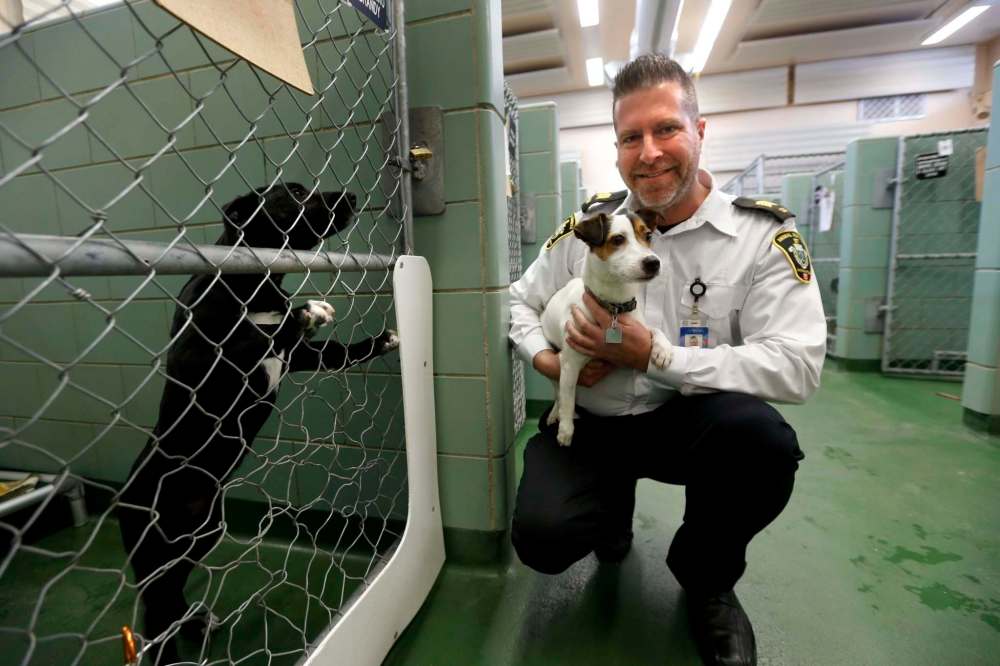
There were 22,898 cats licensed in 2015, the first year of mandatory cat licensing, but that’s only about 15 per cent of owned cats in Winnipeg.
Gordon said a licensed pet can be returned directly to its owner through a call to 311 by the person who found the pet without that pet ever having to come to the animal services facility.
“Why aren’t people licensing their pets? We have huge marketing campaigns, we’re in the media all the time and we do everything we can to educate people,” he said, noting an Ipsos Reid study in 2006 recorded 148,386 owned cats and 112,139 owned dogs in Winnipeg households. He said indications are that current numbers are about the same.
“At the end of the day, when you live in a modern city with that many animals, we have to have the services in place in case people need us.”
Gordon said there’s a 95 per cent live release rate for dogs at animal services and licensing has been a big part of that success rate.
“There are less dogs coming in and more dogs going back to their owners. We’re proud of that,” Gordon said, adding the 95 per cent includes dogs reunited with their families, adopted to new owners or taken in by a rescue shelter. Found or surrendered cats are taken to the Winnipeg Humane Society under a service agreement with the city.
Gordon said the animal services department relies heavily on the money generated by pet licences to operate and provide services.
The 2017 budget to run animal services is $3.1 million but only $667,301 will come from city tax support.
Gordon said that leaves his department needing to raise over $2.5 million through pet licensing fees and donations.
“People say it’s just a cash grab. It’s not,” Gordon said.
“It’s a fee that people pay to raise revenue to protect your pet in the rare event that you need our help,” he said. “In the rare event that your dog or cat gets out, it’s going to be protected by 311 reuniting you with your animal. If it gets here, we’re going to reunite you. If your animal is not wearing a licence, we’re still going to care for it here.”
Licensing of dogs is nothing new — the City of Winnipeg has required dogs to be licensed for more than 100 years. But what is relatively new is the zero tolerance policy on licence renewals adopted in 2011 by the city. The city sends out a renewal notice about five weeks prior to licence expiry dates but it is the pet owner’s responsibility to license the animal.
The city has also streamlined pet license payment options to seven locations which has saved money and reduced errors in the information collected.
Licensed dogs can be housed for 10 days at animal services. Dogs with no licence are only kept for three days before they are put up for adoption or sent to a rescue. Only aggressive or extremely ill dogs are euthanized.
It costs $15 per year to license a spayed/neutered cat and $36 per year to license a spayed/netured dog. By contrast, the fine for no pet licence or not renewing a licence is $250 for a cat or a dog but those funds go to the city’s legal services department.
Licences can be purchased by mail by responding to renewal notifications, online at winnipeg.ca/animal services or by calling 311. Licences can also be purchased in person at the Animal Services Agency at 1057 Logan Ave., the Bilingual Service Centre at 170 Goulet St., Community Services at 395 Main St. and the 311 Customer Service Counter at 510 Main St.
“My dream is two things. There’s no homeless animals in our animal shelters, that’s my first one. My second is that everybody follows our Responsible Pet Ownership bylaw,” Gordon said.

“If everybody was a responsible pet owner, everybody licensed their pets, everybody and their pets had no impact on their neighbours in regard to the livability of those neighbours, for example don’t let your dog get out of your yard because your gate is broken and you haven’t fixed it for a month, and if people kept their pet for their entire life, we’d have no animals in our animal shelters and we’d have to lay no tickets.”
Gordon said animal services officers do patrols for animals-at-large and unlicensed pets as well as database searches for expired pet licences.
Animal services also relies on non-monetary donations from the public such as dog food, dog treats, peanut butter (which goes inside dog toys), and dog toys.
Dogs at animal services receive free check-ups from animal health technology students which saves money and helps students gain experience working with animals.
ashley.prest@freepress.mb.ca