

Bettman needs to give his head a (gentle) shake on concussions
Advertisement
Read this article for free:
or
Already have an account? Log in here »
To continue reading, please subscribe:
Digital Subscription
One year of digital access for only $1.44 a week*
- Enjoy unlimited reading on winnipegfreepress.com
- Read the E-Edition, our digital replica newspaper
- Access News Break, our award-winning app
- Play interactive puzzles
*Billed as $5.77 plus GST every four weeks. After 52 weeks, price increases to the regular rate of $19.95 plus GST every four weeks. Offer available to new and qualified returning subscribers only. Cancel any time.
To continue reading, please subscribe:
Add Free Press access to your Brandon Sun subscription for only an additional
$1 for the first 4 weeks*
- Enjoy unlimited reading on winnipegfreepress.com
- Read the E-Edition, our digital replica newspaper
- Access News Break, our award-winning app
- Play interactive puzzles
*Your next Brandon Sun subscription payment will increase by $1.00 and you will be charged $17.95 plus GST for four weeks. After four weeks, your payment will increase to $24.95 plus GST every four weeks.
Read unlimited articles for free today:
or
Already have an account? Log in here »
Hey there, time traveller!
This article was published 15/02/2017 (3389 days ago), so information in it may no longer be current.
What do climate-change deniers, the tobacco industry and today’s National Hockey League have in common?
Everything. Well, everything that is despicable.
In case you missed it, the NHL has joined the insidious “alternative facts” movement and gone to war against science.
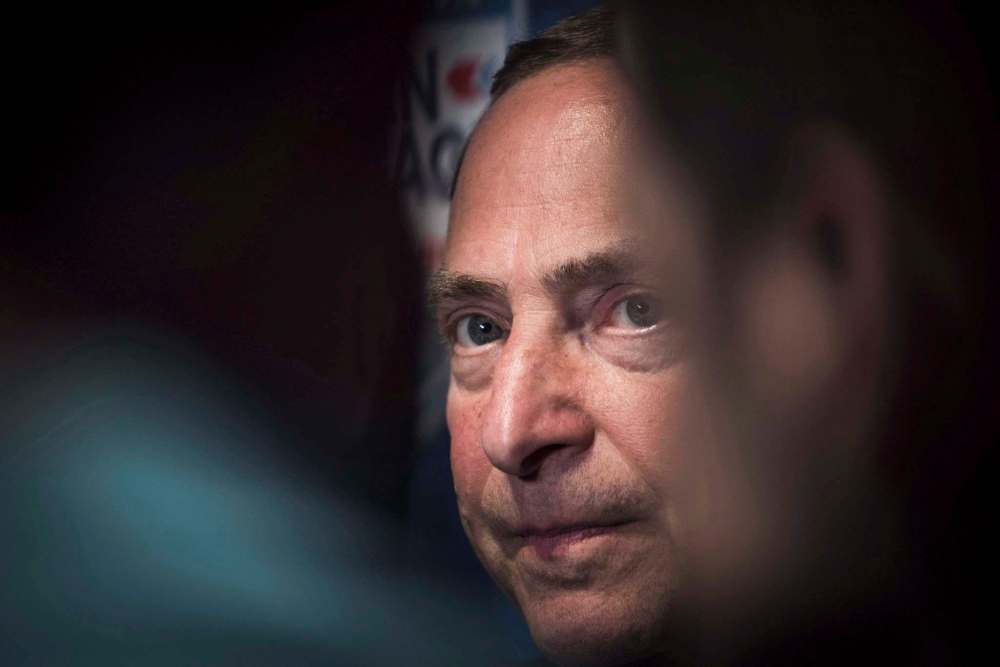
Last week, the NHL served notice in a U.S. federal courtroom in Minneapolis that it’s opening a new front in its ongoing campaign denying that hockey causes concussions and concussions cause chronic traumatic encephalopathy, a degenerative brain disease that mimics the symptoms of Alzheimer’s and dementia.
Until now, the league and its profoundly unlikable commissioner, Gary Bettman, have argued — despite mountains of evidence and research to the contrary — that the link between repeated blows to the head and CTE is inconclusive and, besides, hockey doesn’t have a concussion problem.
Both of those propositions are absurd and the NHL is alone among the four major sports leagues on this continent in denying a link between head trauma and CTE.
Now, denying obvious facts is one thing, and not exactly unchartered territory for a commissioner who also continues to insist, despite huge swaths of empty seats, that the NHL is doing just fine in the U.S. sunbelt, thanks for asking.
But last week’s court filing suggests the NHL has shifted its strategy from denying the facts of CTE to launching a broadside at the researchers who are doing the groundbreaking and absolutely crucial research responsible for those (inconvenient) facts.
As part of their legal fight against a CTE class-action lawsuit brought by former NHL players and their families, the NHL last week filed court papers demanding researchers at Boston University — the world leaders in CTE research — turn over what sounds like nearly every scrap of research they’ve put together on the subject.
In addition to research materials, the league has demanded unpublished data and information related to former athletes whose brains were donated to the university for research.
The NHL’s fishing expedition includes stuff that could even violate medical privacy laws, including — according to the New York Times’ Juliet Macur — “medical records of the deceased and interview notes which would include discussions with their families, even though most of the athletes never even played hockey.
“Hand it all over, the league said, so it can “probe the scientific basis for published conclusions” and “confirm the accuracy of published findings.”’
So what, Gary Bettman is now a research scientist, too? Where does he find the time?
Don’t make me laugh. The NHL’s move here has nothing to do with science and everything to do with sending a chilling message to the Boston researchers — and the players and families who make their research possible — that the NHL will make their lives very difficult if they persist in, well, telling the truth about CTE.
Now, it’s worth noting at this point that Boston University isn’t even a named party in the class-action lawsuit against the NHL — its scientists are just doing the pioneering research on CTE. And with this latest salvo, the NHL could bring that work to a crashing halt.
The NHL’s demands are so sweeping that the university told the court it would bring its CTE work to a stop for months just to comply with such an order, if a federal judge actually rules in the league’s favour.
And that’s the point, see. Macur tracked down a tobacco researcher named Stephen Hecht, who lived this same movie back in the ’70s when the tobacco industry tried to use the courts to stop scientists from proving what everyone long suspected — that smoking is very, very bad for you.
“It’s hard enough to do good, solid science because it’s more than a full-time job,” Hecht told Macur. “So when you have an industry, like the tobacco industry, or the NHL, making all kinds of additional demands, it will essentially shut you down. Their hope is that you just go away.”
And it’s not just researchers in Boston who the NHL wants to discredit. This week, the league filed still more documents in federal court attacking Dr. Bennet Omalu, the researcher credited with discovering the link who was depicted in the feature film Concussion.
The league’s lawyers were angry with a letter Omalu wrote that had been filed with the court, criticizing the work of the “medical expert” the NHL has retained, a guy named Dr. Rudy Castellani, who questions whether CTE even exists.
Omalu wrote that Castellani is undermining “the integrity, purity and independence of this long-established process and standards of practice.” The NHL’s lawyers responded that Omalu’s accusations were “hyperbolic and unprofessional.”
He said, she said? Maybe. But in matters of scientific dispute, I’m generally on the side of the researcher who was played by Will Smith in the movie.
Look, we live in a time when you can turn to whatever source of information fits your worldview for reassurance. Support Trump? Fox News will tell you, 24/7, what a great job he’s doing. Hate Trump? MSNBC — to name just one media outlet — will tell you, 24/7, how right you are.
But even in a world where agreed-upon facts are increasingly an endangered species, there remain a few things upon which everyone but the cranks — and those with vested financial interests — have reached consensus:
The oceans are rising. Smoking kills. And getting hit in the head over and over again is really bad for you.
Even the NFL agrees on the link between head trauma and CTE and late last year agreed to a settlement with its former players that will pay individual sufferers up to $5 million apiece, to a total of about $1 billion.
Now, the NFL didn’t agree to pay its former players who are suffering because it’s the right thing to do, although it’s that too; no, the NFL agreed to a $1-billion CTE settlement for the same reason the NFL agrees to anything — because it’s the right thing for the NFL.
By agreeing to the settlement, the NFL turned a huge and scary financial unknown that threatened to hound the league for decades into a fixed cost certainty that allows the league to get back to doing what it does best — earning billions of dollars in profits. And making excuses for domestic abusers, but I digress.
It is exactly the opposite of the approach the NHL has chosen — and that fact all by itself should cause any hockey fan to lose some sleep. Roger Goodell and Gary Bettman are in different leagues, in more ways than one.
Is hockey different than football? Absolutely, in a million ways — but just not when it comes to CTE, the research suggests.
The five brains of former hockey players that Boston University researchers studied all showed evidence of CTE. And an exhaustive five-year study of 25 NCAA sports published by the American Journal of Sports Medicine found women’s hockey and men’s hockey had the second- and third-highest rates of concussions respectively, ahead of fourth-ranked football. (Wrestling had the highest concussion rates, if you’re wondering. By a mile.)
All of that suggests hockey isn’t nearly as different as Bettman, his lawyers and his “medical experts” would like you to believe. And the sooner the NHL acknowledges that fact and settles with its players the way the NFL settled with theirs, the better off everyone will be.

It’s the right thing to do, but it’s also the right thing to do for the NHL. Just ask the tobacco industry, which paid dearly for their decades-long campaign against science with massive punitive awards in the ’90s from juries who looked very dimly on the industry’s attempts to cover up its own complicity.
CTE exists, it’s not going away and the NHL is going to have to pay its players who are suffering sooner or later.
The price of stalling — for both the NHL and the hockey players who need help — only gets steeper with each passing day.
paul.wiecek@freepress.mb.ca
Twitter: @PaulWiecek