

Too soon to tell if claims trend will persist
Advertisement
Read this article for free:
or
Already have an account? Log in here »
To continue reading, please subscribe:

Digital Subscription
One year of digital access for only $205*
- Enjoy unlimited reading on winnipegfreepress.com
- Read the E-Edition, our digital replica newspaper
- Access News Break, our award-winning app
- Play interactive puzzles
*First annual payment billed as $205.00 + GST for one year. This annual subscription will automatically renew at $233.00 + GST every 52 weeks (10% off the regular annual price of $259.35). Offer available to new and qualified returning subscribers only. Cancel any time.
To continue reading, please subscribe:
Add Free Press access to your Brandon Sun subscription for only an additional
$1 for the first 4 weeks*
- Enjoy unlimited reading on winnipegfreepress.com
- Read the E-Edition, our digital replica newspaper
- Access News Break, our award-winning app
- Play interactive puzzles
*Your next Brandon Sun subscription payment will increase by $1.00 and you will be charged $17.95 plus GST for four weeks. After four weeks, your payment will increase to $24.95 plus GST every four weeks.
Read unlimited articles for free today:
or
Already have an account? Log in here »
Hey there, time traveller!
This article was published 03/03/2017 (3510 days ago), so information in it may no longer be current.
OTTAWA — The number of people making an asylum claim in Manitoba grew fivefold in the past two years, but federal officials say it’s too early to determine whether the trend will continue.
Statistics provided via the Canada Border Services Agency show in 2016, 521 people made a claim for asylum in Manitoba.
That includes all claims made for refugee status within the province, not just those who illegally crossed the border to do so.
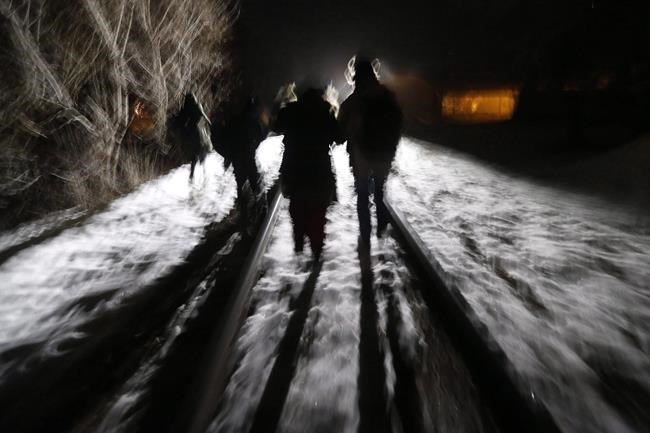
Two years earlier, just 104 people made an asylum claim in Manitoba. In 2015 it was 263.
Nationally, in 2016, there were about 24,000 asylum claimants, up from 16,113 in 2015 and 13,500 in 2014.
In January and most of February, there were almost 4,000 asylum claims at a land border crossing (mostly people taken there by the RCMP after crossing the border illegally) or at inland offices in cities such as Winnipeg.
Canada Border Services Agency says it processed 94 claimants who crossed the border illegally near Emerson from Jan. 1 to Feb. 21.
That number has grown to more than 140, after more than three dozen people crossed the border in the last week alone.
Quebec has seen the lion’s share of the border crossers, with 290 in the first eight weeks of the year. There were another 51 in British Columbia.
Officials from Canada Border Services Agency (CBSA), the RCMP, and Immigration, Refugees and Citizenship Canada (IRCC) who held a technical briefing for the media Thursday in Ottawa, said asylum claim statistics have fluctuated a lot over the past 15 years and it is too early to determine that there will be many more coming to Canada once the snow melts.
Citizenship officials said in 2001, 44,000 asylum claimants filed paperwork in Canada. In 2008, the number was 37,000.
Asylum claimants are different than resettled refugees. The latter, including the 35,000 Syrian refugees who were admitted to Canada since November 2015, are screened and processed overseas before they board a plane for Canada.
Asylum claimants arrive in Canada first and then make a claim.
If they arrive in Canada by crossing the border without going to a border crossing, they will be arrested by the RCMP and then handed over to the custody of the CBSA.
There, they are detained for two to eight hours while they are processed.
Processing involves having any documents screened, biometrics taken and national and international databases checked to determine what their status is elsewhere, or if they are suspected of a crime or human rights violation.
If they are not deemed to be a security threat and have not previously been rejected by Canada as a refugee, they are released and a refugee board hearing set up to hear their case.
The CBSA made clear nobody is released if there are any concerns but the CBSA did not respond Thursday when asked how many asylum claimants have been detained so far this year.
International treaties signed by Canada dictate how Canada treats people who claim they cannot return to their country for fear of prosecution.
Canada’s immigration laws say if someone crosses the border to make a claim, they won’t be charged while their claim is being processed.
If their refugee claim is rejected, they could be charged.
The RCMP and CBSA are working with U.S. counterparts and constantly monitoring the situation and gathering intelligence to try to determine what is causing the influx and whether it will continue.
The IRCC thus far will not say how many claimants are being rejected. In 2016, about 4.9 per cent of claimants were deemed ineligible to make a claim. If a claimant is rejected, they can appeal.
Ultimately, a claimant Canada deems ineligible for asylum will be issued a deportation order.

Bashir Khan, a Winnipeg immigration lawyer who is representing several asylum claimants, said so far this year he has had three claimants accepted and one rejected.
Most of the claimants currently arriving in Manitoba are from Somalia, a country to which Canada will not deport anyone because it is too dangerous.
The only exception is for Somalis deemed inadmissible because of criminal convictions.
However, neither CBSA nor IRCC could or would say Thursday what the status is of people who are turned down as refugees but who are not being deported.
mia.rabson@freepress.mb.ca
Related Articles
Federal ministers head to Emerson
Advertisement Advertise With Us
Advertisement Advertise With Us
History
Updated on Friday, March 3, 2017 7:46 AM CST: Adds photo
Updated on Friday, March 3, 2017 9:58 AM CST: Adds photo