

Landowners dispute province’s flood plan
Some residents favour one option, but groundwater to other communities would be impacted
Advertisement
Read this article for free:
or
Already have an account? Log in here »
To continue reading, please subscribe:
Digital Subscription
One year of digital access for only $75*
- Enjoy unlimited reading on winnipegfreepress.com
- Read the E-Edition, our digital replica newspaper
- Access News Break, our award-winning app
- Play interactive puzzles
*Billed as $5.77 plus GST every four weeks. After 52 weeks, price increases to the regular rate of $19.95 plus GST every four weeks. Offer available to new and qualified returning subscribers only. Cancel any time.
Monthly Digital Subscription
$4.99/week*
- Enjoy unlimited reading on winnipegfreepress.com
- Read the E-Edition, our digital replica newspaper
- Access News Break, our award-winning app
- Play interactive puzzles
*Billed as $19.95 plus GST every four weeks. Cancel any time.
To continue reading, please subscribe:
Add Free Press access to your Brandon Sun subscription for only an additional
$1 for the first 4 weeks*
- Enjoy unlimited reading on winnipegfreepress.com
- Read the E-Edition, our digital replica newspaper
- Access News Break, our award-winning app
- Play interactive puzzles
*Your next Brandon Sun subscription payment will increase by $1.00 and you will be charged $17.95 plus GST for four weeks. After four weeks, your payment will increase to $24.95 plus GST every four weeks.
Read unlimited articles for free today:
or
Already have an account? Log in here »
Hey there, time traveller!
This article was published 03/07/2017 (3246 days ago), so information in it may no longer be current.
MOOSEHORN — The province forecasts a giant wave will swoop down in the early 2020s and wash the Interlake home of Rose Bittner and her husband, Lawrence, off the face of the Earth.
So they better think about moving.
The Bittner home is in the path of the chosen route for the outlet channel to drain Lake Manitoba when the Portage Diversion is operating. The channel will drain Lake Manitoba into Lake St. Martin.
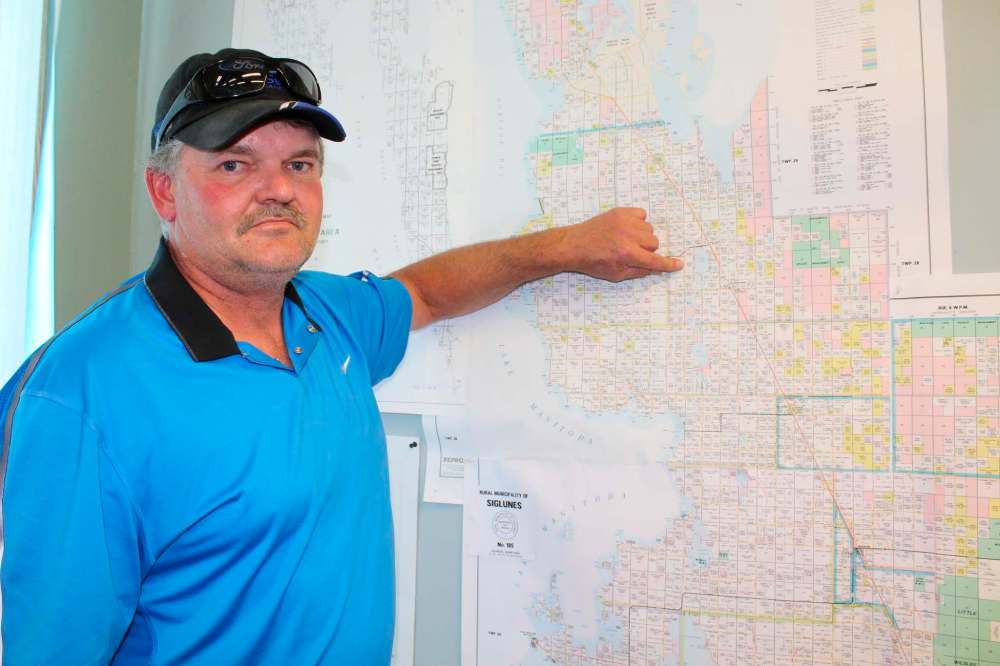
“Well, there isn’t much we can do. The water has to go someplace, and the powers that be feel this is the best place,” Rose Bittner said.
The outlet channel will be 400 metres wide — nearly the equivalent of four football fields without the end zones — and will not just wipe out their home but their entire yard site where they planted close to 1,000 trees over the years.
“We’ve been married 47 years, and lived here for 45 years, and we put some hard work into the yard, and raised our kids and grandkids. It’s heartbreaking,” Bittner, 65, said.
“On the other hand, we’re at retirement age. If the government comes through and compensates us properly, we can live with that.”
Some people are still hoping to convince the province to reconsider the channel route. The Interlake area is mostly pasture, yet somehow engineers chose a route that goes through some of its best cropland, said some landowners who met with the Free Press in Moosehorn.
There were originally six routes studied, including one through a natural drain of marshy lowland, said Dan Meisner, a councillor with the RM of Grahamdale, which the outlet channel traverses.
However, the latter option was quashed by the strict protections afforded wetlands under Fisheries and Oceans Canada.
The province whittled it down to two routes: Option D (23 kilometres), which runs north out Lake Manitoba into Lake St. Martin (and through the Bittner home); and Option C (12 km) running east from Lake Manitoba near Fairford. A drawback to Option C is it requires blasting through limestone ridges and could have implications for a local aquifer.
Farmers such as Brad Dreger are urging the province to take a second look at Option C, with some modifications. Dreger is one of the farmers most affected if the province goes ahead with Option D, as the channel and accompanying changes to Provincial Highway 239 would run through 15 quarter sections on his farm and eat up 25 per cent of his land base. He will also have to work around the channel for the rest of his farming days.
In total, about 20 families would be affected by Option D, whereas three landholders have already stated they are willing to sell their land to accommodate Option C, said John Halchuk, another Grahamdale councillor. Choosing Option C “would have the least social impact to the RM of Grahamdale,” Halchuk said.
However, the province told the Free Press it has accepted the recommendation from engineering consultants that Option D is the preferred route. Option C has negative implications for the groundwater aquifer, which provides drinking water for some First Nations groups and communities such as Hilbre.
The province had hoped to start digging by fall of 2018 but “indigenous consultations and environmental authorizations may push the start date… into 2019,” a Manitoba Infrastructure spokesman said.
A price tag of as much as $250 million has been tossed out but the spokesman said a firm cost has not yet been determined. The federal government is committed to sharing 50 per cent of the cost.
Premier Brian Pallister has stated an outlet channel to stop flooding on Lake Manitoba is a priority for his government.
The outlet channel is the last piece of the flood mitigation plan that was devised after Winnipeg was deluged in the famous Red River flood of 1950. The flood led to the construction of the Winnipeg Floodway, Shellmouth Dam on the Upper Assiniboine River, and the Portage Diversion on the Lower Assiniboine River.

But when it came to the last instalment, an outlet for Lake Manitoba to handle Assiniboine River water entering via the Portage Diversion, the government commitment ran out of steam.
The province has not discussed compensation yet with landowners. The Bittners are awaiting an expropriation order.
“We expect to get a registered letter in the mail. We’re supposing that we will hire a lawyer probably to make sure our T’s are crossed and I’s dotted,” Bittner said.
The Bittners haven’t given too much thought to where they will relocate, except it won’t be anywhere close to a major urban centre such as Winnipeg, she said.
bill.redekop@freepress.mb.ca