

A clean break
Campaign challenging Winnipeg restaurants to cut out the use of plastic straws is gaining support
Advertisement
Read this article for free:
or
Already have an account? Log in here »
To continue reading, please subscribe:

Digital Subscription
One year of digital access for only $205*
- Enjoy unlimited reading on winnipegfreepress.com
- Read the E-Edition, our digital replica newspaper
- Access News Break, our award-winning app
- Play interactive puzzles
*First annual payment billed as $205.00 + GST for one year. This annual subscription will automatically renew at $233.00 + GST every 52 weeks (10% off the regular annual price of $259.35). Offer available to new and qualified returning subscribers only. Cancel any time.
To continue reading, please subscribe:
Add Free Press access to your Brandon Sun subscription for only an additional
$1 for the first 4 weeks*
- Enjoy unlimited reading on winnipegfreepress.com
- Read the E-Edition, our digital replica newspaper
- Access News Break, our award-winning app
- Play interactive puzzles
*Your next Brandon Sun subscription payment will increase by $1.00 and you will be charged $17.95 plus GST for four weeks. After four weeks, your payment will increase to $24.95 plus GST every four weeks.
Read unlimited articles for free today:
or
Already have an account? Log in here »
Hey there, time traveller!
This article was published 05/07/2017 (3349 days ago), so information in it may no longer be current.
It may be the last straw for some Winnipeg restaurant owners — the last plastic drinking straw, that is.
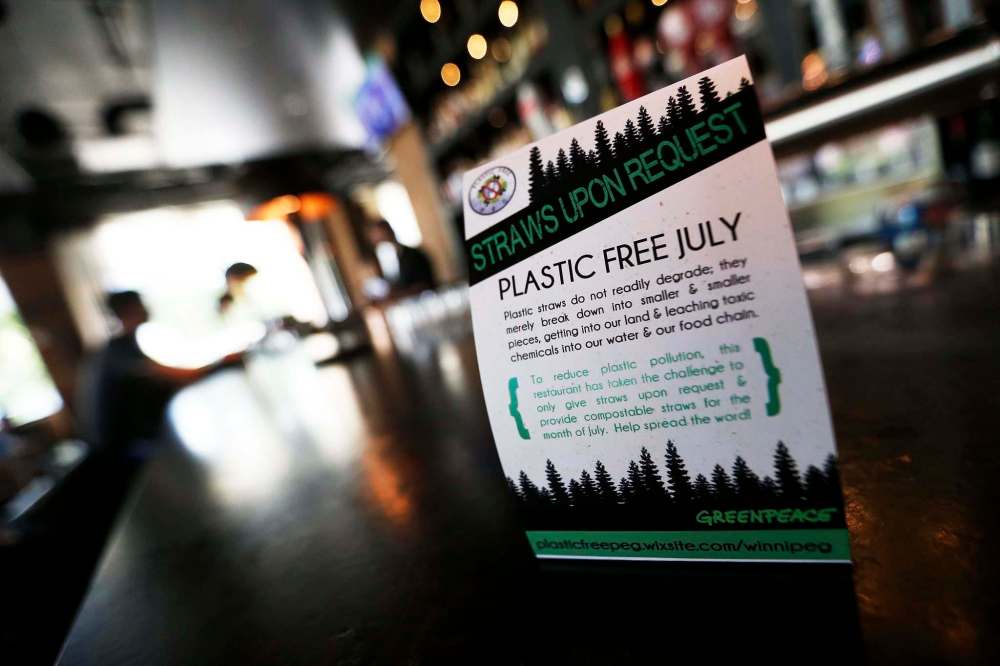
More than 30 city dining establishments recently made a commitment to not give out straws unless patrons ask for them. If diners do ask, they’ll receive a compostable straw.
It’s part of the Plastic Free Peg movement, a local initiative of the global Plastic Free July campaign. Greenpeace Winnipeg members hope the month-long project will bring awareness to an overlooked piece of plastic waste — the drinking straw.
“It seems every day we’re walking, we’re seeing straws on the ground no matter where we’re going,” said Cam Sheppard of Plastic Free Peg.
Even small winds can carry a plastic straw from a garbage or recycling bin to the street, river or field.
Plastic doesn’t compost, but it breaks down slightly and can contaminate land and water. Some of its component chemicals are linked to health problems including cancers, pregnancy complications and brain-development issues, according to an international team of experts.
Animals can also ingest the plastic, which can kill them.
“We are suffocating from the plastic pollution,” said Plastic Free Peg organizer Whitley Schamber, who, along with Melissa Schlichting, food and beverage manager for the Winnipeg Goldeyes, came up with the project’s straw-upon-request idea.
Small, flimsy straws may not seem like a major player in global plastic waste, but conservationists place them among the top five plastic items volunteers clean from beaches.
Plastic Free Peg organizers decided to focus on drinking straws instead of other single-use plastic products because they realized a small change in local businesses’ practices could make a big difference.
“When you think about the number of straws that are in circulation every single day… on a cumulative basis around the world, that’s huge,” said Tracy Hucul, executive director of the Green Action Centre in Winnipeg.
Staff with one participating organization, the Winnipeg Goldeyes, have already seen a difference in the number of straws fans have gone through at Shaw Park just in the early days of July.
“Straw use has gone down exponentially,” Schlichting said.
After talking to servers, she found about 10 to 15 per cent of people asked for a straw. During each game, the organization saved about 450 straws on mixed drinks. Most people didn’t even comment on their absence, she said.
Schlichting called the transition “easy.” However, the team doesn’t operate all ballpark concessions, so some still use plastic straws.
One local restaurant manager said it’s “challenging” to not automatically put a straw in some drinks, so compostable is a nice option.
Melissa Mulder, of Smith restaurant at The Forks, said her eatery used compostable straws before and is now trying out straw-upon-request.
“I haven’t heard any pushback yet,” she said.
The plastic-free movement subverts the notion that to order a drink means to get a straw, but Schamber hopes people won’t be put off by the change.
“If you are one of those individuals who do need a straw, there are many different types of reusable metal and glass straws on the market,” she said.
Schamber and Sheppard, who are married, bring metal straws with them when they go out to eat. (They also brings their own takeout containers.)
“Restaurants have been really receptive to us bringing our own,” Schamber said.
While the straw-upon-request initiative formally ends July 31, organizers hope restaurants will keep it going indefinitely.
The straw-free campaign has opened the couple’s eyes to just how prevalent plastic is in everyday products.
“‘Holy smokes, that’s plastic, that’s got plastic, that’s plastic-wrapped,’” was Sheppard’s reaction during a recent trip to the grocery store.

“We hope the awareness this month of how much plastic is in their daily lives will help them take that extra step to not buying that plastic item,” said Schamber.
About 100,000 marine animals and a million birds die a year from plastic ingestion and entanglement, according to Ocean Crusaders, an online education program. Manitoba’s only connection to the sea is through Hudson Bay in the north, but the province does entertain a vast lake and river system that’s also affected.
Sheppard doesn’t want to see pollution end up there and leach chemicals into drinking water. He also wants Manitoba to pull its weight in environmental conservation.
“Really, we’re all contributing to the pollution of our world and (the) less we can create in terms of pollution, the better this world’s going to be,” he said.
stefanie.lasuik@freepress.mb.ca

Winnipeg Goldeyes Baseball Club, at Shaw Park
Brazen Hall
Saucers Café
Segovia
Bernstein’s Deli
Oakwood Café
Café Ce Soir
Hermanos
Corrientes
Carnaval
Barley Brothers
Prairie 360
Peg Beer Co.
The Mitchell Block
Smith Restaurant
Clementine
Oh Doughnuts
Smitty’s, at 580 Pembina Hwy.
Fusion Grill
Santa Lucia, at 4 St. Mary’s Rd.
Santa Lucia, at 1473 Main St.
Santa Lucia, at 905 Corydon Ave.
Saperavi Restaurant
One Great City Brewing
The Good Will Social Club
Restaurants that had already taken the initiative prior to the campaign to serve straws upon request/provide compostable straws:
All Stella’s locations in Winnipeg
Era Bistro
Bonfire Bistro
Bouchée Boucher
Related Articles
Small acts add up to big change
Advertisement Advertise With Us
Advertisement Advertise With Us