

Construction begins on Reconciliation Way riverside trail
Advertisement
Read this article for free:
or
Already have an account? Log in here »
To continue reading, please subscribe:

Digital Subscription
One year of digital access for only $205*
- Enjoy unlimited reading on winnipegfreepress.com
- Read the E-Edition, our digital replica newspaper
- Access News Break, our award-winning app
- Play interactive puzzles
*First annual payment billed as $205.00 + GST for one year. This annual subscription will automatically renew at $233.00 + GST every 52 weeks (10% off the regular annual price of $259.35). Offer available to new and qualified returning subscribers only. Cancel any time.
To continue reading, please subscribe:
Add Free Press access to your Brandon Sun subscription for only an additional
$1 for the first 4 weeks*
- Enjoy unlimited reading on winnipegfreepress.com
- Read the E-Edition, our digital replica newspaper
- Access News Break, our award-winning app
- Play interactive puzzles
*Your next Brandon Sun subscription payment will increase by $1.00 and you will be charged $17.95 plus GST for four weeks. After four weeks, your payment will increase to $24.95 plus GST every four weeks.
Read unlimited articles for free today:
or
Already have an account? Log in here »
Hey there, time traveller!
This article was published 06/10/2017 (3199 days ago), so information in it may no longer be current.
The original plan for the woods along the Assiniboine River across from The Forks was an “Indian Tourist Village” where tourists could see Indigenous people at work and play.
“The intention was good” in the 1980s by Forks planners but a little insulting, said Niigaan Sinclair, native studies associate professor at the University of Manitoba.
Now construction for the historic space, known as South Point, has finally begun but with a key change: the development is being directed by Indigenous people.
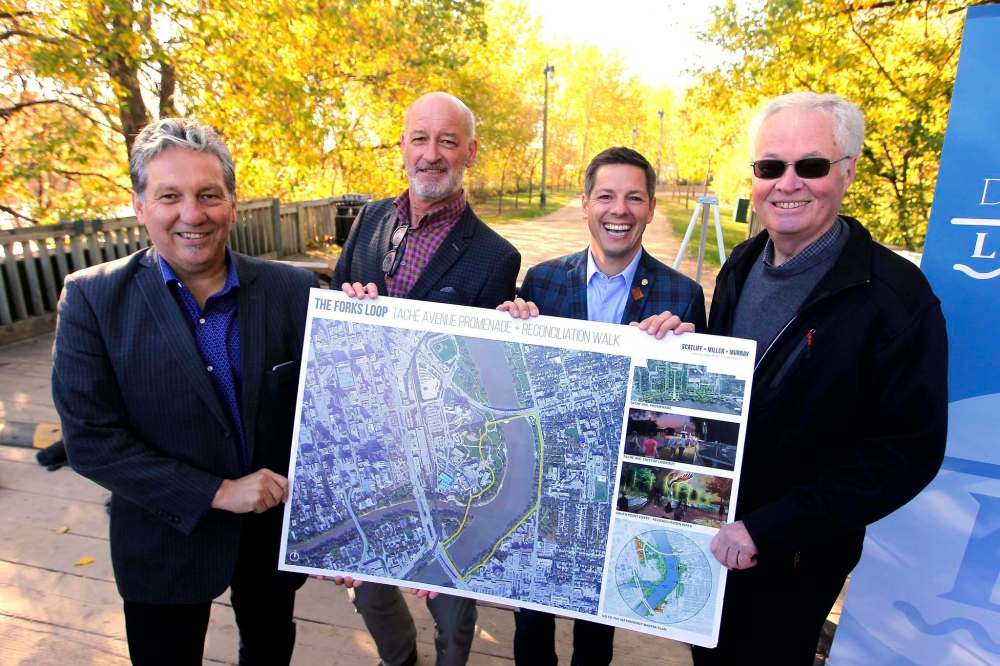
“The Forks has invested us to make an Indigenous experience that the Indigenous community leads,” explained Sinclair.
A news conference at The Forks on Friday kicked off the first phase of construction, which begins next week. It will see an entryway for the new space, most likely an arch, on Main Street at the foot of Queen Elizabeth Way.
“No one even knows this is part of The Forks,” said Sinclair, a project adviser.
A trail in the shape of a serpent will wind its way through the urban park, with improved lighting, connecting to the footbridge that crosses the Assiniboine.
An elders committee has also been struck to come up with an Indigenous name for the space. It’s working title is Reconciliation Trail but it will be changed into something in an Indigenous language.
“There’s already a name for this place. We just don’t know it yet or we’ve forgotten it,” Sinclair said.
The cost of the first phase is $1.2 million, helped by $500,000 from the federal government, $500,000 from the Winnipeg Foundation, and $200,000 from The Forks Renewal Corp.
Paul Jordan, CEO of the Forks Renewal Corp., said the walkway should be completed by this time next year.

Site development will recognize the history of Treaty 1 and other indigenous people who used the site, Sinclair said. That could include interpretive signs or perhaps an app.
“We’ve taken upon ourselves the theme of reconciliation,” Sinclair said.
Plans for future development include an art space, with outdoor galleries like from Urban Shaman and Plug In galleries, Sinclair said. There will also be a ceremonial space for traditional ceremonies with song and dance.
It will be part of the larger 2.5 kilometres Tache Promenade trail. Ottawa has pledged $500,000 to the Promenade Trail.
bill.redekop@freepress.mb.ca