

Deliberate slaughter of Interlake snakes stuns U of M researcher
Advertisement
Read this article for free:
or
Already have an account? Log in here »
To continue reading, please subscribe:

Digital Subscription
One year of digital access for only $205*
- Enjoy unlimited reading on winnipegfreepress.com
- Read the E-Edition, our digital replica newspaper
- Access News Break, our award-winning app
- Play interactive puzzles
*First annual payment billed as $205.00 + GST for one year. This annual subscription will automatically renew at $233.00 + GST every 52 weeks (10% off the regular annual price of $259.35). Offer available to new and qualified returning subscribers only. Cancel any time.
To continue reading, please subscribe:
Add Free Press access to your Brandon Sun subscription for only an additional
$1 for the first 4 weeks*
- Enjoy unlimited reading on winnipegfreepress.com
- Read the E-Edition, our digital replica newspaper
- Access News Break, our award-winning app
- Play interactive puzzles
*Your next Brandon Sun subscription payment will increase by $1.00 and you will be charged $17.95 plus GST for four weeks. After four weeks, your payment will increase to $24.95 plus GST every four weeks.
Read unlimited articles for free today:
or
Already have an account? Log in here »
Hey there, time traveller!
This article was published 06/10/2017 (3292 days ago), so information in it may no longer be current.
When snake researcher Neil Balchan arrived at his Inwood-area research site Thursday morning, he was not prepared for the scene that greeted him — more than 100 garter snakes had been senselessly slaughtered.
“Some had their heads chopped off, others had been clobbered to death…,” said Balchan, 21, a University of Manitoba student who’s doing undergraduate research work on snakes.
“The nature of the injuries were very much human. Some animals were shot. Some cleanly killed, with their heads appearing to be cut off with a knife or scissors.
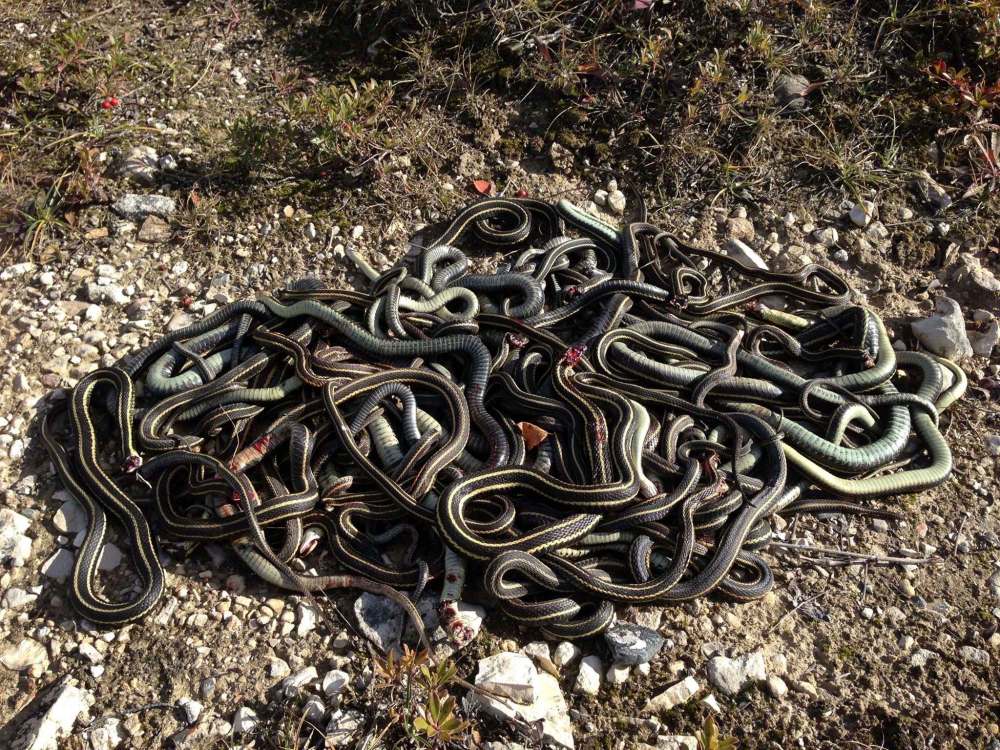
“They were scattered everywhere, hanging from trees, hanging from bushes. It looked like they had essentially been smashed and thrown.”
He estimates whoever came out to the secluded field site — located just north of Inwood and about 15 kilometres south of the province’s famous Narcisse snake pits — did so with the intention of spending their morning killing snakes. Based on the scene he walked into, he guesses the perpetrator left about an hour before he arrived.
Given that it was a cold morning and many of the snakes would have been hiding for warmth, Balchan — who describes himself as a “reptile nut” — believes someone must have spent a great deal of time walking around uncovering the snakes, before cutting off their heads or beating them with rocks.
“You walk in and find one dead snake and you say, ‘OK, something happened here.’ Then you find another one and then it just keeps going. You’re in a den and there’s blood everywhere and there are writhing bodies everywhere,” he said.
“You wonder what goes on in someone’s mind that motivates them, on a Thursday morning, to skip school or work, hike into the bush and kill all these innocent animals. I mean, I don’t understand what would be a motivator or driver for that kind of behaviour. I can’t wrap my head around it.”
Disgusted by what he found, Balchan spent a bit of time gathering up the bodies of dead snakes. He quickly piled up about 50 and took a photo to document it, but estimates there were 50 to 100 more dead snakes scattered around the area.“Some animals were shot. Some cleanly killed, with their heads appearing to be cut off with a knife or scissors. They were scattered everywhere, hanging from trees, hanging from bushes. It looked like they had essentially been smashed and thrown.”
When asked if there was any possible explanation for the death of the snakes other than being deliberately killed by someone, Balchan said in his mind there is “no real alternative” for how these animals met their end.
“I’ve been trying to wrap my head around the cause or reason someone might have to do something like that. I just can’t come up with anything, but in my mind there really is no other explanation for what happened here. Somebody deliberately went out and spent their morning doing that,” Balchan said.
After leaving the site, where he spends three days every week, he says he contacted both his research team and Manitoba Conservation to let them know about what he’d seen. A spokesperson for Manitoba Conservation was reached for comment, but could not immediately speak to the situation.

Although he’s not sure what sort of action can be taken, Balchan hopes with the help of authorities he’ll never again walk onto his field site to find hundreds of dead snakes strewn about.
“There are about 1,000 to 1,500 snakes at that particular den. So, from a biological standpoint this wasn’t a significant amount of mortality,” he said. “These snakes will rebound as they always do. But you kind of question the ethics and morals behind someone going down and killing a large number of animals like that.”
ryan.thorpe@freepress.mb.ca