

Nowhere to go for amputee
Man hit by train frustrated by uncertainty over discharge from hospital
Advertisement
Read this article for free:
or
Already have an account? Log in here »
To continue reading, please subscribe:

Digital Subscription
One year of digital access for only $205*
- Enjoy unlimited reading on winnipegfreepress.com
- Read the E-Edition, our digital replica newspaper
- Access News Break, our award-winning app
- Play interactive puzzles
*First annual payment billed as $205.00 + GST for one year. This annual subscription will automatically renew at $233.00 + GST every 52 weeks (10% off the regular annual price of $259.35). Offer available to new and qualified returning subscribers only. Cancel any time.
To continue reading, please subscribe:
Add Free Press access to your Brandon Sun subscription for only an additional
$1 for the first 4 weeks*
- Enjoy unlimited reading on winnipegfreepress.com
- Read the E-Edition, our digital replica newspaper
- Access News Break, our award-winning app
- Play interactive puzzles
*Your next Brandon Sun subscription payment will increase by $1.00 and you will be charged $17.95 plus GST for four weeks. After four weeks, your payment will increase to $24.95 plus GST every four weeks.
Read unlimited articles for free today:
or
Already have an account? Log in here »
Hey there, time traveller!
This article was published 31/10/2017 (3246 days ago), so information in it may no longer be current.
The immediate future for the Winnipeg man whose legs were amputated after being hit by a train is uncertain, leaving him unsure of where he’ll be living once discharged from hospital.
Elijah Gunner says hospital staff gave him conflicting information over the past week, saying he’ll soon be discharged early despite not having a place to stay.
As of Monday evening, he remains at the Winnipeg Health Sciences Centre, but his family doesn’t know if he’ll be forced to leave today.
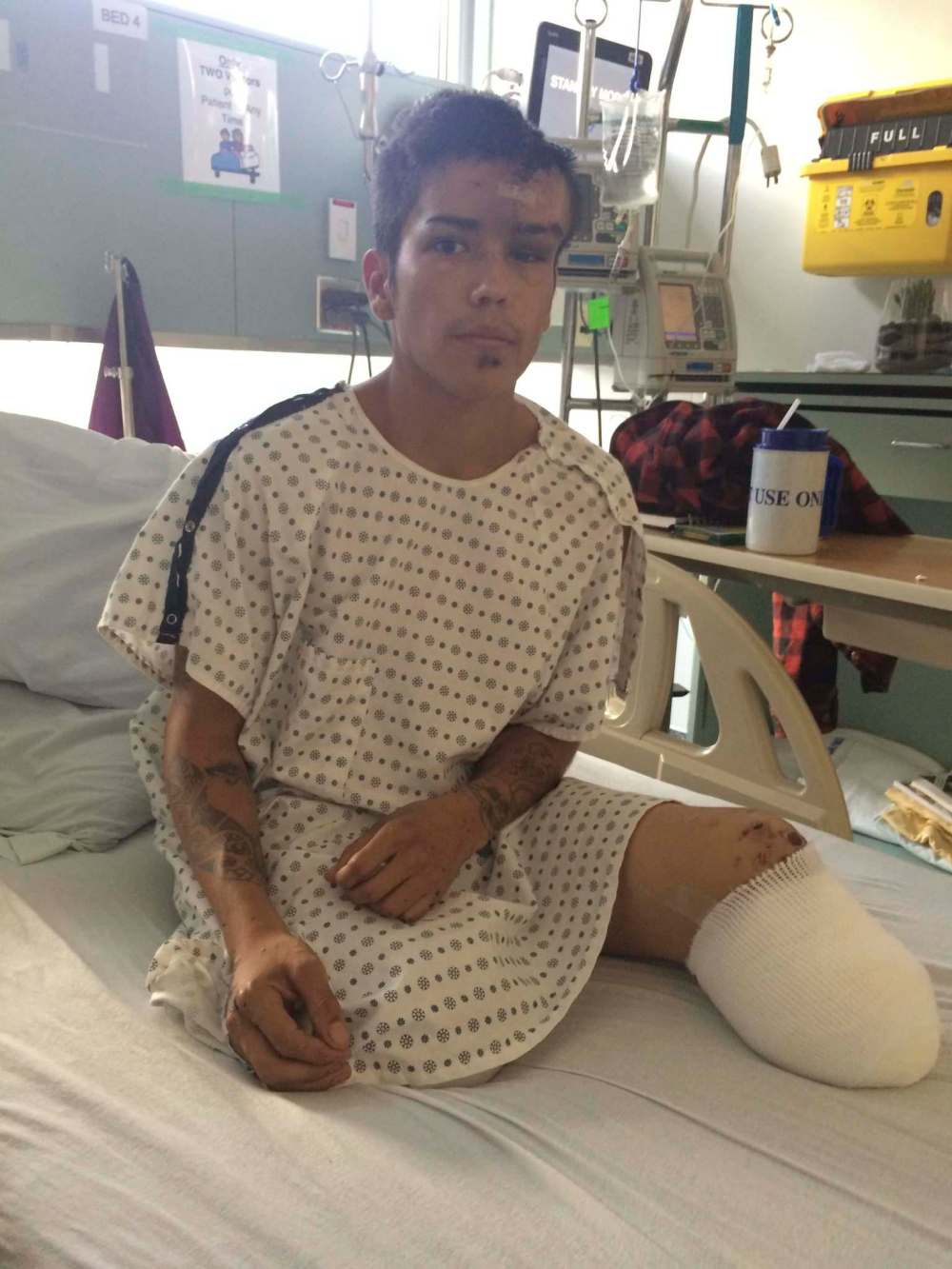
The 20-year-old has been in hospital since Sept. 18, when he was hit by a train near the intersection of Molson Street and Norwich Avenue.
The last thing he remembers is having a few beers with some friends. Then, things go black.
He woke up in a hospital bed. Wanting to leave, he asked an employee where his shoes were. That’s when he was told both his legs had been amputated — one above the knee, one below it.
Following the accident, Gunner’s positive attitude surprised many readers when the Free Press reported his story. He said the loss of his legs would serve as a character-building experience and turning point in his troubled life.
But now Gunner says he needs to focus not on what will happen during his long recovery, but what will happen in the coming days if the hospital discharges him.
“Right now I don’t know what’s next. Everything is up in the air. I have no idea what’s going on. I don’t know if I’m being discharged or not,” Gunner said.
“Throughout my whole recovery I’ve been keeping my head up, remaining calm and positive, but this morning is the first time that’s becoming difficult.”
Uncertainty over discharge, accommodations
That difficulty stems from the fact Gunner feels as if hospital staff have been giving him the runaround over the past week.
Last Tuesday, Gunner says hospital staff told him he’d be given an early discharge that Friday.
By Friday, he was told the discharge had been delayed until Monday. Monday morning, however, staff said there were no plans to discharge him.
A few hours later, a social worker was able to line up a five-day temporary residence for him. Since he’d have a temporary place to stay, he says hospital staff told him they’d be moving forward with the discharge.
Gunner says he tried to explain that after the five days were up, he’d have nowhere to stay and would be in a “pretty bad situation.”
“From Tuesday to Friday I was preparing myself to get ready to leave. On Friday I get told I’m leaving Monday. Then Monday comes and I’m told I’m not being discharged at all,” Gunner said.
“Then an hour later I’m told that I might be discharged but that I’d only have the place for five days. Right now, I don’t know what the hell is going on. I’m tired of preparing for situations that aren’t happening.”
By the evening he was told he’d be allowed to stay the night, but it remains unclear what today will bring.
Not knowing if he’ll soon be discharged, or — if he is — whether or not he’ll have a place to stay, has left Gunner both anxious and frustrated. He also said he gets the impression hospital staff are upset he’s been speaking to reporters about his situation.
A spokeswoman for the Winnipeg Regional Health Authority was reached Monday afternoon, but did not provide a comment on Gunner’s situation by press time.
As a result, it is not clear whether the hospital can choose to discharge Gunner without him having a fixed address or residence lined up.
Intersection dangerous: engineer
Meanwhile, the engineer on the train that hit Gunner last month, David Leroux, reportedly claimed the intersection at Molson Street and Norwich Avenue is notoriously dangerous.
When contacted by the Free Press on Monday, Leroux said he was told by his superiors not to talk to the media further.
But, in an earlier CBC interview, Leroux said: “You’re constantly just tense coming in there because it’s consistently being crossed or people are running there. It’s just a matter of time before it’ll happen again.”
He went on to say that 20 years ago a train he was on hit a woman in the same area.
When contacted for a response to the engineer’s statement, a spokesman for Canadian Pacific Railway declined to comment specifically on the incident or claims that the intersection was unsafe.

“There are too many preventable tragedies each year caused by individuals coming into contact with a train. It is illegal and incredibly dangerous to walk on railway tracks or cross at any location other than a designated crossing,” the spokesman said in a statement.
Between 2015 and 2016, there was a 38 per cent increase in trespassing incidents on railway tracks, resulting in 46 deaths, according to statistics from the Transportation Safety Board of Canada.
While Gunner stresses he takes personal responsibility for his accident, he did add that there are many ways people are able to get to those tracks.
“It’s not particularly safe, since there are a lot of holes in the fence,” he said. “There are plenty of ways people can go across the train tracks where it isn’t an assigned crossing.”
ryan.thorpe.media@mail.com
Related Articles
Double amputee to stay in hospital until social workers find him a home
Advertisement Advertise With Us
Advertisement Advertise With Us
History
Updated on Tuesday, October 31, 2017 12:54 AM CDT: adds photo