

Lake St. Martin flood evacuees finally get to return home
Population has been displaced for six years
Advertisement
Read this article for free:
or
Already have an account? Log in here »
To continue reading, please subscribe:

Digital Subscription
One year of digital access for only $205*
- Enjoy unlimited reading on winnipegfreepress.com
- Read the E-Edition, our digital replica newspaper
- Access News Break, our award-winning app
- Play interactive puzzles
*First annual payment billed as $205.00 + GST for one year. This annual subscription will automatically renew at $233.00 + GST every 52 weeks (10% off the regular annual price of $259.35). Offer available to new and qualified returning subscribers only. Cancel any time.
To continue reading, please subscribe:
Add Free Press access to your Brandon Sun subscription for only an additional
$1 for the first 4 weeks*
- Enjoy unlimited reading on winnipegfreepress.com
- Read the E-Edition, our digital replica newspaper
- Access News Break, our award-winning app
- Play interactive puzzles
*Your next Brandon Sun subscription payment will increase by $1.00 and you will be charged $17.95 plus GST for four weeks. After four weeks, your payment will increase to $24.95 plus GST every four weeks.
Read unlimited articles for free today:
or
Already have an account? Log in here »
Hey there, time traveller!
This article was published 02/11/2017 (3251 days ago), so information in it may no longer be current.
Some flood evacuees from Lake St. Martin displaced for six years got keys to brand-new homes Thursday.
The Ojibway First Nation issued a statement Thursday to celebrate the first 30 families to move in to the houses, situated on new lands.
“Today, the community of Lake St. Martin First Nation will present keys to the homes of the first phase of families moving back to their traditional lands. This will mark the final stages of Operation Return Home,” the statement said.
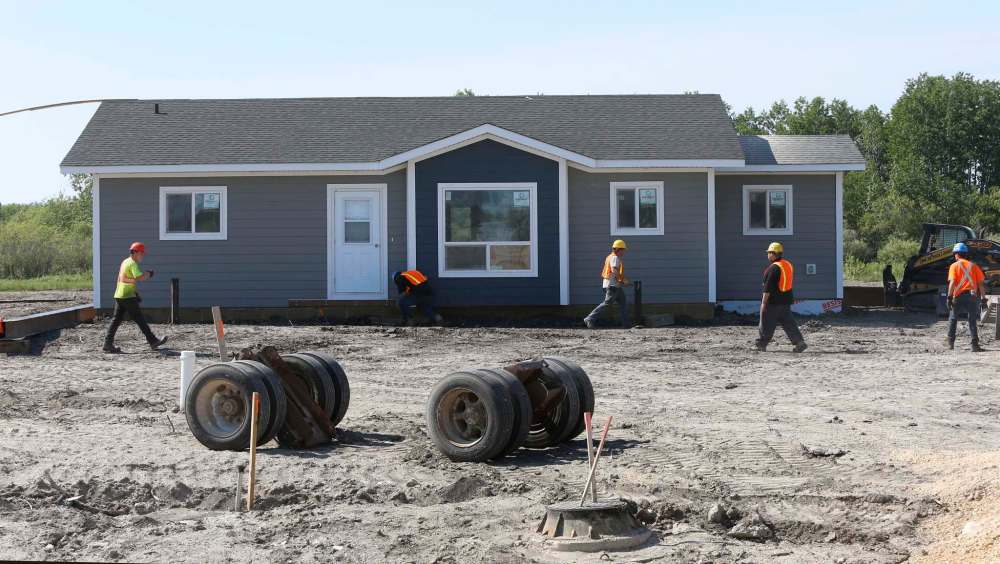
Up to 190 homes are to be ready for occupation by the end of January 2018 in a new community on new lands adjacent to the flooded out reserve land, but on higher ground, the federal governement said in its own statement.
The $49.5 million cost of the housing was shared 50/50 between the province and Ottawa, the federal statement said.
Ottawa paid $19.7 million for a new school and both levels of government shared servicing costs. The development includes water treatment and sewage treatment facilities, including a new lagoon. A new kindergarten-to-grade 12 school is expected to accommodate up to 324 students. Plans call for it to completed by next September.
“This has been a difficult time for First Nations affected by the 2011 flood, and they are determined to rebuild as safer and stronger communities. I am thrilled that members of Lake St. Martin First Nation have started to return home to their newly rebuilt community,” Ottawa’s Minister of Indigenous Services Jane Philpott said in the statement.
The homes were built on former farm lands the province purchased to replace lands lost to flood waters. About 150 homes should be ready for occupancy by the end of November.
It’s been a long road home, with political rancour and lawsuits marking disputes over where the new lands would be located, who and how the homes should be built, and how federal and provincial governments would co-operate on compensation to the community.

Lake St. Martin was not the only Interlake First Nation that saw evacuations and lost traditional lands to the flood waters. It was, however, the worst affected and the only community that was completely gutted and had the entire population evacuated. A few families held out and refused to leave, and they remain there to this day, relying on gas-fuelled generators for electricity and wood stoves for heat.
The Interlake First Nations have always maintained their lands were sacrificed to save Winnipeg when the Assiniboine River flooded in 2011, similar to arguments from other land owners along the shores of Lake Manitoba, which swelled when the province diverted flood waters north.
For nearly six years, federal statistics listed nearly 2,000 people on evacuation lists, most of whom were in Winnipeg, and most of whom were from Lake St. Martin. They were initially lodged in hotels before being moved to subsidized housing.
Leaders have repeatedly called for compassion, informing the public the move came at an enormous social and emotional cost for the former fishing community. The latest tally reported in the media blame about 100 deaths on the displacement; young and old alike who ended up victims of suicide, illness, addiction and crime.
alexandra.paul@freepress.mb.ca