

Polar bear exhibit jewel of zoo, city
Award-winning Journey to Churchill part of conservation effort

Advertisement
Read this article for free:
or
Already have an account? Log in here »
To continue reading, please subscribe:

Digital Subscription
One year of digital access for only $205*
- Enjoy unlimited reading on winnipegfreepress.com
- Read the E-Edition, our digital replica newspaper
- Access News Break, our award-winning app
- Play interactive puzzles
*First annual payment billed as $205.00 + GST for one year. This annual subscription will automatically renew at $233.00 + GST every 52 weeks (10% off the regular annual price of $259.35). Offer available to new and qualified returning subscribers only. Cancel any time.
To continue reading, please subscribe:
Add Free Press access to your Brandon Sun subscription for only an additional
$1 for the first 4 weeks*
- Enjoy unlimited reading on winnipegfreepress.com
- Read the E-Edition, our digital replica newspaper
- Access News Break, our award-winning app
- Play interactive puzzles
*Your next Brandon Sun subscription payment will increase by $1.00 and you will be charged $17.95 plus GST for four weeks. After four weeks, your payment will increase to $24.95 plus GST every four weeks.
Read unlimited articles for free today:
or
Already have an account? Log in here »
Hey there, time traveller!
This article was published 26/12/2017 (3196 days ago), so information in it may no longer be current.
‘That polar bear is the same age as you!”
A mother is pointing to the majestic white beast — either Nanuq or Siku, it’s hard to tell — who just swam past her two-year-old. The toddler is transfixed.
They are standing in the sun-dappled Sea Ice Passage in Assiniboine Park Zoo’s Journey to Churchill exhibit, a place where polar bears can swim directly over your head.
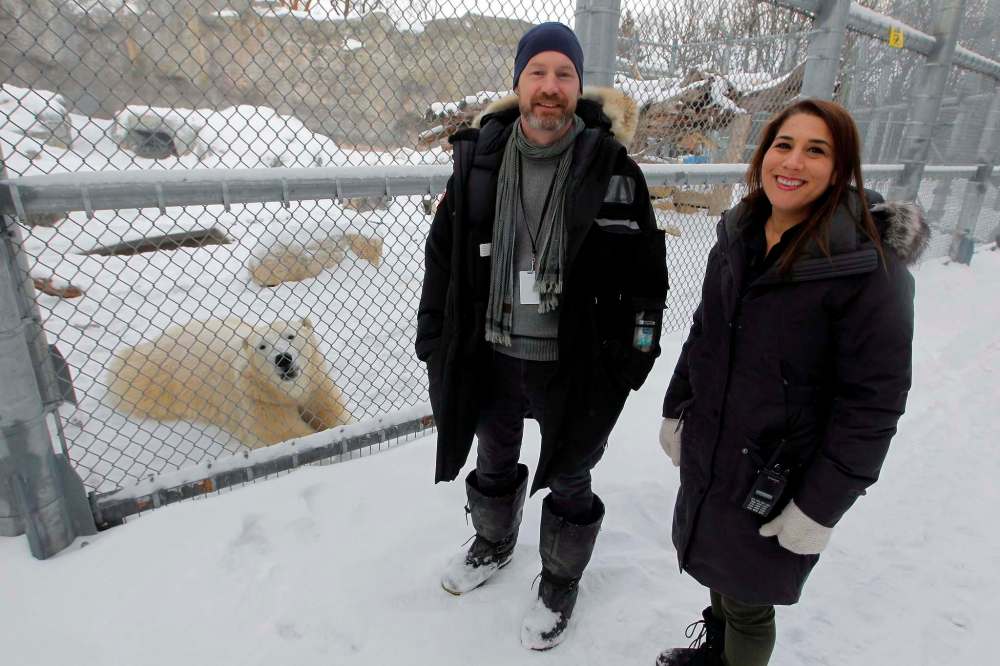
It’s the kind of must-see attraction one might expect to find in a bigger zoo, in a bigger city.
But an exhibit such as Journey to Churchill could really only exist in Manitoba. When the Assiniboine Park Conservancy started looking at ways it could rejuvenate its aging zoo in 2008, it decided to seize the opportunities a northern zoo in a winter city could provide.
Instead of focusing on exotic species, why not focus on the species that exist here in our province?
Since opening in 2014, the $90-million, award-winning Arctic species exhibit has become not only the jewel of the zoo, but also of Winnipeg.
It’s a destination tourist attraction, pulling in hundreds of thousands of visitors every year, and a source of civic pride. The polar bears are, undoubtedly, the biggest draw. But the polar bears at the zoo don’t just come here to be admired. Journey to Churchill is also the site of important conservation work and research.
Opened in 2012, the Leatherdale International Polar Bear Conservation Centre is the raison d’etre for the exhibit, which aims to educate visitors about a variety of northern species — which, in addition to polar bears, includes harbour seals, muskox, arctic foxes, snowy owls, caribou and wolves — as well as the greatest threat to their survival: climate change. Most of the polar bears that populate Journey to Churchill are rescued bears from northern Manitoba. Bears, who come to the zoo, only do so under specific circumstances as outlined by Manitoba’s Polar Bear Protection Act.
They must either be orphaned cubs who will not survive on their own, or at-risk bears who would otherwise be euthanized. Having bears on-site allows researchers and scientists to develop field study techniques to better understand the bears themselves, and study the effects of climate change.
“All these glimmers of information and things that we can gather can hopefully help us to better understand and care for polar bears in the wild,” says Allison Ginsburg, curator of animal care (large carnivores).
That’s not the only way captive polar bears may benefit their wild counterparts. They also serve as what’s known as ambassador animals.
The idea is people will fall in love with the polar bears and the Arctic, and be inspired to take action and make changes in their own lives in order to conserve the animals’ natural habitats. After all, a polar bear can’t remain in — or return to — a wild that no longer exists.
Earlier this month, two 11-month-old polar bear cubs arrived in Winnipeg, bringing the number of polar bears at the zoo to 11.
Not everyone is happy about that. Churchill Mayor Mike Spence has been among the most vocal in his criticism of the practice of sending orphaned cubs south, and believes more should be done to keep those bears in the wild.
“We’ve definitely heard that sentiment from people in Churchill over the years,” says Stephen Petersen, the head of conservation and research at the zoo.
“Some people just don’t think bears should go into facilities at all and would rather see them euthanized — which is definitely a way of looking at it, though not one we necessarily agree with. We also want every chance for a bear to be in the wild, rather than coming into captivity. But these cubs aren’t going to survive.”
The earliest most polar bear cubs are weaned is 16 months old, Petersen explains, and it’s their mothers who teach them how to hunt.
Orphaned cubs that do not possess hunting skills will usually starve to death. Cubs that survive usually weigh between 250 and 270 pounds.
If they’re smaller than that, they easily become prey for wolves and other bears.
Feeding, then releasing bears back into the wild poses serious risks to the bears and humans.
“We’d have to double or more the weight of a cub, pretend they have some skills and could hunt, which we don’t think they can,” Petersen says.
“You can feed up an animal that fast, but how do you do that without it becoming habituated to people. Right now, we don’t have the information to actually do that successfully.”
Petersen says the number of orphaned cubs in the North appears to be on the rise, but it’s difficult to pin down a number. What he does know is there are orphaned cubs they never find.
“We really know so little about what the true number of orphans is, or why cubs become orphaned,” he says. “It could be other bears, it could be wolves, mom could die, mom could abandon — although we know it’s usually pretty difficult to separate mom from her cubs. There’s a lot we don’t know. Rather than focus on rehabilitating bears and releasing them, we should put some upfront research into how they become orphans and try to prevent that from occurring.”
When a cub is spotted and identified for potential rescue, the zoo works closely with Sustainable Development and Manitoba Conservation officers in Churchill.
“They usually try to give every chance they can for an orphan to reunite with its mom. In some cases, that means keeping an eye on it for a couple days, but there’s a risk of it getting into trouble if it’s near town, or getting killed if there’s other bears around.”
If it’s determined a bear is a candidate for rescue, the zoo wastes no time arranging its safe transport.
“It’s a fast process — usually within 24 to 48 hours we mobilize and get up there,” Ginsburg says.
“Being that we’re on our 10th and 11th rescued cub, we have a great deal of experience now, but it’s still a learning process. Every situation is different.”
When new cubs arrive in Winnipeg, Ginsburg and her team must first assess where they are at in their diets (polar bears at the zoo are fed fish as well as high-protein polar bear chow). Cubs undergo a 30-day quarantine period to make sure they don’t have any parasites or other issues that need medical attention.
The idea, Ginsburg says, is not to overwhelm them with too much, too soon. There’s lots to get used to: feeding, noises, people.
Bears who eventually move over to Journey to Churchill from the polar bear conservation centre follow a detailed integration plan. “It’s not, ‘Let’s introduce you to five adult bears, good luck,’” Ginsburg says. Nanuq and Siku, who arrived in late 2016, made a successful transition to the exhibit two weeks ago.
While there are happy stories about rescued cubs thriving in their new home in Winnipeg, there has also been tragedy at Journey to Churchill.
In July, Eli, a nearly three-year-old polar bear, died after internal swelling of the tissues in his throat and neck interfered with his breathing.
Eli and his brother York came to the zoo in 2015 after their mother was killed by a cracker shell that exploded too close to her.
For the keepers who worked with Eli every day, his loss hurt.
“These animals become part of our extended family,” Ginsburg says. “I’ve been in this field for 21 years, and I always tell people, who want to get into it, that it’s not a 9 to 5 job. You’re here when these animals need you. It is a lifestyle, not a job. We develop very strong relationships with them, which is vital for their care — they depend on us. But it makes it devastating when you lose them.”

Winnipeggers also get attached to these bears. We help name them. We visit them. We watch them grow up.
The challenge now, Petersen and Ginsburg agree, is translating that connection into action, and to continue to figure out ways to land the exhibit’s conservation and climate change messages.
“(The polar bears) are here, most likely, because of human impact in their environment,” Ginsburg says. “And so, we have an obligation to these animals and the visitors who come to visit these animals to address that, and to have them experience these animals and learn from these animals.
There’s nothing like coming face to face with one of these bears.”
jen.zoratti@freepress.mb.caTwitter: @JenZoratti
Jen Zoratti is a columnist and feature writer working in the Arts & Life department, as well as the author of the weekly newsletter NEXT. A National Newspaper Award finalist for arts and entertainment writing, Jen is a graduate of the Creative Communications program at RRC Polytech and was a music writer before joining the Free Press in 2013. Read more about Jen.
Every piece of reporting Jen produces is reviewed by an editing team before it is posted online or published in print – part of the Free Press‘s tradition, since 1872, of producing reliable independent journalism. Read more about Free Press’s history and mandate, and learn how our newsroom operates.
Our newsroom depends on a growing audience of readers to power our journalism. If you are not a paid reader, please consider becoming a subscriber.
Our newsroom depends on its audience of readers to power our journalism. Thank you for your support.
Jen Zoratti is a columnist and feature writer working in the Arts & Life department, as well as the author of the weekly newsletter NEXT. A National Newspaper Award finalist for arts and entertainment writing, Jen is a graduate of the Creative Communications program at RRC Polytech and was a music writer before joining the Free Press in 2013. Read more about Jen.
Every piece of reporting Jen produces is reviewed by an editing team before it is posted online or published in print – part of the Free Press‘s tradition, since 1872, of producing reliable independent journalism. Read more about Free Press’s history and mandate, and learn how our newsroom operates.
Our newsroom depends on a growing audience of readers to power our journalism. If you are not a paid reader, please consider becoming a subscriber.
Our newsroom depends on its audience of readers to power our journalism. Thank you for your support.
Advertisement Advertise With Us
Advertisement Advertise With Us