

New Scotties format a flop
Curlers vocal in their condemnation of pool play

Advertisement
Read this article for free:
or
Already have an account? Log in here »
To continue reading, please subscribe:

Digital Subscription
One year of digital access for only $205*
- Enjoy unlimited reading on winnipegfreepress.com
- Read the E-Edition, our digital replica newspaper
- Access News Break, our award-winning app
- Play interactive puzzles
*First annual payment billed as $205.00 + GST for one year. This annual subscription will automatically renew at $233.00 + GST every 52 weeks (10% off the regular annual price of $259.35). Offer available to new and qualified returning subscribers only. Cancel any time.
To continue reading, please subscribe:
Add Free Press access to your Brandon Sun subscription for only an additional
$1 for the first 4 weeks*
- Enjoy unlimited reading on winnipegfreepress.com
- Read the E-Edition, our digital replica newspaper
- Access News Break, our award-winning app
- Play interactive puzzles
*Your next Brandon Sun subscription payment will increase by $1.00 and you will be charged $17.95 plus GST for four weeks. After four weeks, your payment will increase to $24.95 plus GST every four weeks.
Read unlimited articles for free today:
or
Already have an account? Log in here »
Hey there, time traveller!
This article was published 02/02/2018 (3150 days ago), so information in it may no longer be current.
PENTICTON, B.C. — Before we can talk about change, we must first talk about love: they complicate each other.
So indulge me in a reflection on my love for the Canadian women’s curling championship, and how it has shaped me.
This is my fifth time covering a Scotties Tournment of Hearts. That is not yet so many that they run together in memory, as more veteran scribes sometimes find. Each one is crisply outlined in my recollection, as vibrant and clear as when they happened.
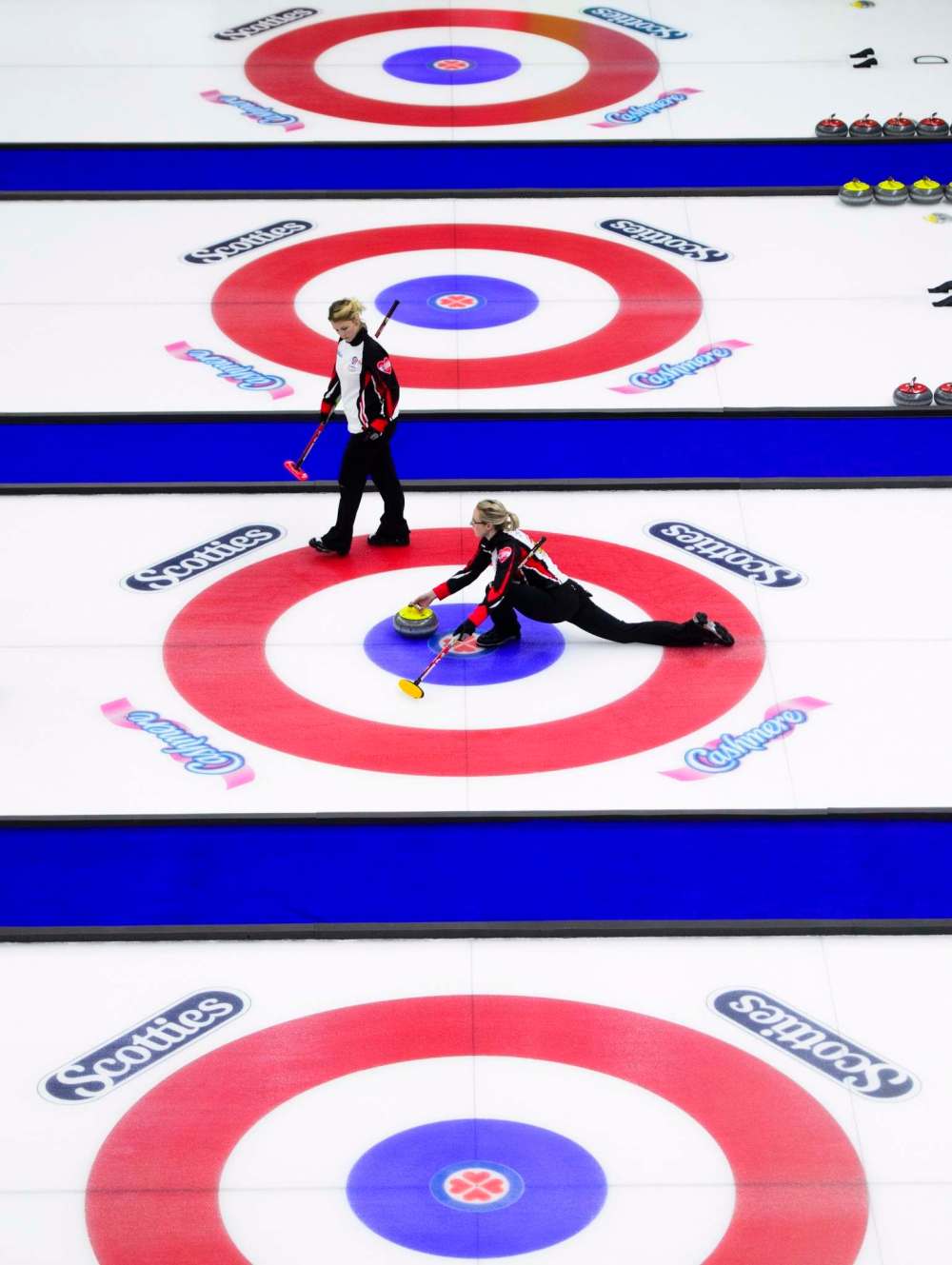
There was Moose Jaw 2015, when Jennifer Jones rose triumphant and Saskatchewan fans splayed out a sea of green. There was St. Catharine’s, Ont. last year, warmed by the sun and buoyed by Michelle Englot’s magic run.
And there was 2014 Montreal, moored in a faded (and often empty) 1962 arena, memorable only for being my first.
If that is where I fell in love with covering the Scotties, then every city since has grown that emotion. It is a love that is annually renewed on the first day of every round robin, a love that swells in pace with the week’s growing momentum.
Until now. Until here. Which brings us to change, and the format I cannot even like, let alone love.
This was always going to be a difficult Scotties. The Olympic machine is revving its engine, guzzling up media attention. The time zone, the schedule, and the fact the final goes up against Super Bowl Sunday don’t help.
Those things would explain why the overall buzz is muted. They do not explain why much of the week at South Okanagan Events Centre often felt so confusing, marred by inconsistent pacing and underwhelming draws.
For that, all credit goes to the new format — and now that it’s done, it’s time to give it a closer examination.
This year’s format, which will also be used at the Brier, grew the field to 16 teams (up from 12) and split them into two pools of eight. The top four from each pool advanced to the new “championship round” to battle for four playoff spots.
In making the change, Curling Canada aimed to solve the complaints of some member associations. The format axed relegation and guaranteed smaller regions, such as Nunavut or Yukon, at least seven games on the draw.
But it came at a cost, and for me, it was a love gone missing. This never really felt like a Scotties to me.
Not just me, either.
On Thursday, a reporter asked Manitoba’s Jones if she liked the format: “No I don’t, not at all,” she said swiftly.
Why not? There are “too many things to list,” she replied, and then she promptly proceeded to list them: the pools, some awkward seeding, the way the pre-playoff momentum was so heavily weighted on the last two days of play.
“I think they’ve got to go back to the drawing board and fix it,” Jones said earlier in the week. “It’s not going to work this way. It loses the excitement early, and it just doesn’t have that same kind of vibe.”
Jones is perhaps the most vocal critic among the curlers. (Outspokenness is, perhaps, one of the perks of being in her position.)
But nearly every player the Free Press spoke to shared at least some of her concerns and thoughts.
Most said they wished they’d played every team. Northwest Territories third Sarah Koltun, who skipped past Yukon teams in relegation as well as the 2014 full draw, thought it felt as if there were two separate tournaments going on.
Veteran Saskatchewan skip Sherry Anderson was frank in her assessment: the pool play dented the vibe.
“It was really different this year than all the other Scotties I’ve been to,” Anderson said Friday morning. “We didn’t even see half the teams, let alone play them. You’re on an opposite draw, you’re on a (different) floor in the hotel.”
This isn’t just a social problem. The format is more inclusive of lower-ranked teams but penalizes others, especially those on the bubble.
Effectively, the price of ensuring some regions get more experience is that others get less.
Because to advance to the championship round, and contend for playoffs at all, you have to be sharp early on. That is complicated by the fact that pools can never be perfectly balanced — and this year, they were very far from even.
“Right away, you lose your first game, and in our pool we could only afford one more loss,” Anderson said.
“In the past, not that you wanted to lose a couple early, but you stayed in it. It’s a long week. You kept plugging away.
“With this format, you have a loss or two early and you’re fighting for your life.”
Nobody was more caught by that trap, to more disappointing effect, than New Brunswick’s Sylvie Robichaud.
Despite being stuck in a pool of death with Jones, Kerri Einarson, Nova Scotia’s Mary-Anne Arsenault and Northern Ontario’s Tracy Fleury — all four potential playoff teams, pending Friday’s results — Robichaud achieved a 4-3 record.
Had she done the same, but in the other pool, Robichaud would have had either a tiebreaker or a pass to the next round. Instead, she was left out entirely, forced to finish her week with one last seeding game over Newfoundland.
“It’s a little hard, obviously we would have liked to play everybody,” Robichaud said. “Overall, I think a lot of teams would prefer to play everybody. But that’s how CCA has decided it this year, so we’ll just follow the flow.”
If the argument is that Nunavut or Yukon will benefit from seven Scotties games, it could be argued that someone like Robichaud or young Quebec skip Emilia Gagne would’ve benefited even more from the traditional 11 full matches.
Meanwhile, the conceptual division between the round robin and the championship round made tracking the action difficult. It was cumbersome to explain, and media struggled to find storyline threads, especially earlier in the week.
For me, the first four days felt like a purgatory. The games did matter, since advancing teams carried their records forward (an issue in itself, as they faced different opponents), but it was hard to see how the field was taking shape.
Some attempts to follow the action were awkwardly anticlimactic. Consider how TSN had to hype a tiebreaker between Newfoundland’s Stacie Curtis and Ontario’s Hollie Duncan for their pool’s final championship berth.
Duncan won, advancing to the next round, but was eliminated from playoff contention later the same day.
The early days also struggled with being too repetitive. Viewers widely complained that there was too much of Jen Jones on their TVs, but having the same teams on the ice every second draw limited the meaningful game options.
While it started slow, all the intensity kicked in at once, making for a frantic championship round.
In theory, it should have been fun to have four draws with playoff ramifications on each sheet. In practice, it diffused the excitement and focus that would usually have been visited on each. There was just too much happening at once.
That imbalanced schedule hampered the steady build of momentum. Usually, by the penultimate day of the round robin, you can circle a few games — helpfully happening at different times — and know what each have on the line.
For a journalist, that’s when the magic happens. Under this format, the magic was too diluted to feel the same.
To be clear, writers and TV producers are not the important ones, here. But our only job or skill is to follow the threads of a tournament’s stories — so what does it say, that many of us struggled to find threads and hold on?
Finally, a lot of sharp words have been said about the Nunavut’s inclusion here; there ought to be some more understanding of their position. Earlier this week, Team Canada skip Englot shrugged when asked about their presence.
“I think people should chill out,” she said, with a big smile.
Agreed. Some of the words lobbed this week have been needlessly critical. Nunavut curlers are in a difficult position; but the North is an equal part of Canada, and the region’s desire to be included equally here is understandable.
It’s just not clear that the two-pool format is the best way to do that, for them and other curlers.
Frankly, I sympathize with Curling Canada. The organization is caught in an impossible position, in a sport that has no semblance of competitive balance between regions, and one where amateurs and elites have yet to fully diverge.

In a way, that, too, is part of what I love about the sport: it has not yet outgrown its grassroots. Besides, even Olympic champions sometimes lose their handle on the ice, and crash against a decent club team. Shockers do happen.
Perhaps there is some way to bring all of the sport’s competing needs together; a way to get all regions at nationals, and more of Canada’s best teams at nationals, and keep the field both balanced and manageable.
For now, I’m with Jones: after this year, Curling Canada should head back to the drawing board.
The new format has admirable aims, and the old one had definite problems. But the solutions implemented this year did not truly make the Scotties Tournament of Hearts better — though perhaps, they can light the way forward.
melissa.martin@freepress.mb.ca
Melissa Martin
Reporter-at-large
Melissa Martin reports and opines for the Winnipeg Free Press.
Every piece of reporting Melissa produces is reviewed by an editing team before it is posted online or published in print — part of the Free Press‘s tradition, since 1872, of producing reliable independent journalism. Read more about Free Press’s history and mandate, and learn how our newsroom operates.
Our newsroom depends on a growing audience of readers to power our journalism. If you are not a paid reader, please consider becoming a subscriber.
Our newsroom depends on its audience of readers to power our journalism. Thank you for your support.
Melissa Martin
Reporter-at-large
Melissa Martin reports and opines for the Winnipeg Free Press.
Every piece of reporting Melissa produces is reviewed by an editing team before it is posted online or published in print — part of the Free Press‘s tradition, since 1872, of producing reliable independent journalism. Read more about Free Press’s history and mandate, and learn how our newsroom operates.
Our newsroom depends on a growing audience of readers to power our journalism. If you are not a paid reader, please consider becoming a subscriber.
Our newsroom depends on its audience of readers to power our journalism. Thank you for your support.
Related Articles
Mixed doubles curling was preposterous -- until it suddenly wasn't





Advertisement Advertise With Us
Advertisement Advertise With Us