

Reports of brown water in city taps decreasing
New coagulant being tested to prevent another outbreak
Advertisement
Read this article for free:
or
Already have an account? Log in here »
To continue reading, please subscribe:

Digital Subscription
One year of digital access for only $205*
- Enjoy unlimited reading on winnipegfreepress.com
- Read the E-Edition, our digital replica newspaper
- Access News Break, our award-winning app
- Play interactive puzzles
*First annual payment billed as $205.00 + GST for one year. This annual subscription will automatically renew at $233.00 + GST every 52 weeks (10% off the regular annual price of $259.35). Offer available to new and qualified returning subscribers only. Cancel any time.
To continue reading, please subscribe:
Add Free Press access to your Brandon Sun subscription for only an additional
$1 for the first 4 weeks*
- Enjoy unlimited reading on winnipegfreepress.com
- Read the E-Edition, our digital replica newspaper
- Access News Break, our award-winning app
- Play interactive puzzles
*Your next Brandon Sun subscription payment will increase by $1.00 and you will be charged $17.95 plus GST for four weeks. After four weeks, your payment will increase to $24.95 plus GST every four weeks.
Read unlimited articles for free today:
or
Already have an account? Log in here »
Hey there, time traveller!
This article was published 03/05/2018 (3034 days ago), so information in it may no longer be current.
Instances of brown water coming out of Winnipeg taps will likely be with us forever, but a city official said a recurrence of the outbreak that happened in 2013 should not be repeated.
The city is progressing with its plan to eliminate incidents of discoloured water outbreaks that shocked residents in 2013, but there will continue to be isolated occurrences during water main breaks, Tim Shanks, manager of water services, told reporters Thursday.
There were fewer reported incidents of discoloured water in the months of February, March and April compared to the same period two years ago, he said, adding that’s an indication the city’s efforts are having an impact.
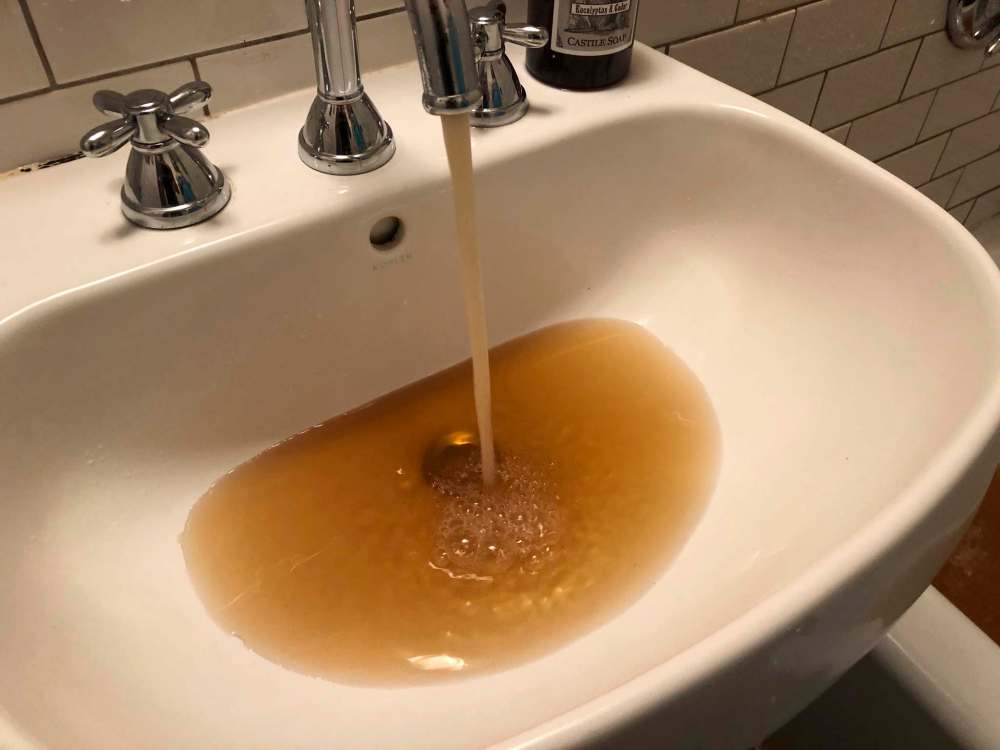
“But we’re still not where we want to be. We’re still getting calls. We’re still susceptible to discoloured water calls when there is a change in flow in the system,” Shanks said. “The problem we’re trying to solve here is the heightened sensitivity in the system to smaller flow changes — valve operations, hydrant use — where it tints the water and the discolouration can last for a few hours in some cases.
“If you have a major event on your street, you’re still going to see discoloured water, we won’t be able to do anything on that.”
Historically, incidents of discoloured water was never a common problem in Winnipeg homes but, ironically, the situation started to deteriorate after the city built a new water treatment plant in 2009.
The number of reports took a dramatic jump in the summer of 2013; instead of the typical 100 reports a month, August 2013 saw more than 1,500 reports and a total of 5,182 for the year. There were 2,613 reports for all of 2012.
The 2013 situation prompted a review of the city’s water system to determine the cause and develop a plan to resolve the issue.
The discoloured water was found to be manganese, a harmless component of the coagulant added to the city’s water supply. A coagulant binds smaller solids together and makes it easier to clean the water. The manganese was attaching to the inside of water mains, but would peel off in chunks with a change in water flow and randomly flow into household water lines.
City and health officials have repeatedly said the putrid-looking brown water is safe to drink, but advised residents not to drink or bathe in it or use it for cooking or laundry.
One of the solutions was to fast track the flushing program for the city’s water lines, which minimizes the build-up of manganese.
The other solution was to find a replacement coagulant. As part of the review following the incidents in 2013, a pilot plant was built to test and find a replacement coagulant.
Shanks said the city has been piloting the replacement coagulant for the past year and expects to have it fully incorporated into the water system before the end of the year.
Residents should notice a marked decline in the number and duration of discoloured water incidents by the summer of 2019, he said.
Coun. Brian Mayes, chairman of council’s environment committee, said he’s been pleased with the progress city staff have been making on the problem.
“If my ward is typical, I get fewer complaints each year,” Mayes said. “That said, I still get complaints. Often it’s the same houses, so we have certain structural issues. We are trying to address the problem.”

It has taken time to switch coagulants because the city has been testing the impact the new coagulant is having on the water lines and the water, and determining the appropriate doses, Shanks said.
“It’s taking time to look how (the new coagulant) will affect other processes at the (treatment) plant and water chemistry, in terms of corrosion,” Shanks said, adding he’s not anticipating any problems once the switch goes into effect.
aldo.santin@freepress.mb.ca