

Opening up about depression
Becoming mental-health advocate a slam dunk for pro basketball player
Advertisement
Read this article for free:
or
Already have an account? Log in here »
To continue reading, please subscribe:

Digital Subscription
One year of digital access for only $205*
- Enjoy unlimited reading on winnipegfreepress.com
- Read the E-Edition, our digital replica newspaper
- Access News Break, our award-winning app
- Play interactive puzzles
*First annual payment billed as $205.00 + GST for one year. This annual subscription will automatically renew at $233.00 + GST every 52 weeks (10% off the regular annual price of $259.35). Offer available to new and qualified returning subscribers only. Cancel any time.
To continue reading, please subscribe:
Add Free Press access to your Brandon Sun subscription for only an additional
$1 for the first 4 weeks*
- Enjoy unlimited reading on winnipegfreepress.com
- Read the E-Edition, our digital replica newspaper
- Access News Break, our award-winning app
- Play interactive puzzles
*Your next Brandon Sun subscription payment will increase by $1.00 and you will be charged $17.95 plus GST for four weeks. After four weeks, your payment will increase to $24.95 plus GST every four weeks.
Read unlimited articles for free today:
or
Already have an account? Log in here »
Hey there, time traveller!
This article was published 24/01/2019 (2785 days ago), so information in it may no longer be current.
Eighteen months ago, Emily Potter was the confident, well-spoken star of the basketball court with a secret.
The brief bouts of depression that had plagued her earlier in her career at the University of Utah had become more pronounced.
She was hardly sleeping — maybe three or four hours a night — and going to practice before returning home to lie in bed. Between basketball practice and team weight-lifting sessions, she would go outside to cry alone.
Life had become a struggle during her senior season in college for reasons she didn’t fully understand.
But she hid it well, her private torment known only to a handful of close confidantes. By February, however, she decided to go public, writing an intensely personal account of her battle with mental illness for her school newspaper, The Daily Utah Chronicle. In her essay, Potter admitted she took medication and required counselling.
Her life had been laid bare, partly by coincidence. She was already moonlighting as a sports writer at the Chronicle when opportunity knocked.
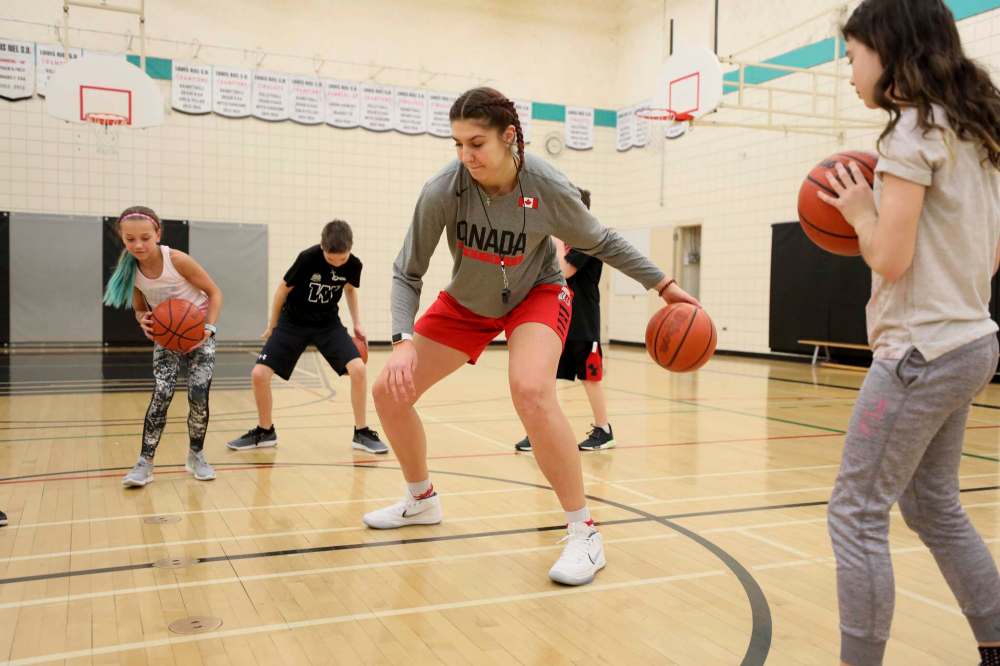
“I kinda took a jump myself,” said Potter Thursday afternoon during a break in a Basketball Manitoba-sponsored visit to Samuel Burland School in south Winnipeg, a K-to-8 facility she attended as a child. “I wrote for the school newspaper and that’s where it was originally published.
“The theme of our paper was mental health and my editor was like, ‘We’d love for you to write a piece from your perspective on mental health as an athlete.’ (I thought), I could write something and it would be fine but it would be so phoney, with everything I was going through myself. I thought this was a perfect opportunity, I have to do something with this.”
The response, from friends, family and strangers alike, was astonishingly supportive.
“I still think I’ve done a lot in basketball but I’m probably the most proud of being able to do that and make an impact that way,” said Potter, a 23-year-old who once led Glenlawn Collegiate’s varsity girls team to a pair of provincial finals, winning in 2012. “I told myself, ‘If it helps one person, that’s enough for me,’ because I lost a friend to suicide. That one death causes so much (upset) around you, for so many people. So if I can help one person, it would help all the people around.”
Potter admits she was taken aback by the power of her message.
“Yeah, I was pretty surprised,” she said. “I mean, a weight was lifted off my chest at the same time. It was like, ‘OK, I did it, it’s over’ but at the same time it was, ‘Now everybody knows everything about me.’ I felt a little exposed…
“The best response I personally got was somebody who messaged me on social media and said, ‘You were inside my head. You took the words right out of my mouth.’ It’s not something that just one person goes through. Why don’t we talk about it?”
“Some of my family and friends were like, ‘Why didn’t you tell me that?’ I’m sorry, I didn’t tell anyone. I didn’t want to admit it to myself.”
By choice, Potter has become a public advocate for destigmatizing mental illness but she is also a role model, especially for girls and young women. The 6-foot-6 forward, who finished her Utah career as the first woman in school history to score at least 1,500 points, grab at least 900 rebounds and block more than 200 shots, commands respect whenever she walks into a room.
Potter takes her status as a role model seriously.
“It is important to me,” she said. “Sometimes I don’t think I have the influence that I do, that I’m a regular person and just a basketball player… I do hope to inspire some kids to believe in themselves that otherwise wouldn’t.”
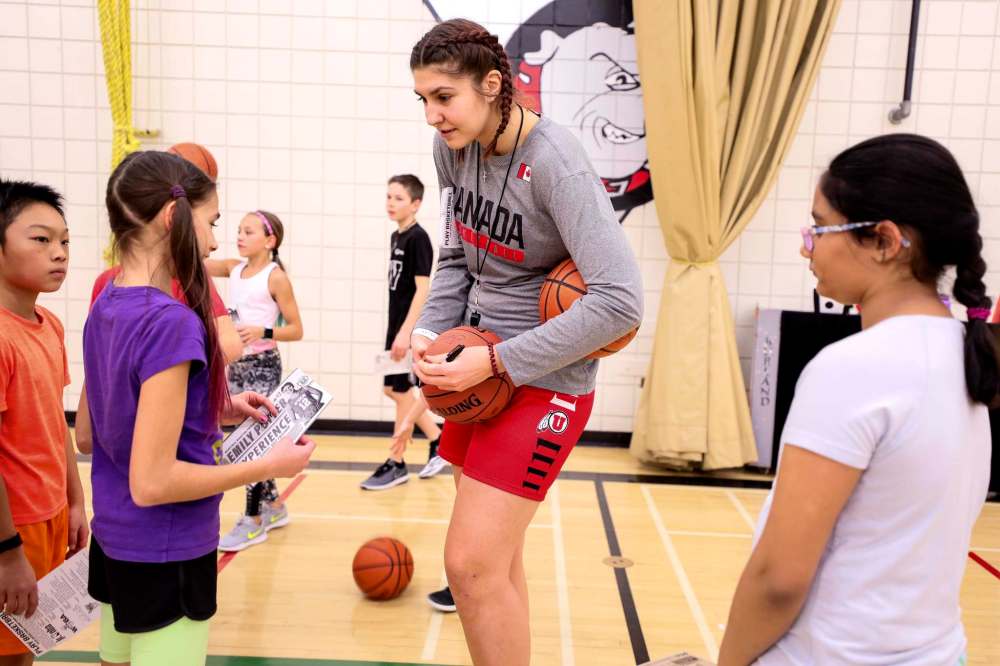
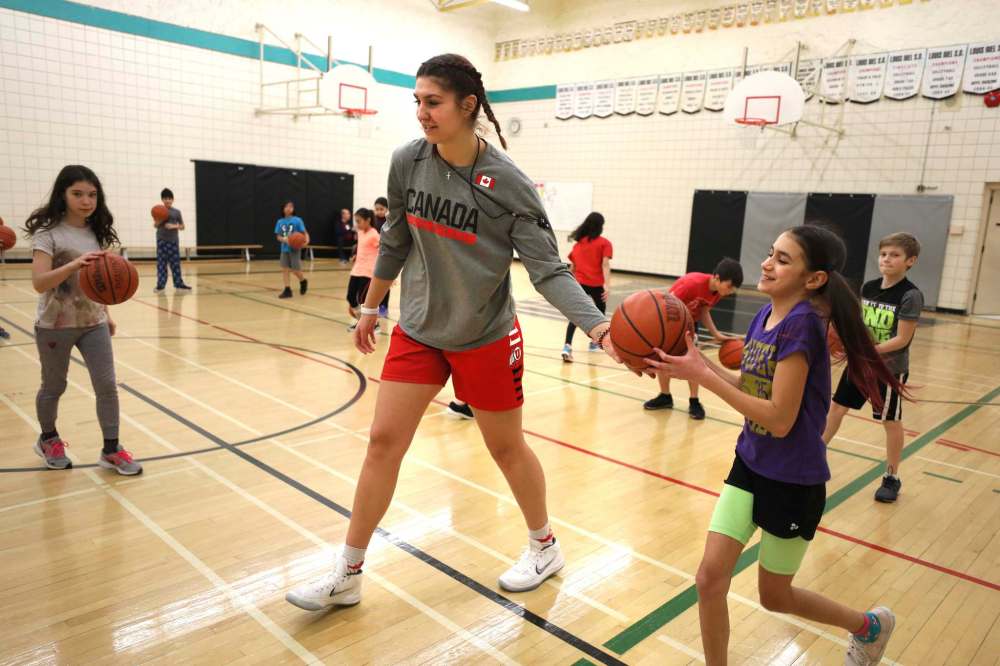
Her tour of Winnipeg middle schools, dubbed the Emily Potter Experience, has been wildly popular and will finish a 26-date run later this month. While rehabbing a knee injury that ended her first pro season in Poland last fall, Potter has 24 more schools on a waiting list that could extend her tour into the spring.
On Thursday, a number of youngsters shyly approached Potter alone after their on-court activities were finished.
“One girl, she was so nervous she was crying,” said Potter. “She was saying I was a big role model for her and, ‘Because of you I want to play basketball,’ and I was like, ‘Because of me, you don’t need to play basketball. You can play softball, you can play chess. Just find something you love to do and run with it. I love basketball and that’s why I play it.

“Yes, I want to promote it, I want everyone to have the same joy that I had with basketball but it doesn’t have to be basketball. Being active as a kid is super important and having a passion for something opens doors.”
As was immediately evident Thursday, Potter’s charisma shines through and she quickly bonds with the kids. At another recent tour visit, the school’s administration asked her to take questions about mental health from a group of Grade 7 and 8 students.
“A lot of people ask how you can help somebody you know is struggling and that’s still the hardest question to answer because, like I don’t know,” said Potter. “When I’m feeling down, I know I have people who will reach out to me but at the same time, I’m (thinking), ‘Yeah, I’m fine, leave me alone.’ Like I told the kids, ‘Keep calling, keep texting and keep showing up and letting people know you’re there.’ “
mike.sawatzky@freepress.mb.ca
Twitter: @sawa14
History
Updated on Friday, January 25, 2019 3:53 PM CST: fixes typo