

Residents concerned about traffic near tank farm
Advertisement
Read this article for free:
or
Already have an account? Log in here »
To continue reading, please subscribe:

Digital Subscription
One year of digital access for only $205*
- Enjoy unlimited reading on winnipegfreepress.com
- Read the E-Edition, our digital replica newspaper
- Access News Break, our award-winning app
- Play interactive puzzles
*First annual payment billed as $205.00 + GST for one year. This annual subscription will automatically renew at $233.00 + GST every 52 weeks (10% off the regular annual price of $259.35). Offer available to new and qualified returning subscribers only. Cancel any time.
To continue reading, please subscribe:
Add Free Press access to your Brandon Sun subscription for only an additional
$1 for the first 4 weeks*
- Enjoy unlimited reading on winnipegfreepress.com
- Read the E-Edition, our digital replica newspaper
- Access News Break, our award-winning app
- Play interactive puzzles
*Your next Brandon Sun subscription payment will increase by $1.00 and you will be charged $17.95 plus GST for four weeks. After four weeks, your payment will increase to $24.95 plus GST every four weeks.
Read unlimited articles for free today:
or
Already have an account? Log in here »
Hey there, time traveller!
This article was published 09/02/2019 (2741 days ago), so information in it may no longer be current.
Residents of East St. Paul are pondering the future of the massive Esso tank plant that fuels the Manitoba rural municipality’s coffers, concerned about the number of gas trucks trying to navigate an area that’s increasingly populated.
“There’s been a few close calls with those tankers,” said Dwayne Holmes, one of numerous residents along the Henderson Highway wondering about the safety of their neighbourhood.
While gravel trucks, commuters and tractor-trailers whiz down the route — often well over the 70 km/h speed limit — it’s the gas trucks pulling in and out of the Imperial Oil terminal that worry Holmes the most.
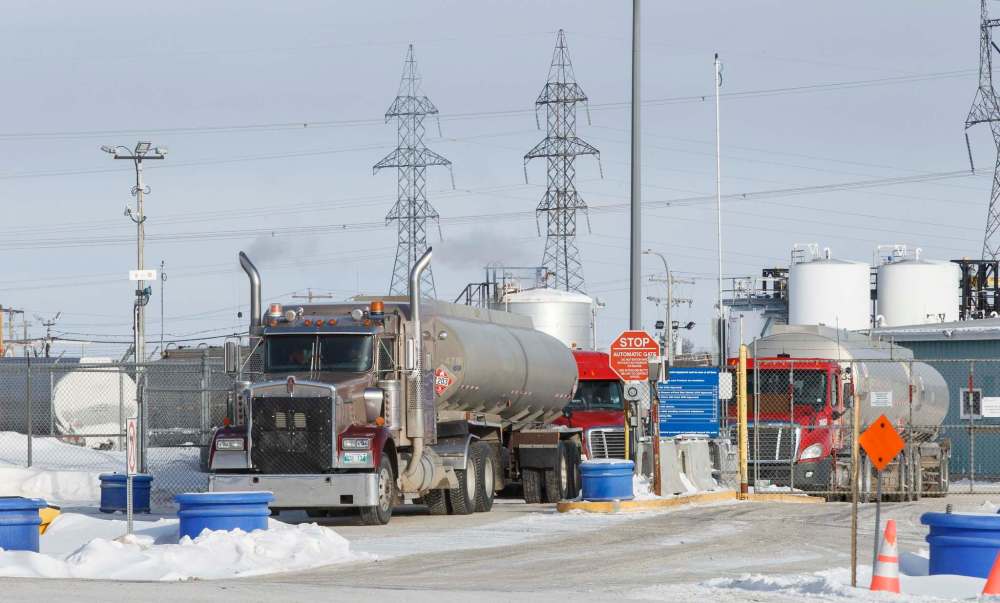
The depot opened as a refinery in 1951, processing Alberta oil until 1975, when it became a terminal facility. Its large cylinders hold gasoline to be dropped off at Esso stations across Winnipeg, as well as shipped on rail across the continent.
The problem, Holmes said, is seven decades of development has brought so many people to the area that the road has constant high-speed traffic, making it hard for large trucks to enter or exit the plant.
“There’s been a few close calls with those tankers,” he said.
“They kind of have to go when there’s a decent chance.”
Al Yakimchuk said he’s seen rear-end collisions along the road, and wondered if they’re more common there than similar routes around Winnipeg.
“The trucks go by 24-7; they’re noisy and they shake the ground,” he said. “It just doesn’t seem safe.”
Yakimchuk was among a handful of readers who contacted the Free Press about the facility, after a series of articles last month on rail-safety issues amid an uptick in oil transported through Winnipeg on trains.
“Nobody follows the speed limit along Henderson Highway, and there’s all these new homes,” Yakimchuk said.
Those concerns came up in 2011, when Manitoba Conservation (now called Sustainable Development) was reviewing a waste-water permit for the site.
“The facility and its industrial zoning predates much of the current residential development. Would it be prudent, from a hazardous goods transportation and human health and safety perspective, to begin to consider implications of maintaining the existing site?” bureaucrats asked after speaking with locals.
Officials noted the depot sits on industrial zoning, but is in the uncommon position of neighbouring parcels of land zoned as residential, parks, recreation and agriculture.
Holmes worries a gas-truck collision or some form of tampering would repeat the 2013 rail disaster in Lac-Megantic, Que., where a runaway oil train crashed down a hill and killed 47.
“It makes you think just what could happen.”
Residents admitted moving the lucrative plant out of the area, or even scaling down its operations, is taboo. In 2015, Imperial Oil paid $452,000 in property taxes to the RM on the northeast edge of Winnipeg, which numbered 9,372 residents in the census a year later.
Holmes, an East St. Paul resident of six decades, said he’s skeptical of new residents moving near the plant and then complaining about it.
The depot sits in the riding of Liberal MP MaryAnn Mihychuk, who said the province clearly needs to expand the highway and add sidewalks.
The former NDP MLA took shots at the PC provincial government for not agreeing to some cost-shared infrastructure projects elsewhere in the city. However, it appears the RM of East St. Paul has not formally sought changes to its stretch of the highway.
“Clearly, we need infrastructure, and it’s been a No. 1 priority for me,” Mihychuk said. “North Winnipeg needs major infrastructure investment.”
Some residents along the strip also questioned an upgrade to the rail line connected to the depot.
Last August, Mihychuk announced $5.6 million in funding for the Central Manitoba Railway, whose biggest client is the Imperial plant, helping bring oil to and from Canada and the U.S.
Every day, the railway brings 10 to 15 tanker cars to and from the depot, carrying between one million and 1.5 million litres of oil.
Construction is set to start this summer, with upgrades meant to result in even more oil loaded onto cars along the line, but also to make them safer, Mihychuk said.

Imperial spokesman Jon Harding said his company would gladly speak with any concerned residents.
“We strive to be a good neighbour,” he said. “Safety is paramount in all of our operations.”
— with files from Bill Redekop
dylan.robertson@freepress.mb.ca