

Real grass or turf: it’s all soccer for Valour coach, players
Advertisement
Read this article for free:
or
Already have an account? Log in here »
To continue reading, please subscribe:

Digital Subscription
One year of digital access for only $205*
- Enjoy unlimited reading on winnipegfreepress.com
- Read the E-Edition, our digital replica newspaper
- Access News Break, our award-winning app
- Play interactive puzzles
*First annual payment billed as $205.00 + GST for one year. This annual subscription will automatically renew at $233.00 + GST every 52 weeks (10% off the regular annual price of $259.35). Offer available to new and qualified returning subscribers only. Cancel any time.
To continue reading, please subscribe:
Add Free Press access to your Brandon Sun subscription for only an additional
$1 for the first 4 weeks*
- Enjoy unlimited reading on winnipegfreepress.com
- Read the E-Edition, our digital replica newspaper
- Access News Break, our award-winning app
- Play interactive puzzles
*Your next Brandon Sun subscription payment will increase by $1.00 and you will be charged $17.95 plus GST for four weeks. After four weeks, your payment will increase to $24.95 plus GST every four weeks.
Read unlimited articles for free today:
or
Already have an account? Log in here »
Hey there, time traveller!
This article was published 21/03/2019 (2752 days ago), so information in it may no longer be current.
Home-field advantage will have a distinct look when the Canadian Premier League kicks off its inaugural season in May.
Four of the fledgling pro soccer league’s seven franchises will play their matches on some version of artificial turf while three others — namely Cavalry FC in Calgary, Wanderers FC in Halifax and Toronto’s York 9 FC — will play on real grass.
Wanderers boss Stephen Hart has touted his club’s carefully manicured grass pitch as a competitive edge for his squad.
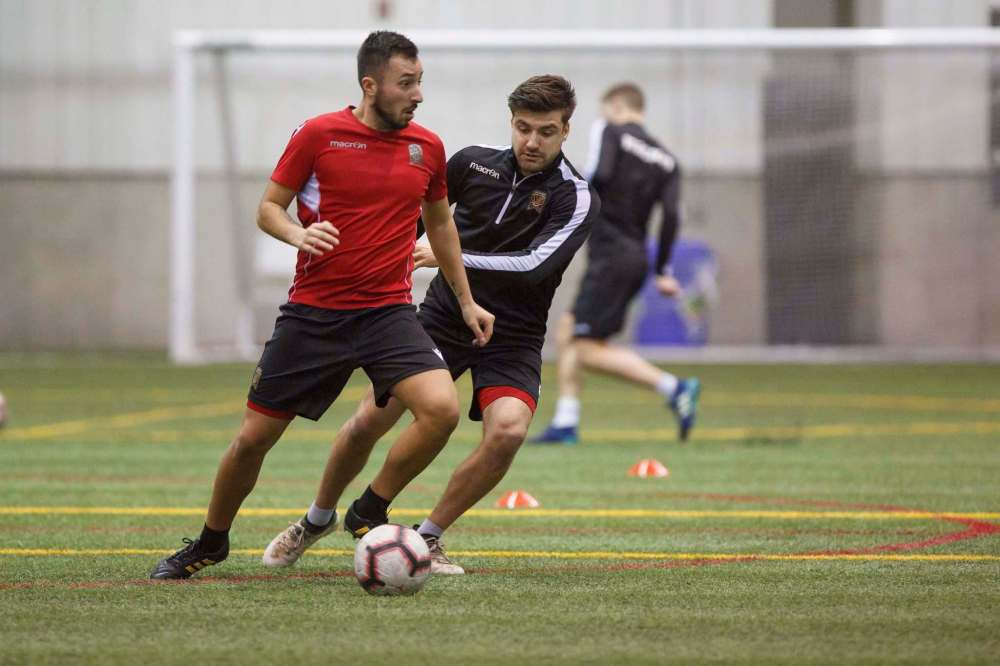
Rob Gale, a transplanted Englishman who serves as head coach and GM of Winnipeg’s Valour FC, admits there’s something special about a grass field.
“Steve’s a purist like myself,” Gale said following a training camp workout at the Subway Soccer South indoor facility Thursday morning. “There’s nothing like it going out every day and smelling that fresh-cut grass with a little bit of slip under the surface.”
The reality of soccer in most regions of Canada is quite different. Artificial fields have become standard-issue in most locales, including Winnipeg.
“What I will say is the North American player has grown up on turf now and it’s become the norm,” said Gale. “Players, even on the national team, they struggle when they’re on grass, the slippery surface. People don’t wear six studs anymore — you’ve got all these rubberized blades and turf shoes. They’re not used to it.
“I don’t think it can be an excuse at any level; it can be difficult and a bit slow in the heat with the turf. But with the modern turf… they are as close to grass as you can possibly get.”
Valour has spent the first three weeks of training indoors. After Friday’s workout and with temperatures on the rise, Gale plans to take his charges outside to Investors Group Field, where they will play their home opener May 4 against Edmonton FC.
The pitch at IGF was installed in advance of the 2015 Women’s World Cup, so it has absorbed some wear and tear during the past 3 1/2 years.
Midfielder Dylan Carreiro, a 24-year-old Winnipegger, is eager to give it a test run.
“Growing up, especially in Winnipeg there’s a lot of winter season and the turf was always there and it was always usable,” said Carreiro. “So for me, I don’t mind the turf. I would love to play on grass, it feels better on the body and it helps us play a little bit better, whereas this turf’s a little bit bouncy.”
Carreiro needed to adjust when he played almost exclusively on grass earlier his career on the youth team of England’s Queen’s Park Rangers or later as a professional in Scotland. He admits a grass pitch made for less wear and tear on his hips, quads and glutes.
“It’s all grass — even on wet, rainy days, you just put your studs on, your six studs, and you go and train on the grass,” he said of his time in the U.K. “Unless it’s really, really icy on the ground, then they’ll go to the 4G (artificial) turf but very rarely we would be on turf there.”

Defender Skylar Thomas has experience on both surfaces.
“The ball moves differently,” said Thomas, a 25-year-old from Scarborough, Ont. “I would say it’s faster on grass. It changes the way you defend and the way you attack…

“I do have a preference. However, I am a Canadian and I grew up in Canada for 18 years of my life and like you would imagine… it’s been on turf. I’m used to it and I don’t mind it at all. I understand it and I’m going to be playing on it for the next two years at least.”
Gale has no complaints.
“I’m not one to have excuses as players or coaches,” said Gale. “So if it’s turf, it’s turf. If it’s grass, it’s grass. I’ve seen top-quality football in South America and Africa on fields that you’d think were mowed by a donkey, so it’s not an excuse. You’ve gotta play where you play.”
mike.sawatzky@freepress.mb.ca
Twitter: @sawa14
TURF VS. GRASS IN THE CPL
Wanders Grounds (HFX Wanderers): grass
FC Edmonton (Clarke Stadium): artificial turf
Forge FC (Tim Hortons Field): artificial turf
Investors Group Field (Valour FC): artificial turf
Spruce Meadows (Cavalry FC): grass
Westhills Stadium (Pacific FC): artificial
York Lions Stadium (York 9 FC): grass; converting to artificial after 2019 season
Related Articles
Brazil held by Panama to 1-1 in friendly played in Portugal







Advertisement Advertise With Us
Advertisement Advertise With Us