

Study finds Métis children not as ready for school as other kids
Advertisement
Read this article for free:
or
Already have an account? Log in here »
To continue reading, please subscribe:

Digital Subscription
One year of digital access for only $205*
- Enjoy unlimited reading on winnipegfreepress.com
- Read the E-Edition, our digital replica newspaper
- Access News Break, our award-winning app
- Play interactive puzzles
*First annual payment billed as $205.00 + GST for one year. This annual subscription will automatically renew at $233.00 + GST every 52 weeks (10% off the regular annual price of $259.35). Offer available to new and qualified returning subscribers only. Cancel any time.
To continue reading, please subscribe:
Add Free Press access to your Brandon Sun subscription for only an additional
$1 for the first 4 weeks*
- Enjoy unlimited reading on winnipegfreepress.com
- Read the E-Edition, our digital replica newspaper
- Access News Break, our award-winning app
- Play interactive puzzles
*Your next Brandon Sun subscription payment will increase by $1.00 and you will be charged $17.95 plus GST for four weeks. After four weeks, your payment will increase to $24.95 plus GST every four weeks.
Read unlimited articles for free today:
or
Already have an account? Log in here »
Hey there, time traveller!
This article was published 07/05/2019 (2694 days ago), so information in it may no longer be current.
The Manitoba Metis Federation castigated the provincial government’s spending priorities Tuesday, citing new research that shows young Métis children aren’t keeping up with their peers in educational attainment.
“It began with a simple question from (MMF president David) Chartrand, and that was simply, are Métis children falling behind? Is there a difference between Métis kids entering school and the rest of the province?” said report co-author Jino Distasio, director of the University of Winnipeg’s Institute of Urban Studies, during a Tuesday morning press conference at the MMF’s Winnipeg headquarters.
“And what we found was that, yes… Métis children and children in Manitoba are certainly starting behind, when we get to the early readiness skills.”

That early educational attainment gap is “systemic and long term,” Distasio added.
The study from the U of W’s Institute of Urban Studies is the first result of a 10-year, $600,000 funding agreement between the MMF and the university that was signed in 2018. The research drew on nearly 60,000 educational records. Researchers tracked a measure of school readiness called the Early Development Instrument that measures whether children are “ready” or “not ready” for school across five different domains: communication skills and general knowledge, emotional maturity, language and cognitive development, health and well-being, and social competence.
Non-Métis Manitoba students performed slightly worse in all five categories than children across Canada, according to the research. But Métis children in Manitoba consistently performed worse than their non-Métis classmates, and were more likely to score as “not ready” for school.
“(It) certainly gives us a strong indication that there is a significant difference between the Métis kids and non-Métis kids,” Distasio said.
“In particular, we know that 35 per cent — just over a third of Métis children — are not prepared for school, and that compares to 28 per cent for the rest of the province and 27 per cent nationally.”
MMF minister of provincial education Joan Ledoux said there was little evidence until now that Manitoba’s educational system wasn’t working as well for Métis students.
The new, Métis-focused research “is the first of it’s kind, it’s never been done before,” said Ledoux.
“And it tells us a troubling story: the province is basically failing our Métis children and families.”
MMF president David Chartrand didn’t lay the blame for the situation solely at the feet of Manitoba’s current Progressive Conservative government, and said decisions made by the previous NDP government also played a role.
“So there’s been no investment in the Métis community. And we pay over $400 million in taxes in this province, and yet there is nothing coming back to our community to help the shortfall,” he said.
“Starting behind is a serious and scary thing for any Manitoban, but this is not just a Métis story — this is all Manitoba’s story.”
Chartrand referenced Premier Brian Pallister’s goal of eliminating the provincial deficit, and said the spending cuts required to achieve that goal would hurt Manitobans.
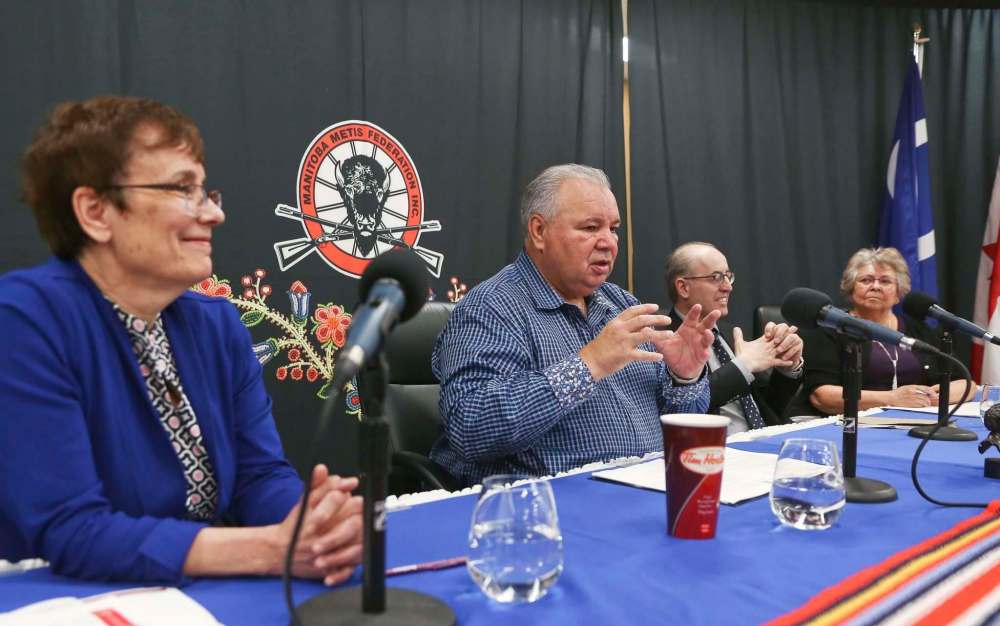
“That’s the whole danger of when politicians don’t look towards the future, and they look only to their short-term, four years or eight years. And they don’t look 20 years down the road,” said Chartrand.
“We’re looking 20 years down the road.”
Chartrand also praised federal funding, announced in 2018, that will help fund Indigenous child-care programs and said the MMF will be using its share of that money to build daycare centres and Aboriginal Head Start centres.
“Now imagine if the province decided to come onboard, and said, ‘I want to be partner and make that difference,'” he said.

An emailed statement from Education and Training Minister Kelvin Goertzen did not directly address the MMF’s statements Tuesday.
“We know educational outcomes need to improve and that is why we have launched a comprehensive, independent review of Manitoba’s education system, the first of its kind in decades,” he said in the statement.
“All Manitobans are encouraged to participate in the ongoing consultation process to help shape the future of our education system.”
solomon.israel@freepress.mb.ca
@sol_israel
History
Updated on Tuesday, May 7, 2019 1:28 PM CDT: updates with government reaction, more info, quotes
Updated on Tuesday, May 7, 2019 1:44 PM CDT: corrects name of Institute of Urban Studies