

Hitting the right notes
Lifelong passion for music shared through teaching, performance
Advertisement
Read this article for free:
or
Already have an account? Log in here »
To continue reading, please subscribe:
Monthly Digital Subscription
$1 per week for 24 weeks*
- Enjoy unlimited reading on winnipegfreepress.com
- Read the E-Edition, our digital replica newspaper
- Access News Break, our award-winning app
- Play interactive puzzles
*Billed as $4.00 plus GST every four weeks. After 24 weeks, price increases to the regular rate of $19.95 plus GST every four weeks. Offer available to new and qualified returning subscribers only. Cancel any time.
Monthly Digital Subscription
$4.99/week*
- Enjoy unlimited reading on winnipegfreepress.com
- Read the E-Edition, our digital replica newspaper
- Access News Break, our award-winning app
- Play interactive puzzles
*Billed as $19.95 plus GST every four weeks. Cancel any time.
To continue reading, please subscribe:
Add Free Press access to your Brandon Sun subscription for only an additional
$1 for the first 4 weeks*
*Your next subscription payment will increase by $1.00 and you will be charged $16.99 plus GST for four weeks. After four weeks, your payment will increase to $23.99 plus GST every four weeks.
Read unlimited articles for free today:
or
Already have an account? Log in here »
Hey there, time traveller!
This article was published 20/10/2019 (2359 days ago), so information in it may no longer be current.
The halls are alive with the sound of music.
In 1995, Robert Geurts founded his private music academy, Spirited Music, on St. Mary’s Road, a block away from Nelson McIntyre Collegiate. With only a dozen students signed up for lessons that first year, Geurts was worried potential, paying customers poking their head inside to have a look-see would arrive when there wasn’t much going on and, underwhelmed, make a beeline out the door. To combat that, the married father of three, one of the first music teachers in the city to employ a video lab and computer lab, came up with a plan to trick visitors into believing his was a bustling biz.
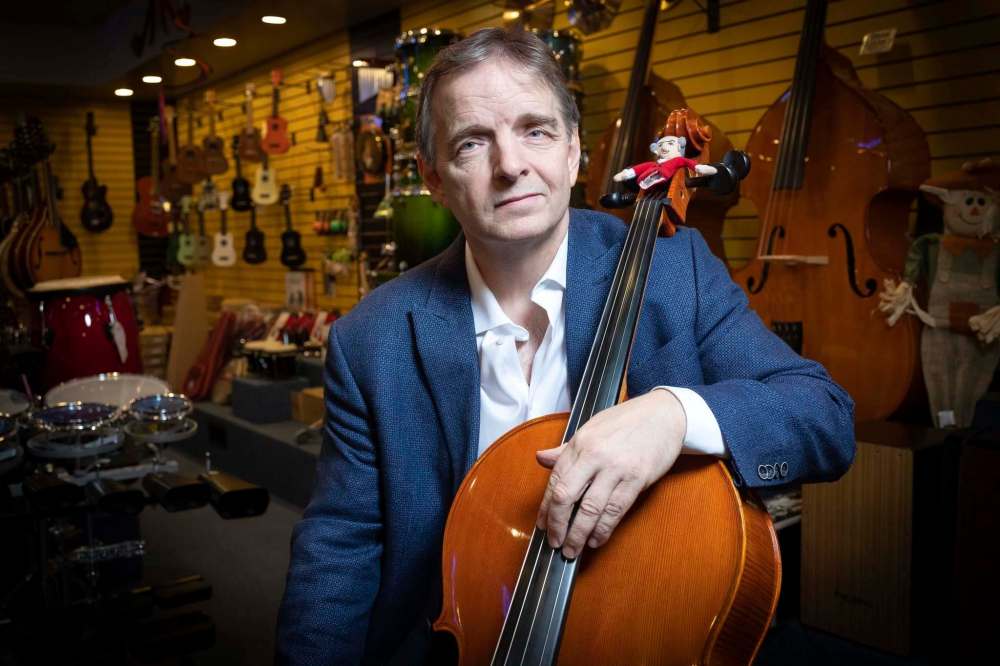
“The first thing I did was divide the space, which was only 300 square feet, into three, separate rooms, to make it seem bigger than it actually was,” Geurts says, seated in the retail section of his current operation at 246 St. Mary’s Rd., recognizable by its emerald green façade and bright, mustard-yellow awning. “In one room I plugged in a radio to provide background noise and in another I had an electronic piano playing demo tunes, morning, noon and night, as if somebody was practising away. After all, it was supposed to be a music place, not a morgue, right?”
Almost a quarter of a century later, a quiet day at the office is no longer a concern. Far from it.
“I was just reminiscing with the carpet installer who’s replacing the rug in our waiting room. I was telling him in the 19 years since we moved here, over a million people had walked on that old carpet. That’s a lot of recitals and lessons,” he says, tapping his fingers along to Thin Lizzy’s The Boys Are Back in Town, playing on his in-house stereo system. “We’ve had students as young as three and as old as 93. One of the beautiful things about music is you’re never too young or too old to learn. I’m 57 and still learn something new, practically every day.”
● ● ●
Geurts, the youngest of 11 siblings, grew up on a farm near Oak Hammock Marsh. He was drawn to music at an early age, thanks in large part to his mother, Mary, an accomplished accordionist who made a living playing dance halls in the Bissett region in the 1940s.
The first instrument he learned to play was the xylophone, which he took up after hearing his brothers’ Herb Alpert and the Tijuana Brass records. He was eight when he switched from xylophone to guitar, 10 when he started fooling around with a banjo.
“I distinctly remember watching The Johnny Cash Show on TV and seeing this fellow Norman Blake performing Mama Don’t Allow, alongside Cash,” he says. “In the space of a few minutes, he switched from guitar to banjo to fiddle and that’s when I realized a person doesn’t have to be limited to one instrument. There was no reason you couldn’t learn to play as many as possible.”
Growing up, about the only thing Geurts enjoyed more than making music was making money. He got a job driving a tractor, of all things, at the age of 11, and worked continuously from then on, part time during the school year, full time every summer. In his senior year, he had a decision to make: remain at Lord Selkirk School, where he was a starting guard on the provincial champion high school basketball team, or accept a 40-hours-a-week offer from Versatile, his weekend employer at the time. His father Albert had one question: “How much does it pay?” When he responded $13 an hour, the elder Geurts said, “Well, you’re not going to make that much with a high school diploma. Take the job.”
“Even though I was now working full time, I never gave up music,” he goes on. “I was still living at my parents’ and every night when I got home from work, I’d head into my room after supper and play, sometimes till four or five in the morning. That was my primary form of relaxation.”
When Geurts was 23, by which time he had moved to “the city,” he was laid off from his machinist’s job. To pay the rent on his Talbot Avenue apartment, he landed a part-time position teaching guitar at Mar-Schell’s Music on Henderson Highway. He fell in love with teaching immediately and made up his mind what he really wanted to do was head back to school, to become a high school band teacher.
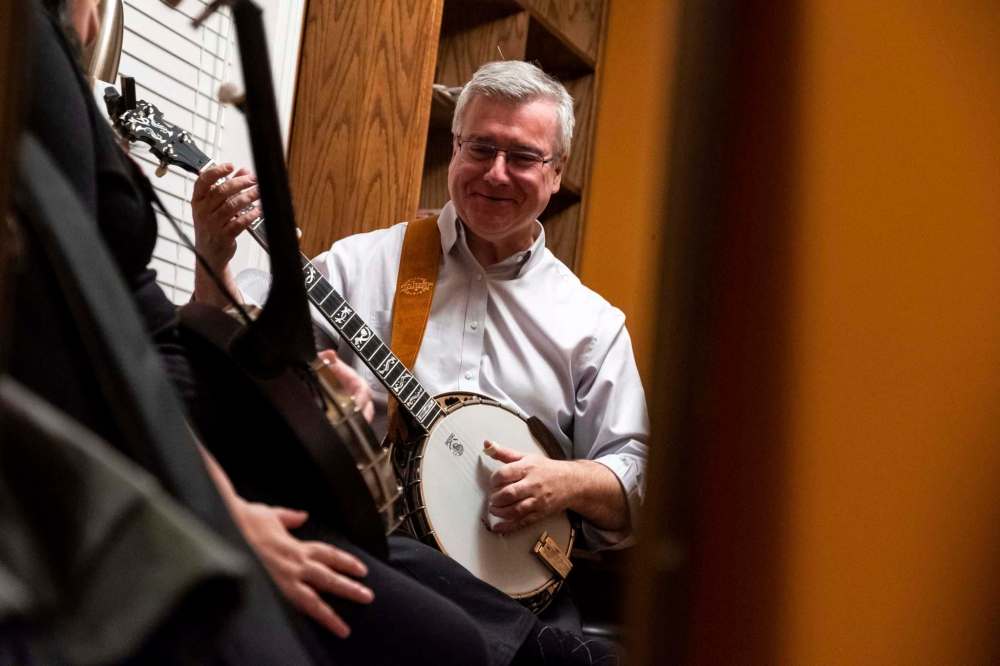
Because he had been required to take courses at Red River College for his machinist job, he had already netted his Grade 12 equivalency. He enrolled in the music program at Concord College, now Canadian Mennonite University, before transferring to the University of Manitoba to complete his degree. When he wasn’t hitting the books — or learning how to play trumpet, percussion, even the bagpipes — he was making a few bucks on the side with his band, the Muddy River Stringers, a unit that performed at the Winnipeg Folk Festival in 1991, ’92 and ’95, or by busking under the name Bobby Geurts.
Geurts graduated from the U of M in 1994. He was interviewed for a number of jobs, except there was one problem: he was no longer convinced standing in front of a classroom waving a conductor’s baton was his true calling.
“While I was in university, I did some student teaching at Isaac Newton and Miles Mac,” he says. “Yes, I loved teaching but I found the group lesson concept to be slow and inefficient. Invariably, there would either be somebody ready to race ahead of the pack or someone in danger of being left behind. You could never progress properly. Whereas in a private lesson, the person could progress at their most optimum speed. To me, it seemed private lessons were the only ones that made sense.”
One evening over dinner, he sat down with his wife Laurette — they got married in 1990 — to figure out their options. At the time, they had one child with another on the way, as well as a mortgage on their Hill Street abode. A steady, teacher’s cheque made the most sense, they agreed, but at the end of the day, Laurette wanted her husband to be happy. They came up with a compromise: he would establish his own academy but if, after two years, it was a bust, he would start applying for jobs teaching high school band.
“I opened up with nothing and by that I mean zero, not even a guitar pick,” he says, recalling how, for months, he would teach every Saturday until 4 p.m., then spend four or five hours in a mall parking lot, placing flyers on car windshields in an effort to drum up business. “The problem was, if somebody came in and said they were interested in learning whatever and asked if I had an instrument they could rent, I told them no, that they’d have to get that somewhere else, then come back for lessons. Except because they almost never came back, I realized fairly quickly I needed to start investing in instruments, too.” (Get this: in an effort to save a few pennies early on, Geurts purchased defective music books, ones loaded with typos, which he would painstakingly correct himself before handing them out to his students.)
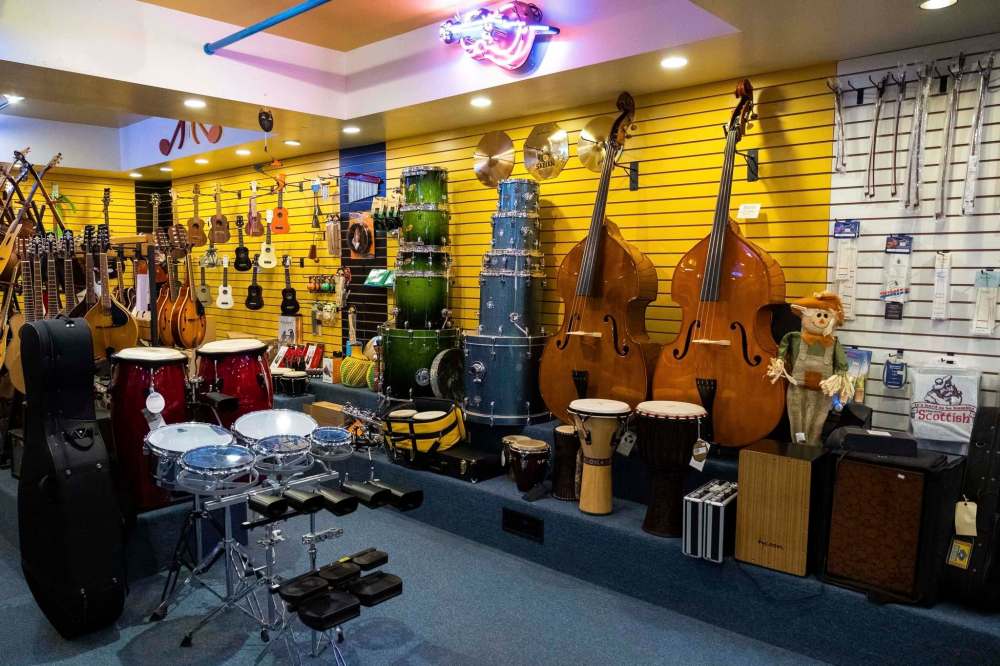
At the end of his second year, his cut-off point, his roster had grown to 80 students, a number that increased exponentially every year until 1999, by which time he had close to 250 students, and had outgrown his space. In 2000, Geurts visited a vacant building immediately next door, a former Food Fare outlet that had been on the market for some time. It was in serious disrepair, it needed a new roof and new floor for starters, but at 5,000 sq.-ft., it suited his needs. After getting it for a song, he moved in that summer. He opened his retail store, which, in case you’re wondering why there’s still tinsel on the floor, recently served as a film location for the Hallmark Channel movie, Our Christmas Song, a year later.
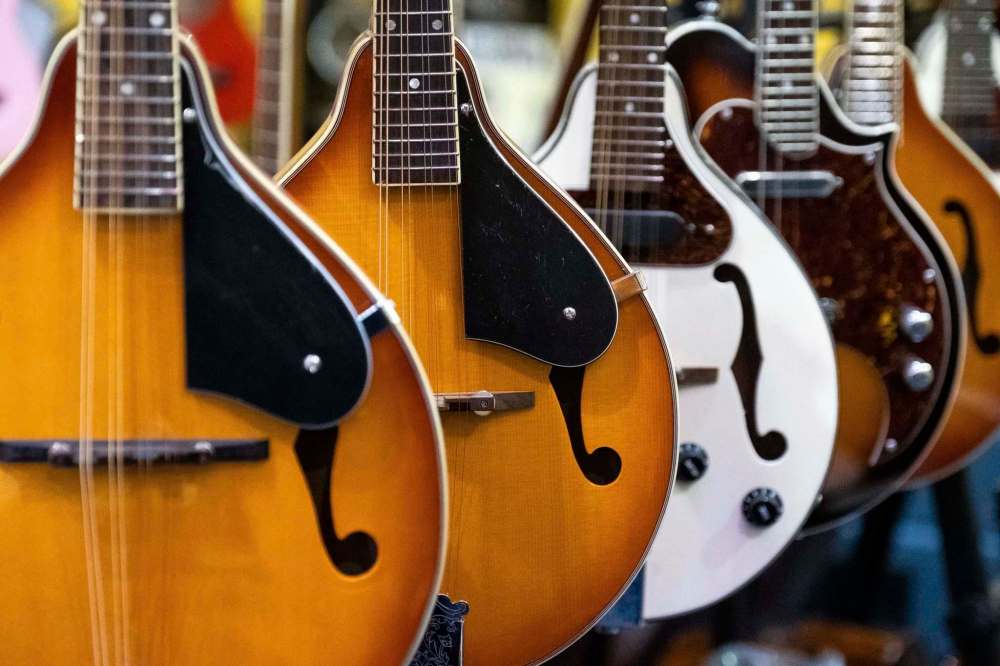
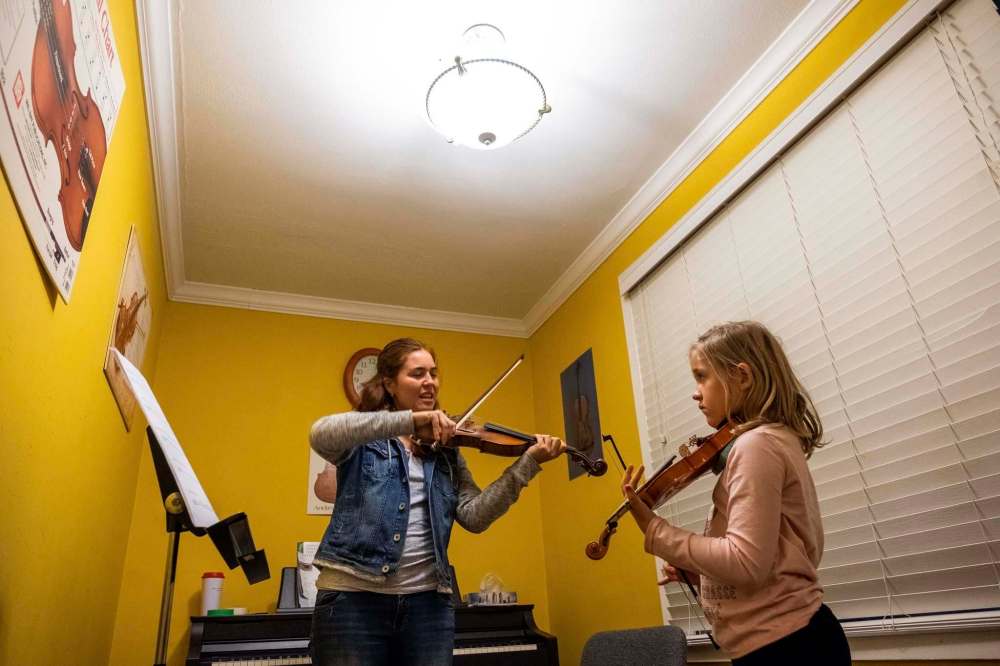
“We’ve stocked didgeridoos, bouzoukis, concertinas, electric kazoos…” he says, noting he currently has 16 teachers on staff, one of whom is his son, Nathan, proficient at saxophone, flute, violin, piano and drums. “We also have every accessory under the sun, and in the neighbourhood of 10,000 music books. The biggest compliment I receive is when people walk in and say this is the first real music store they’ve seen in a long time.”
● ● ●
From time to time, Geurts gets asked if, after all these years of teaching, he ever tires of hearing beginners plunking the wrong keys or butchering a tune on the cello or oboe. What he tells them is he’s not listening to what’s being played as much as he’s studying a student’s technique. Instead of reaching for something to stick in his ears, he’s wondering what’s causing that sound? What do the two of them need to do to address the problem?

That said, he does admit that, just like any other line of work, teaching music can become routine sooner or later, and there have definitely been moments when he’s wondered, “Why am I doing this?” But then along comes recital time.
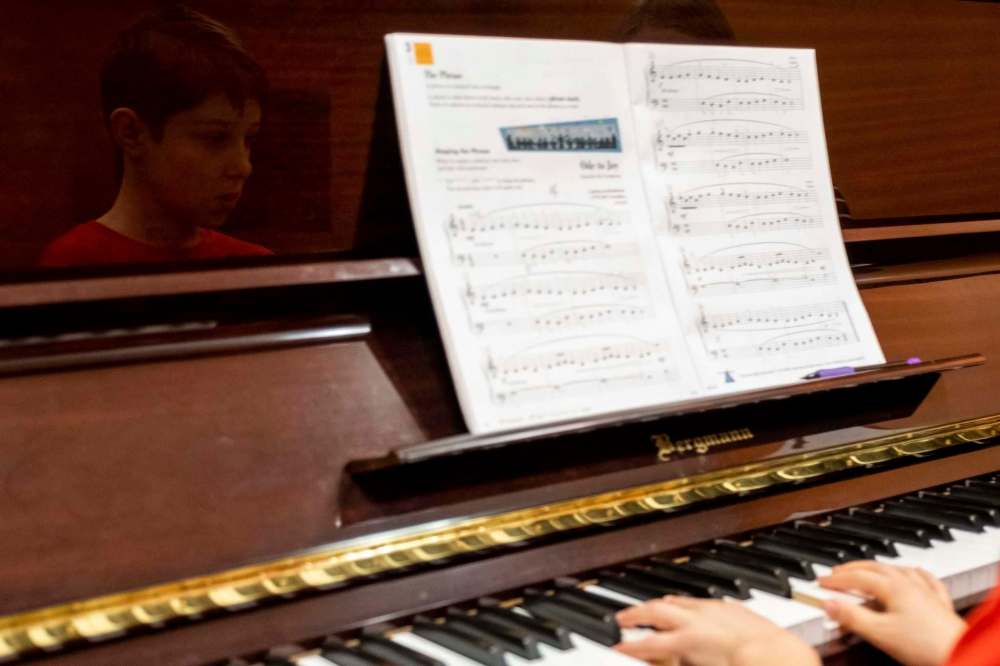
“Recitals always charge my batteries, especially if it’s somebody who’s stepping onto a music stage and playing in front of a live audience for the first time,” he says, guessing his dedicated, concert space, adorned with framed posters of Billie Holiday, Louis Armstrong and Bob Marley, has hosted in the neighbourhood of 10,000 performances to date. “You hear the crowd after that first number, everybody’s receptive, and honest to god, there are moments when I’m in the back of the room, bawling my eyes out.
“To watch people develop a skill they never had before and to discover a part of themselves they didn’t know existed, then to realize you were instrumental, no pun intended, in that process? That makes all the time and effort worth it.”
David Sanderson writes about Winnipeg-centric restaurants and businesses.
david.sanderson@freepress.mb.ca
Dave Sanderson was born in Regina but please, don’t hold that against him.
Our newsroom depends on a growing audience of readers to power our journalism. If you are not a paid reader, please consider becoming a subscriber.
Our newsroom depends on its audience of readers to power our journalism. Thank you for your support.