

Curling Canada delivers pay equalization
Men's, women's national championships will divvy up $300,000 pots

Advertisement
Read this article for free:
or
Already have an account? Log in here »
To continue reading, please subscribe:

Digital Subscription
One year of digital access for only $205*
- Enjoy unlimited reading on winnipegfreepress.com
- Read the E-Edition, our digital replica newspaper
- Access News Break, our award-winning app
- Play interactive puzzles
*First annual payment billed as $205.00 + GST for one year. This annual subscription will automatically renew at $233.00 + GST every 52 weeks (10% off the regular annual price of $259.35). Offer available to new and qualified returning subscribers only. Cancel any time.
To continue reading, please subscribe:
Add Free Press access to your Brandon Sun subscription for only an additional
$1 for the first 4 weeks*
- Enjoy unlimited reading on winnipegfreepress.com
- Read the E-Edition, our digital replica newspaper
- Access News Break, our award-winning app
- Play interactive puzzles
*Your next Brandon Sun subscription payment will increase by $1.00 and you will be charged $17.95 plus GST for four weeks. After four weeks, your payment will increase to $24.95 plus GST every four weeks.
Read unlimited articles for free today:
or
Already have an account? Log in here »
Hey there, time traveller!
This article was published 03/12/2019 (2486 days ago), so information in it may no longer be current.
Of all the stories to be written about curling’s curious journey through the 21st century, about its colourful and even unlikely push to evolve from cosy curling club rock-throwing to finely tuned elite sport, one of the most compelling narratives would have to be about the remarkable trajectory of the women’s game.
Across the world, elite women’s curling has soared. In many places, women even became the face of the sport: in Korea, for instance, EunJung Kim and the so-called Garlic Girls became national heroes when they captured a 2018 silver medal on home ice, bringing a fresh wave of excitement to curling.
At home, a similar trend has played out. For years, Curling Canada has banked on stars such as Jennifer Jones and Rachel Homan as the game’s most recognizable ambassadors and surefire draws. And it was Jones who threw the most memorable hit in curling history, with the 2005 shot that is now up to over 2.1 million YouTube views.
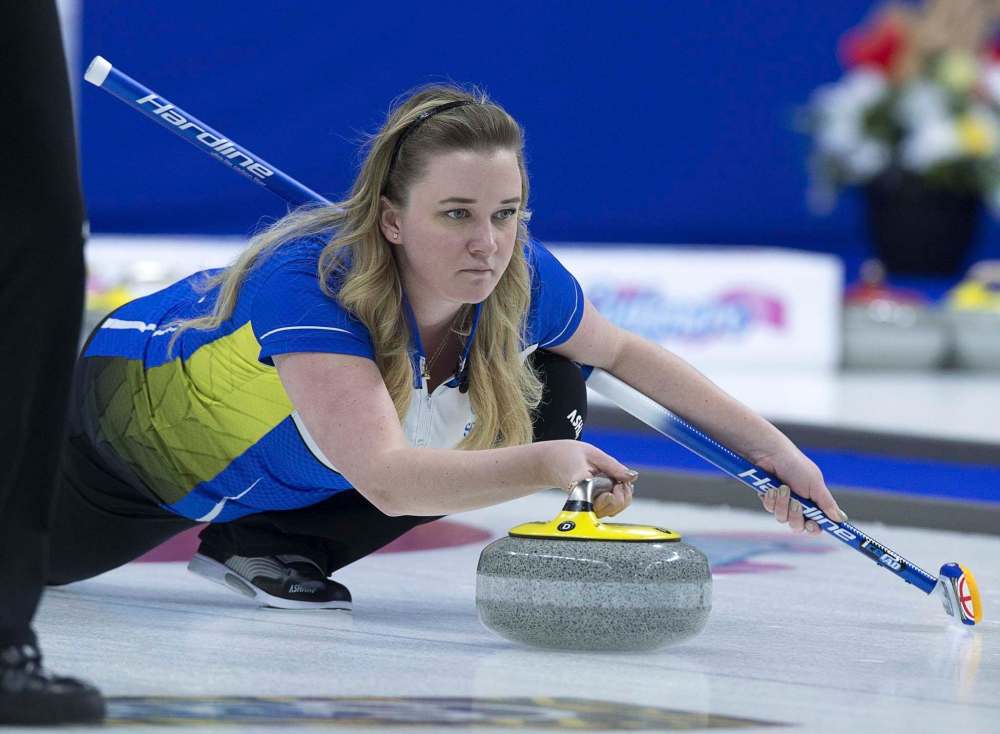
Yet despite these strides, the women who won Canadian curling’s top prize were cashing out at a rate far lower than their male counterparts. But that is about to change: when the 2020 Scotties Tournament of Hearts rolls into Moose Jaw, Sask. in February, the 16-team women’s field will be gunning for a vastly improved prize.
On Sunday, in the midst of the elite Canada Cup, Curling Canada CEO Katherine Henderson — a veteran sport executive, now three years into Canadian curling’s top job — announced that pay equalization was coming to the men’s and women’s national championships this season, for the very first time.
Pay equity, Henderson says, had been one of her goals since she joined the organization in December 2016. But though the issue had been longstanding, it received little public attention until the 2019 Brier, when CBC journalist Devin Hereux tweeted about the significant pay differential.
The numbers were stark, and touched off a tempestuous debate on social media. In 2019, Scotties champ Chelsea Carey took home $59,000 for her win; Alberta’s Kevin Koe pocketed $100,500 when his team clinched the Brier. In total, this year’s Brier had a $295,000 purse. The Scotties doled out just over half of that, at $165,000.
This, despite the fact that television ratings for both events were much closer together; indeed, when it came to the playoffs and the final, more people tuned in to watch the women’s battles than they did the Brier’s closing rounds.
As the debate wore on, some were quick to point out that the women’s teams also receive jewelry, a cherished tradition. Fair enough, but let’s be honest: the value of the baubles didn’t come close to closing the value gap.
Now, with equalization in place for 2020, both events will divvy up a $300,000 pot. The champions of each will pocket $105,000, with silver medallists earning $65,000 and third-place teams taking home $45,000. Another $85,000 will be spread amongst the remaining 13 teams in each field. And yes, the jewelry remains.
Though the timing of the announcement follows this spring’s public debate, Henderson says it wasn’t what pushed the change.
“In some ways, there was a feeling of ‘don’t steal our thunder, we really are working on this right now,'” she says of that brouhaha. “I had talked about it with the athletes. There was a great deal of support.”
When the news was announced, curlers on the men’s and women’s sides were pleased. It was a decision many had hoped to see for some time, although few athletes in elite curling’s tiny pond wished to rock the boat by openly campaigning. But it was a long-simmering idea whose time, many agreed, had come.
Some observers wondered how the organization could make the move now. Though some of the financials involved are confidential, Henderson says, the gist of it is “basic business stuff.” Since coming to the organization in 2016, she says, she has sought to overhaul and modernize how Curling Canada and its championship events are run.
For instance, in recent years the organization has switched to more volume purchasing, brought some functions in-house that resulted in cost savings, and diversified revenue streams. Those things, Henderson says, allowed Curling Canada to equalize and increase prize pools without cutting investment in grassroots programs.

“You try and strengthen your revenue, you manage costs a little bit better, and you also invest in some things that allow you to invest in the product,” she says. “At the end of the day, what it means is we’re making more money… It really has to do with transforming curling into a tighter, learner and more high-performing business model.”
Meanwhile, give credit where credit is due: Curling Canada has previously been at the forefront of equalizing the stakes for women’s sport. Its Canada Cup, which dangles as its most coveted prize an Olympic trials berth, has had prize equity since its 2003 launch. So does its Continental Cup, which is one year older.
Prize gaps between sexes are the rule in sport, more often than they’re not. Tennis is one of the few that has pursued equalization for events at the same level and played under the same umbrella. Outside of that, sports such as golf still wrestle with how to bring compensation for women’s achievement up to the same level.
Curling, perhaps, offers a unique opportunity to chart the course forward. While the Brier remains “the larger property” for Curling Canada and brings in more revenue, Henderson says, the level of public familiarity with women’s curlers is much closer to par. That much is evident from the 2019 viewership figures.

Fans know the women’s teams. They watch the women’s teams. And with more investment and some tweaks to its presentation, there is no reason that the Scotties can’t become as big an engine for Curling Canada as the Brier. The building blocks for a uniquely gender-balanced sport are there. It’s just a matter of how to put them together.
Equalization is part of that puzzle. Where prize money is unequal, then so is opportunity. It means lower stakes and less money for development. It means less of an incentive for athletes to make the sacrifices to family, career and life that underpin any high-performance athletic endeavour. It also means, frankly, a little less glamour.
Above all, it comes down to one simple fact: in this world, if you want to properly honour the value of someone’s labour, you need to pay them. The stars of women’s curling have put in the work, and done their part to lift curling as a whole into the new millennium, to take it out of the clubs and into the spotlight.
Now, at long last, those who claim the Maple Leaf in the course of that journey will be adequately rewarded.
melissa.martin@freepress.mb.ca
Melissa Martin
Reporter-at-large
Melissa Martin reports and opines for the Winnipeg Free Press.
Every piece of reporting Melissa produces is reviewed by an editing team before it is posted online or published in print — part of the Free Press‘s tradition, since 1872, of producing reliable independent journalism. Read more about Free Press’s history and mandate, and learn how our newsroom operates.
Our newsroom depends on a growing audience of readers to power our journalism. If you are not a paid reader, please consider becoming a subscriber.
Our newsroom depends on its audience of readers to power our journalism. Thank you for your support.
Melissa Martin
Reporter-at-large
Melissa Martin reports and opines for the Winnipeg Free Press.
Every piece of reporting Melissa produces is reviewed by an editing team before it is posted online or published in print — part of the Free Press‘s tradition, since 1872, of producing reliable independent journalism. Read more about Free Press’s history and mandate, and learn how our newsroom operates.
Our newsroom depends on a growing audience of readers to power our journalism. If you are not a paid reader, please consider becoming a subscriber.
Our newsroom depends on its audience of readers to power our journalism. Thank you for your support.
Related Articles
More perfect eight-enders are recorded in Manitoba than anywhere else in Canada


Advertisement Advertise With Us
Advertisement Advertise With Us
History
Updated on Tuesday, December 3, 2019 8:02 PM CST: Adds photo