

U.S. issues spring major flood warning for Red River basin

Advertisement
Read this article for free:
or
Already have an account? Log in here »
To continue reading, please subscribe:
Monthly Digital Subscription
$1 per week for 24 weeks*
- Enjoy unlimited reading on winnipegfreepress.com
- Read the E-Edition, our digital replica newspaper
- Access News Break, our award-winning app
- Play interactive puzzles
*Billed as $4.00 plus GST every four weeks. After 24 weeks, price increases to the regular rate of $19.95 plus GST every four weeks. Offer available to new and qualified returning subscribers only. Cancel any time.
Monthly Digital Subscription
$4.99/week*
- Enjoy unlimited reading on winnipegfreepress.com
- Read the E-Edition, our digital replica newspaper
- Access News Break, our award-winning app
- Play interactive puzzles
*Billed as $19.95 plus GST every four weeks. Cancel any time.
To continue reading, please subscribe:
Add Free Press access to your Brandon Sun subscription for only an additional
$1 for the first 4 weeks*
*Your next subscription payment will increase by $1.00 and you will be charged $16.99 plus GST for four weeks. After four weeks, your payment will increase to $23.99 plus GST every four weeks.
Read unlimited articles for free today:
or
Already have an account? Log in here »
Hey there, time traveller!
This article was published 28/01/2020 (2238 days ago), so information in it may no longer be current.
A major spring flood along the Red River is being anticipated by the National Weather Service, confirming what communities on either side of the U.S. border have expected since record precipitation hammered the region in the fall.
A report from the U.S. federal agency published last week pegs the likelihood of significant overflow along the Red at 65 per cent, with communities such as Fargo-Moorhead, Grand Forks and Pembina expected to surpass major flood levels.
In Grand Forks, there’s an estimated three-in-four chance of exceeding the major flood level of 46 feet. At Pembina, there is a 95 per cent chance of reaching the major flood level of 49 feet, and a 50 per cent chance levels could reach as high as 53 feet.
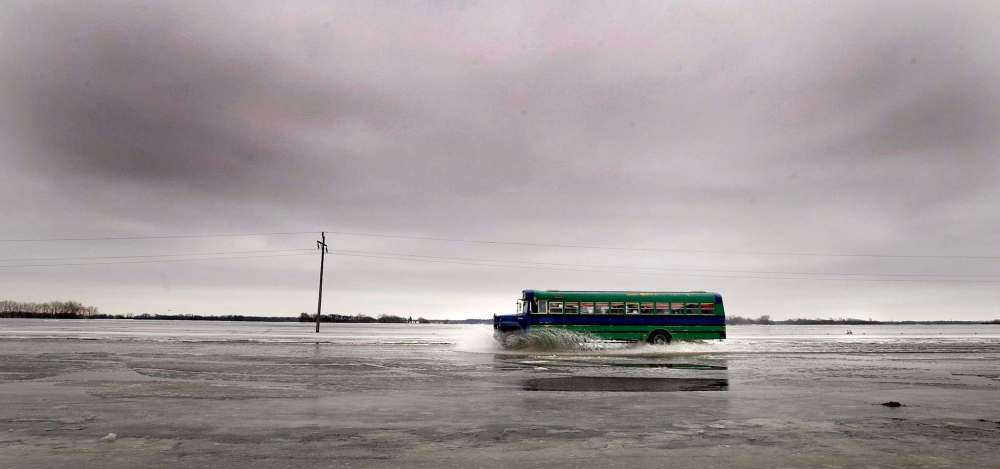
If reached, those levels would mirror ones reached in the spring floods of 2009 and 2011, said Greg Gust, a warning co-ordination meteorologist with the National Weather Service.
While Gust could only comment on the experience south of the border, those conditions could spell similar concerns in Manitoban communities such as Emerson, Ste. Agathe and Winnipeg, which sit along the north-flowing river.
The Free Press reached out to the Manitoba Department of Infrastructure for an update on anticipated spring levels in the Canadian side of the basin, and were told, based on current conditions, the first spring flood outlook should be released in February.
After an extremely dry summer, the Prairie region was hit last fall with record or near-record levels of precipitation across the board, best-exemplified by a September rain storm and a mid-October snowfall that left thousands of Manitobans without power.
In North Dakota and Manitoba, the Red rose substantially as a result, and the province was forced to activate the Red River Floodway for 29 days between Oct. 9 and Nov. 7 — the latest it had been used in its 50-year history. Since Sept. 1, the U.S. portion of the river basin has experienced more precipitation than ever recorded over the same period, Gust said.
The fall levels set the table for a likely spring flood in North Dakota, Gust said. The soil moisture along the American side of the basin remains at the 95th percentile or greater, as does the river’s base streamflow. Combined with the snow that’s fallen since, Gust said the likelihood has increased.
Manitoba’s fall conditions report, published Dec. 17, said most of the provincial watersheds were experiencing above-normal to well-above-normal levels of soil moisture, and base streamflows also generally fell in that range. Both are indications of elevated spring flood risks.

However, the report noted, it was “not very practical or feasible” to provide a long-term forecast for spring 2020, given certain conditions — such as snowmelt or winter precipitation — could influence the potential for a flood.
“There is an inherent risk of overestimating or underestimating the flood potential, if one considers the conditions and available precipitation four months in advance of the spring runoff,” it said.
According to Agriculture and Agri-Food Canada’s database, most of southern Manitoba experienced between 40 to 85 per cent of the average winter precipitation between Nov. 1 and Jan. 20.
The next flood outlook report from the National Weather Service will be issued Feb. 13.
ben.waldman@freepress.mb.ca
Ben Waldman is a National Newspaper Award-nominated reporter on the Arts & Life desk at the Free Press. Born and raised in Winnipeg, Ben completed three internships with the Free Press while earning his degree at Ryerson University’s (now Toronto Metropolitan University’s) School of Journalism before joining the newsroom full-time in 2019. Read more about Ben.
Every piece of reporting Ben produces is reviewed by an editing team before it is posted online or published in print — part of the Free Press‘s tradition, since 1872, of producing reliable independent journalism. Read more about Free Press’s history and mandate, and learn how our newsroom operates.
Our newsroom depends on a growing audience of readers to power our journalism. If you are not a paid reader, please consider becoming a subscriber.
Our newsroom depends on its audience of readers to power our journalism. Thank you for your support.
Ben Waldman is a National Newspaper Award-nominated reporter on the Arts & Life desk at the Free Press. Born and raised in Winnipeg, Ben completed three internships with the Free Press while earning his degree at Ryerson University’s (now Toronto Metropolitan University’s) School of Journalism before joining the newsroom full-time in 2019. Read more about Ben.
Every piece of reporting Ben produces is reviewed by an editing team before it is posted online or published in print — part of the Free Press‘s tradition, since 1872, of producing reliable independent journalism. Read more about Free Press’s history and mandate, and learn how our newsroom operates.
Our newsroom depends on a growing audience of readers to power our journalism. If you are not a paid reader, please consider becoming a subscriber.
Our newsroom depends on its audience of readers to power our journalism. Thank you for your support.
Advertisement Advertise With Us
Advertisement Advertise With Us