

Powerhouse Scotties draws on rich legacy

Advertisement
Read this article for free:
or
Already have an account? Log in here »
To continue reading, please subscribe:

Digital Subscription
One year of digital access for only $205*
- Enjoy unlimited reading on winnipegfreepress.com
- Read the E-Edition, our digital replica newspaper
- Access News Break, our award-winning app
- Play interactive puzzles
*First annual payment billed as $205.00 + GST for one year. This annual subscription will automatically renew at $233.00 + GST every 52 weeks (10% off the regular annual price of $259.35). Offer available to new and qualified returning subscribers only. Cancel any time.
To continue reading, please subscribe:
Add Free Press access to your Brandon Sun subscription for only an additional
$1 for the first 4 weeks*
- Enjoy unlimited reading on winnipegfreepress.com
- Read the E-Edition, our digital replica newspaper
- Access News Break, our award-winning app
- Play interactive puzzles
*Your next Brandon Sun subscription payment will increase by $1.00 and you will be charged $17.95 plus GST for four weeks. After four weeks, your payment will increase to $24.95 plus GST every four weeks.
Read unlimited articles for free today:
or
Already have an account? Log in here »
Hey there, time traveller!
This article was published 31/01/2020 (2411 days ago), so information in it may no longer be current.
RIVERS, Man. — So here’s a question that’s been echoing between the walls of this Manitoba Scotties, sometimes asked openly, sometimes just thought. It’s been unavoidable since long before the draw was even announced, and here, in the thick of it all, it’s hard not to keep mulling it over in something like wonder.
Why is Manitoba women’s curling so damn good right now?
It’s an easy question to ask and maybe, on the surface, an easy one to answer: because Manitoba has always been a curling-mad province. Because there is a tradition, stretching back generations, of kids raised at the club, granite in their blood, growing up and then into their own greatness.
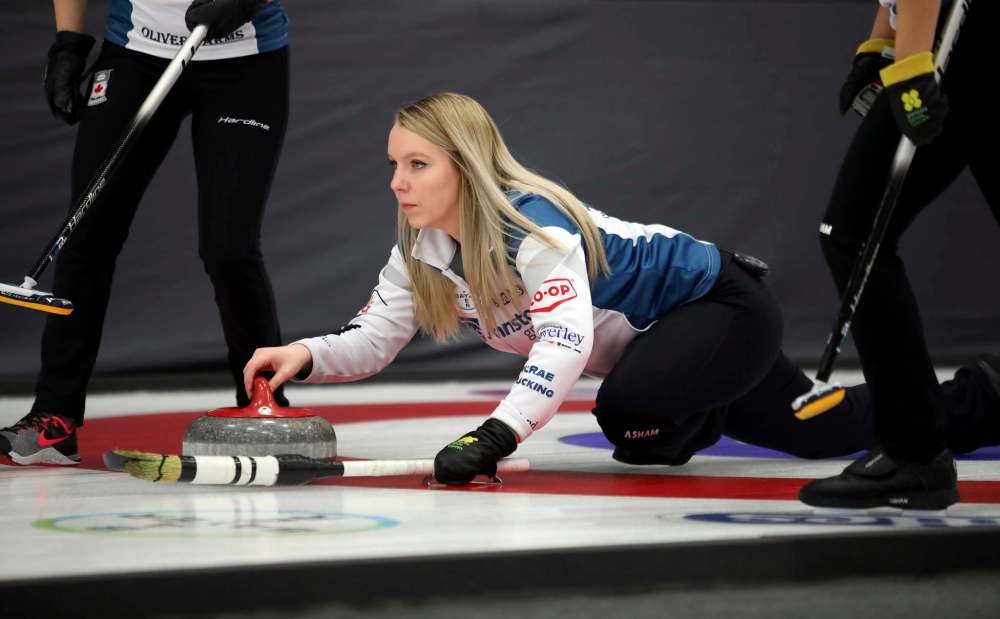
Still, though the wave of talent chasing the buffalo jacket ebbs and flows, it has never seen a tide quite this high. What else to make of having the three top-ranked women’s teams in Canada at a single provincials, along with a mountain of rising talent and a couple of the local scene’s steadiest veterans?
“When we looked at the seeding I was like, I don’t even know,” says Hailey Ryan, who is calling the shots for Team Abby Ackland this week. In most years her team, which reached playoffs last year, would get plenty of attention, but that’s hard to come by in a field that includes Tracy Fleury, Jennifer Jones and Kerri Einarson.
“Those ones are clearly top three, but after that it’s like, anybody can come to play,” Ryan continues. “Anybody could beat those teams if they have a great game and capitalize on their mistakes.”
And that’s just what’s on offer in the ladies’ side here in Rivers. There is also the future, and that too is bright: 20-year-old Altona skip Mackenzie Zacharias just swept the Canadian women’s junior championship. For all the top contenders on the ice, it seems there are plenty more looking up, hungry to replace them.
Or, look at the younger teams on the ice, skipped by players such as Ryan, fourth seed Beth Peterson, or Kristy Watling. On their rosters (and others) is a passel of players that came out of junior in close succession. They all played with and against each other, and something clearly sparked a fire in that generation.
That’s what veteran Darcy Robertson sees, when she looks at how deep the field has become.
“It’s been the mentors we’ve had in this province,” she says. “Through the years we always had great role models, in all men’s and women’s, with great success. When you’re a young person, you strive to be one of those. That’s what your goal is. We have so much of that in this province, that they can see what it takes to get to the top.”
What it takes has changed, and is changing, and maybe the current depth is as simple as a whole generation coming up that saw that up close. Because Manitoba hasn’t only kept up with the professionalization that has swept the sport, but it has led it; Robertson, who won her first Manitoba title in 1986, watched that evolution firsthand.

Back then, most of the provincial contenders still got most of their experience through local events and their club leagues. They’d travel to a bonspiel somewhere else in Canada here and there, but they were in most ways true amateurs: all the same potential that’s bursting out now, without the same infrastructure to develop them.
“The ice wasn’t as good, but the talent was there,” Robertson says. “There were lots of great teams. But the time you need to put into the game is way ahead, now. We’re putting in way more hours, we’re practising more, we’re putting more money into it too. The teams that are doing it full-time, that’s where you have to be to compete.”
Consider this: just five years ago, in Winkler, Einarson came in as seventh seed. She had all the fire in her to win it, having gone to the Manitoba final against Chelsea Carey just one year before. In Winkler she returned to the final and put up a spirited fight against Jones, but at that time lacked the finesse to truly match her.
Well, that’s changed. It would take Einarson 18 career tries to beat Jones, but in 2018 she did it, surging past her longtime rival in a national Scotties round robin game. Now that’s old news: Einarson has bested Jones in both of their matches on the World Curling Tour this season, and is ranked above her on the tour standings.
So, the Jones effect, maybe? She was so dominant in Manitoba, for so long. Young curlers came up knowing that if they ever wanted to get out of Manitoba, they’d have to get past her first. They’d watched her on TV, grown up with The Shot. Whether the fact of her consciously shaped their arcs or not, it had to have fanned the flames.
Still, other provinces have had dominant teams, without seeing quite the same effect. But the infrastructure that existed when Robertson was just starting out — the clubs, the culture, the accumulated knowledge — was a solid foundation to build on, when the shift to curling’s demands swept over the sport in earnest.

So that’s why all the curlers surveyed now point to some of the programming: the junior events, the camps run by local titans. There are several bonspiels that lure some of the world’s best, and a Curl Manitoba high performance program that can invest in polishing the most promising talents a little brighter.

“Number one is the curlers,” Curl Manitoba president Craig Baker says. “Curlers have to want to be good, and right now, in Manitoba, they want to be good. But it’s not just free agency. It’s not just residency. It’s not just our events or our programming. They all combine to create this perfect storm.”
This much is certain: when the field at a women’s provincials is so deep that even Jones isn’t the favourite to capture the buffalo jacket, it’s a good thing all around. It’s great for the fans in Rivers, who are looking ahead to a hard-hitting finish. Above all, it’s great for a sport that is still discovering just how high it can soar.
“It’s fun to be a part of,” Jones says, and laughs. “But hard. Really hard.”
melissa.martin@freepress.mb.ca
Melissa Martin
Reporter-at-large
Melissa Martin reports and opines for the Winnipeg Free Press.
Every piece of reporting Melissa produces is reviewed by an editing team before it is posted online or published in print — part of the Free Press‘s tradition, since 1872, of producing reliable independent journalism. Read more about Free Press’s history and mandate, and learn how our newsroom operates.
Our newsroom depends on a growing audience of readers to power our journalism. If you are not a paid reader, please consider becoming a subscriber.
Our newsroom depends on its audience of readers to power our journalism. Thank you for your support.
Melissa Martin
Reporter-at-large
Melissa Martin reports and opines for the Winnipeg Free Press.
Every piece of reporting Melissa produces is reviewed by an editing team before it is posted online or published in print — part of the Free Press‘s tradition, since 1872, of producing reliable independent journalism. Read more about Free Press’s history and mandate, and learn how our newsroom operates.
Our newsroom depends on a growing audience of readers to power our journalism. If you are not a paid reader, please consider becoming a subscriber.
Our newsroom depends on its audience of readers to power our journalism. Thank you for your support.
Related Articles
Young guns shooting down stars





Advertisement Advertise With Us
Advertisement Advertise With Us
History
Updated on Friday, January 31, 2020 12:05 AM CST: Adds photo