

Beauty for the masses
The city is home to 49 pieces of public art installed since 2004. Here's just a sampling

Advertisement
Read this article for free:
or
Already have an account? Log in here »
To continue reading, please subscribe:
Monthly Digital Subscription
$1 per week for 24 weeks*
- Enjoy unlimited reading on winnipegfreepress.com
- Read the E-Edition, our digital replica newspaper
- Access News Break, our award-winning app
- Play interactive puzzles
*Billed as $4.00 plus GST every four weeks. After 24 weeks, price increases to the regular rate of $19.95 plus GST every four weeks. Offer available to new and qualified returning subscribers only. Cancel any time.
Monthly Digital Subscription
$4.99/week*
- Enjoy unlimited reading on winnipegfreepress.com
- Read the E-Edition, our digital replica newspaper
- Access News Break, our award-winning app
- Play interactive puzzles
*Billed as $19.95 plus GST every four weeks. Cancel any time.
To continue reading, please subscribe:
Add Free Press access to your Brandon Sun subscription for only an additional
$1 for the first 4 weeks*
*Your next subscription payment will increase by $1.00 and you will be charged $16.99 plus GST for four weeks. After four weeks, your payment will increase to $23.99 plus GST every four weeks.
Read unlimited articles for free today:
or
Already have an account? Log in here »
Hey there, time traveller!
This article was published 12/07/2020 (2093 days ago), so information in it may no longer be current.
With a running start, Leif Timmerman lands his third attempt at jumping a wide gap between two limestone benches adjacent to the duck pond at St. Vital Park.
The eight-year-old, who is practising parkour on a hot July day, likes the challenge of hopping from one rough-cut limestone block to another in the plaza next to the pavilion and washroom building.
“This is what he prefers, the natural world,” explains his mother, Kendra Floyde, of her son’s affinity for moving through the outdoors by running, climbing, and jumping.
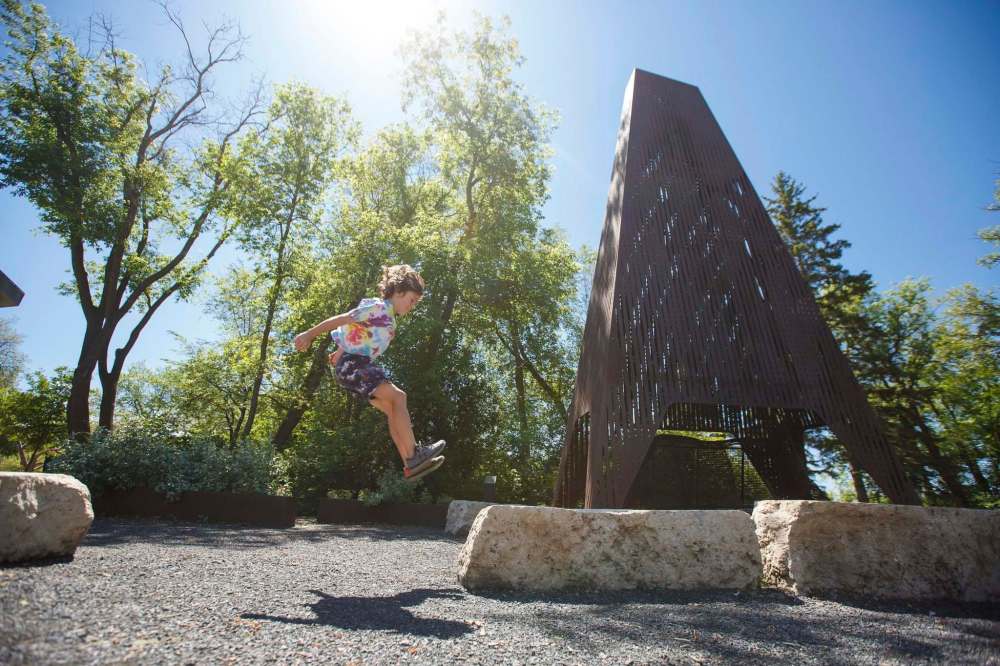
The limestone blocks are part of a public art installation titled Écobuage, which translates as controlled burn, at the centre of the southeast Winnipeg park. Designed as a place to gather and reflect about the relationship between humans and nature, it features a metal fire pit with a six-metre high pyramid-shaped metal hood, and three smaller fire pits scattered among the limestone blocks.
“I would be interested to see what it looks like full of fire,” Floyde says of the central firepit topped with a perforated metal hood.
A joint project between designer Marcelle Lussier of Urban Ink and landscape architect Liz Wreford when she was with Plain Projects, the piece, installed in 2014, is meant for park visitors to enjoy throughout the seasons, says Tamara Rae Biebrich of the Winnipeg Arts Council. That includes bringing wood to build a fire, sitting on the limestone blocks to watch the geese and ducks, or even jumping from stone to stone.
“Public art is about engaging with the public,” says Biebrich, senior project manager of public art for the non-profit organization that administers arts grants and public art projects for the city.
“Our communities (in Winnipeg) are so diverse. Every individual person brings their own knowledge and experience to the artwork.”
With people staying closer to home because of the global pandemic, consider playing tourist this summer by exploring Winnipeg’s public art.
Although several pieces are congregated downtown at Air Canada Park and Millennium Library, publicly funded artwork is also spread across the city, including at three regional parks: St. Vital, Assiniboine and Kildonan, says Biebrich.
“Our goal is to really get artwork into neighbourhoods around the city and not just downtown,” she says.
Check out the 65-page guide called Explore Winnipeg’s Public Art, published last year by the Winnipeg Arts Council, available at libraries, museums, galleries and Travel Manitoba kiosks. Or wait for its new app, available in a few weeks, which will point you to the 49 pieces of public art installed since 2004, including the seven along the new Blue Rapid Transit Line.
We’ll provide you with a running start, exploring some of the installations on the east side of the Red River and let you continue from there.
land/mark
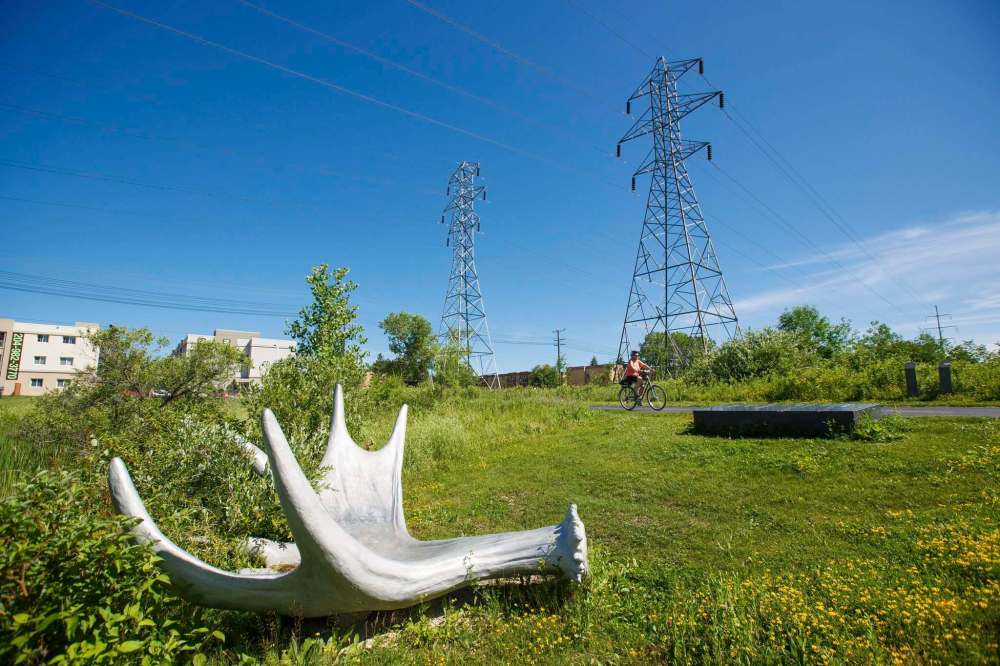
This 2009 piece by Jaqueline Metz and Nancy Chew of Muse Atelier may seem like a quick flash of silver when driving west on Bishop Grandin Boulevard, but it’s worth parking the car for a closer look. This piece consists of a large black granite bench marked with grooves mimicking the long river lots of the city’s early history, and a larger-than-life moose antler laying near bulrushes of the adjacent marsh and retention pond.
Accessed from the dead end of Kearney Street, north of Bishop Grandin, the sculpture is located along the Bishop Grandin Trail, a multi-use asphalt pathway connecting Sage Creek to St. Vital Park, well-used by cyclists and neighbourhood walkers.
“It’s beautiful here in the evening with lots of blackbirds,” says area resident Alan, who didn’t provide his last name, while on his regular walk in the area.
“I love the sound of nature.”
The cast aluminum sculpture, combined with the granite block, reflects the marks people and animals leave on the land, as well as providing a surprise for people strolling through this area of southeast Winnipeg, suggests Biebrich.
“I love the idea you can imagine this giant moose is roaming the prairie and it’s shedding its antlers,” she says.
Watershed
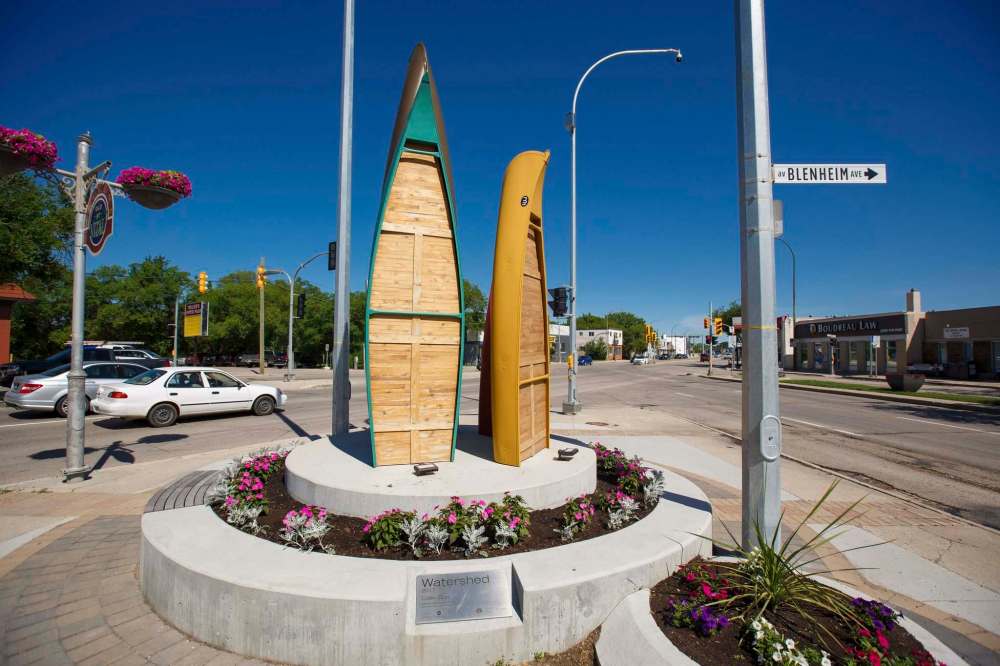
No longer seaworthy, the five upright canoes at a busy St. Vital intersection recall a time when paddling the Red River was the best — and only — way to travel the area.
Located at the northern tip of the triangle formed by the intersection of St. Anne’s Road and St. Mary’s Road, the upright canoes of varying heights and colours recall spring floods as well as the Métis heritage of the area. The tallest canoe sports the Métis infinity symbol near its tip, while a green-painted canoe marks the levels of Red River floods in 1826, 1950 and 1991.
This 2017 art piece by Collin Zipp employs real canoes, filled with wooden slats hiding metal mounting rods driven deep into the ground in order to face the dual challenges of Winnipeg’s climate and unpredictable human activity, says Biebrich.
“The stuff we build has to be safe, has to be durable, has to be (weather) resistant because public art is meant to be interacted with,” she says of the challenges of installing outdoor sculptures.
For this piece, the interaction may be limited to sitting on the circular concrete flower planter around the canoes while waiting for the bus or trying to comprehend the height of the water during the big floods of the past.
Monument
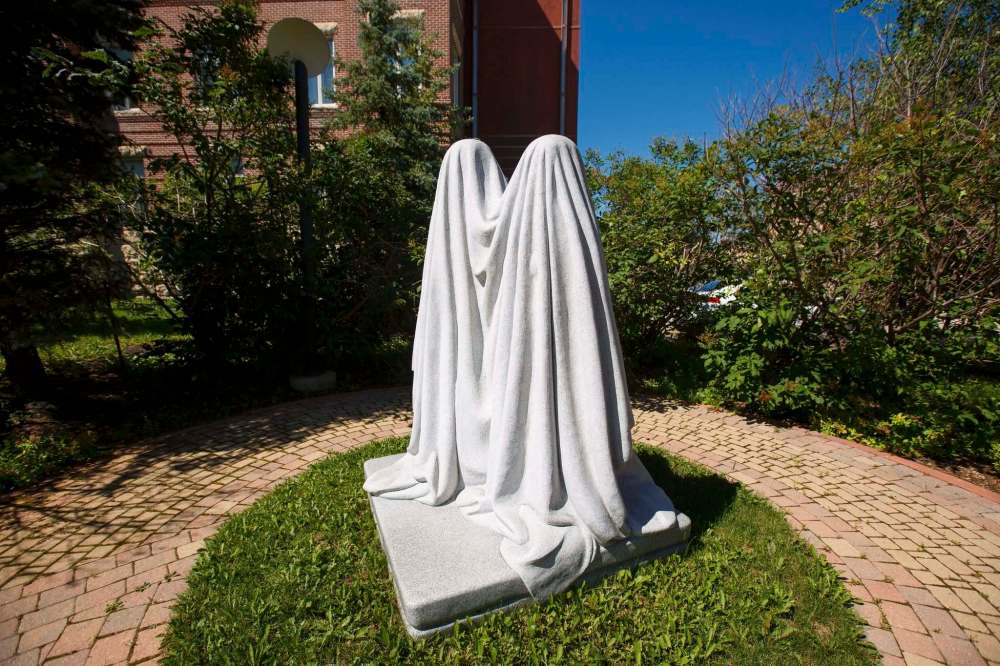
Located in the back corner of the Jardin de sculptures at 219 Provencher Blvd, this granite sculpture leaves the viewer wondering about these two shrouded figures. Are they nameless nuns in flowing habits? Children playing dress-up? Unidentified classical figures?

It probably doesn’t matter, but artist Michel de Broin invites us to ponder who might be hiding under the granite draping, says Biebrich.
“Everyone can imagine who is under there,” she says.
The granite piece is the first work — and the only piece funded through Winnipeg Arts Council — installed in the sculpture garden at La Maison des artistes, established to celebrate the 100th anniversary of the city of St. Boniface in 2008.
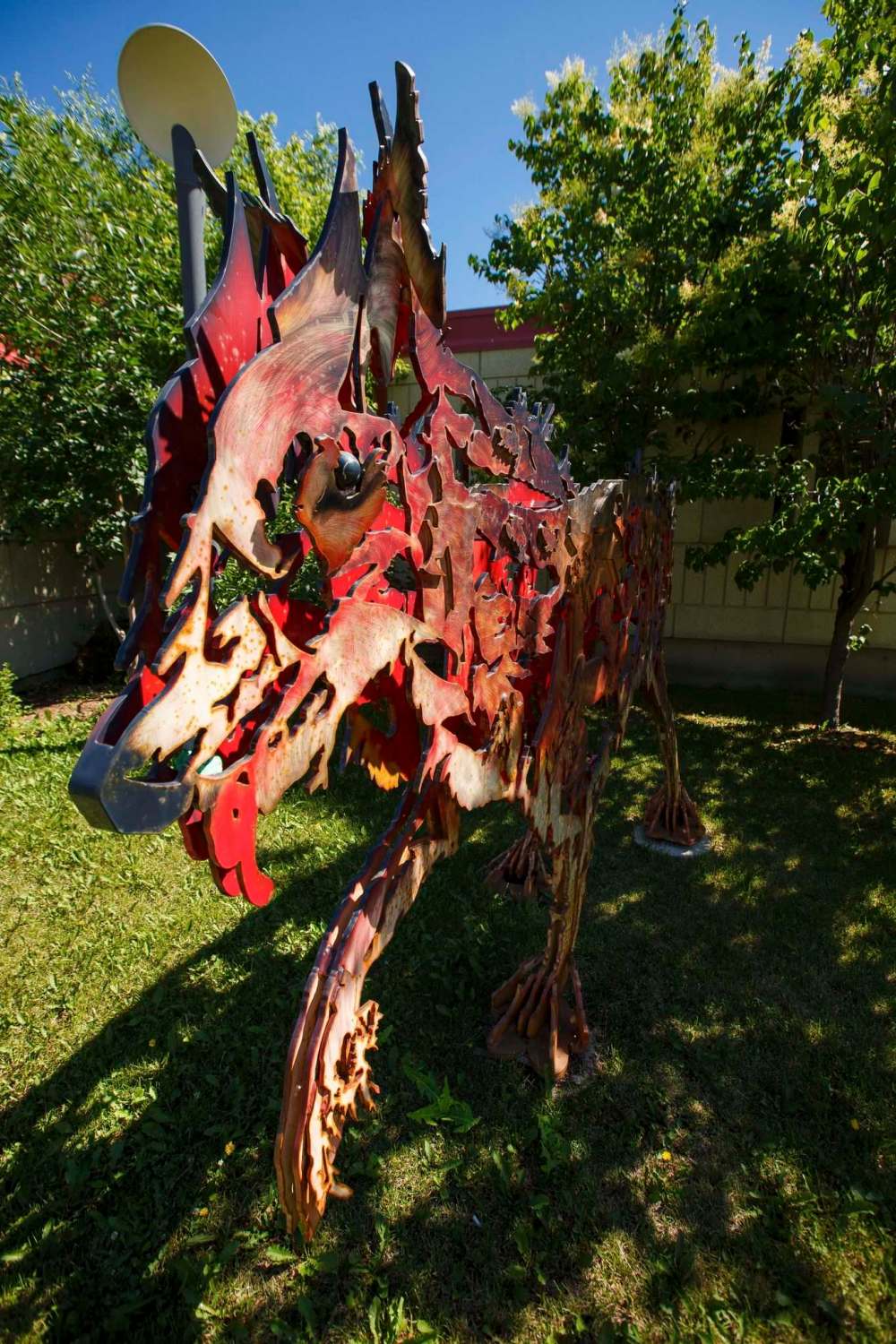
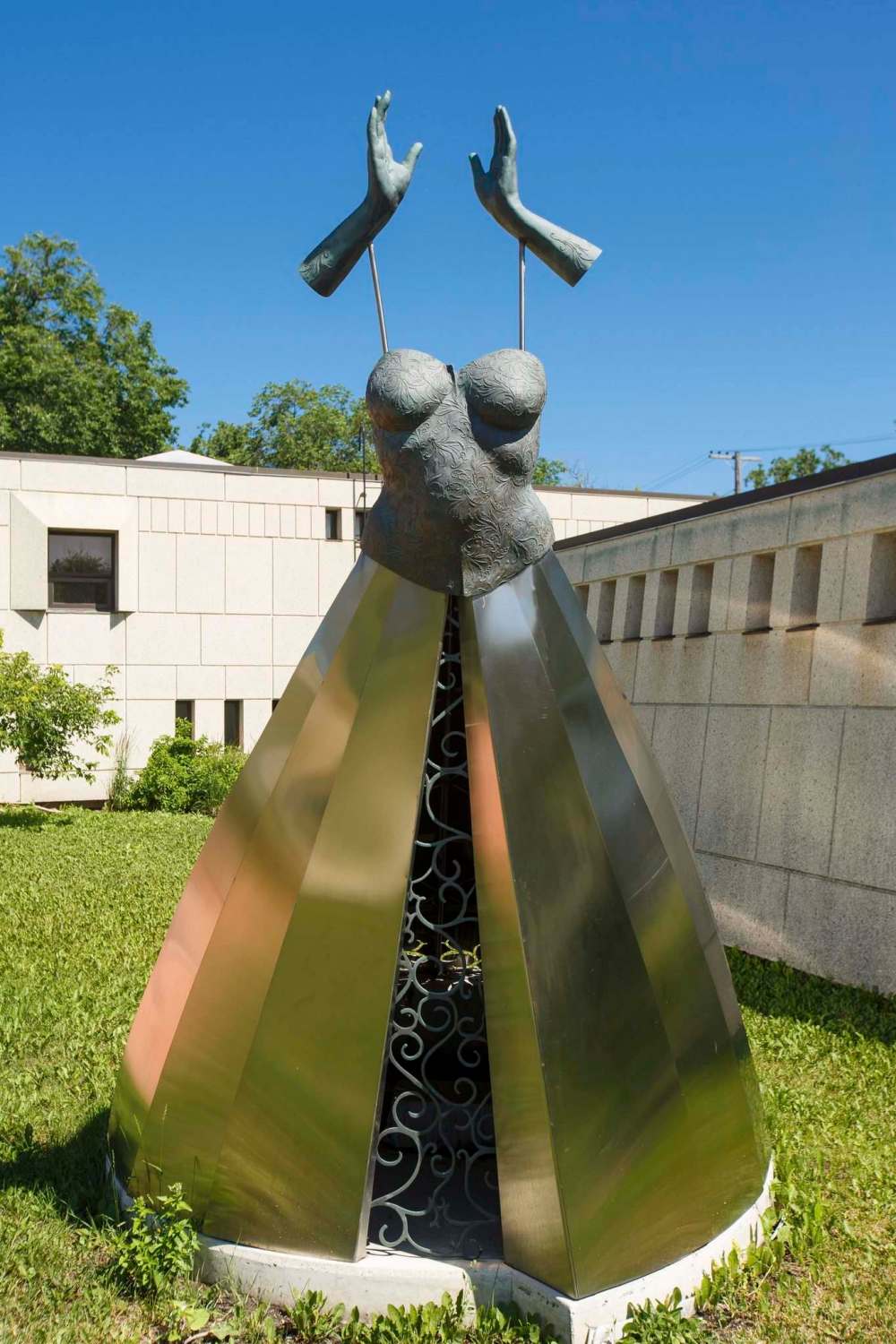
The garden is located on the east side of the former St. Boniface City Hall, and is home to several other dramatic sculptures, such as Joseph Fafard’s laser-cut steel Entre chien et loup (Between dog and wolf) and the intriguing woman-less gown La Promise by Madeleine Vrignon, which invokes the sense of a tipi in its voluminous stainless steel skirt.
brenda@suderman.com
Brenda Suderman has been a columnist in the Saturday paper since 2000, first writing about family entertainment, and about faith and religion since 2006.
Our newsroom depends on a growing audience of readers to power our journalism. If you are not a paid reader, please consider becoming a subscriber.
Our newsroom depends on its audience of readers to power our journalism. Thank you for your support.
Guided art tours
JOIN a free bike or walking tour of Winnipeg’s public art this summer and fall. The next summer evening bicycle tour takes place on Thursday, Aug. 6. Daytime and evening art walks are scheduled for Thursday, July 23, Sunday July 26 and throughout August, September and October. Register at http://winnipegarts.ca/GuidedPublicArtTours
Brenda Suderman has been a columnist in the Saturday paper since 2000, first writing about family entertainment, and about faith and religion since 2006.
Our newsroom depends on a growing audience of readers to power our journalism. If you are not a paid reader, please consider becoming a subscriber.
Our newsroom depends on its audience of readers to power our journalism. Thank you for your support.
Advertisement Advertise With Us
Advertisement Advertise With Us