

New name, same vital mission for former Winnipeg Harvest

Advertisement
Read this article for free:
or
Already have an account? Log in here »
To continue reading, please subscribe:
Digital Subscription
One year of digital access for only $1.44 a week*
- Enjoy unlimited reading on winnipegfreepress.com
- Read the E-Edition, our digital replica newspaper
- Access News Break, our award-winning app
- Play interactive puzzles
*Billed as $5.77 plus GST every four weeks. After 52 weeks, price increases to the regular rate of $19.95 plus GST every four weeks. Offer available to new and qualified returning subscribers only. Cancel any time.
To continue reading, please subscribe:
Add Free Press access to your Brandon Sun subscription for only an additional
$1 for the first 4 weeks*
- Enjoy unlimited reading on winnipegfreepress.com
- Read the E-Edition, our digital replica newspaper
- Access News Break, our award-winning app
- Play interactive puzzles
*Your next Brandon Sun subscription payment will increase by $1.00 and you will be charged $17.95 plus GST for four weeks. After four weeks, your payment will increase to $24.95 plus GST every four weeks.
Read unlimited articles for free today:
or
Already have an account? Log in here »
Hey there, time traveller!
This article was published 25/11/2020 (2014 days ago), so information in it may no longer be current.
The combination of COVID-19-related food insecurity and the approaching holiday season have led to increased need at Manitoba food banks.
The province’s largest food distribution centre, Harvest Manitoba (formerly Winnipeg Harvest), typically feeds more than 70,000 people in a month. Heading toward the new year, Harvest’s chief executive officer says the organization expects to feed more than 85,000 people in November.
“We’re probably getting calls in our call centre every single day, anywhere from 10 to 15 new families a day are calling that are new to our food bank system,” said Keren Taylor-Hughes.
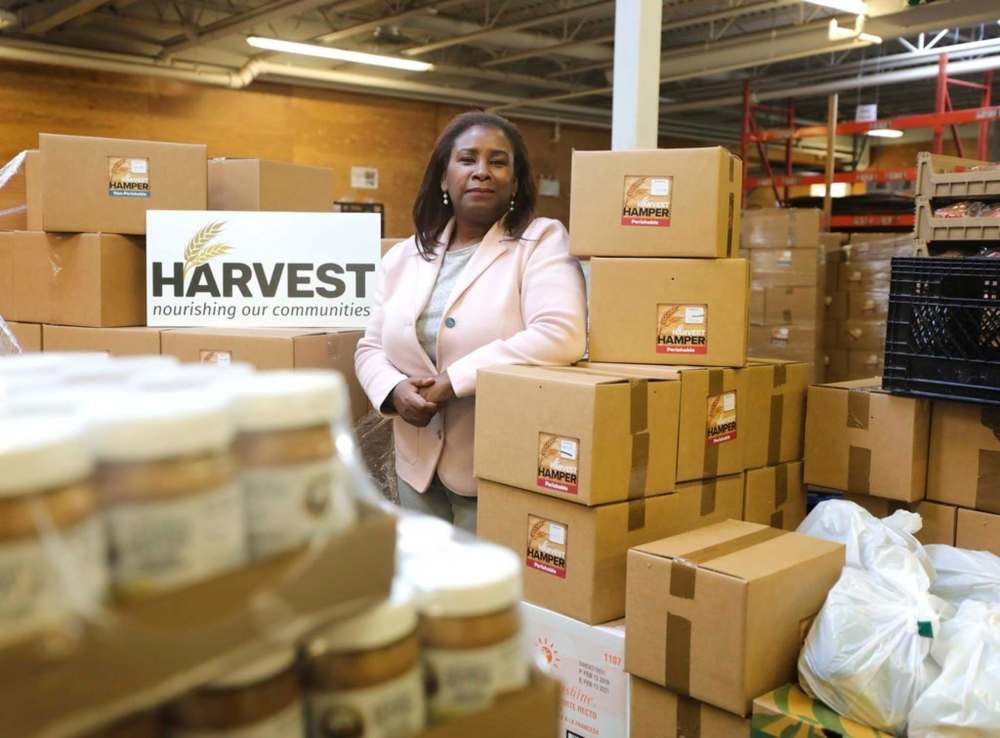
In the early months of the pandemic, need for local food bank resources spiked by 30 per cent. Those months were “the hardest,” Taylor-Hughes said, as families and individuals who had just been getting by in pre-COVID times lost jobs and security.
As federal funding programs offered stability for families, businesses and organizations, Taylor-Hughes said Harvest Manitoba’s numbers dipped and plateaued.
Now, as fall draws to a close and federal programs began to dry up, food insecurity is again on the rise, she said, though donations have remained steady.
“I think people are aware of the need. I think Manitobans understand that people are in circumstances for reasons beyond their own, and I think those that have want to give,” said Taylor-Hughes.
On Wednesday, to reflect ongoing work to ensure food security for all Manitobans — not just those within city limits — Winnipeg Harvest announced a merger with the Manitoba Association of Food Banks, uniting the two organizations under the name Harvest Manitoba.
“It’s important for people to grasp the scope of the work that we do. We’re one of the largest food distribution centres in the country, and that’s because we serve our whole province,” said Taylor-Hughes.
“We will work closely with all of our food banks and agencies to help them become stronger, especially in the rural sites. We want to support our food banks to get their voice out in the community.”
The province’s second-largest food bank, Samaritan House Ministries Inc. in Brandon, said its need has increased again as the holiday season draws closer.
“They were slowly starting to go up over summer and fall, but we’ll be back to our numbers pre-COVID, if not a little higher,” said Barbara McNish, executive director at Samaritan House.
“I just have a sense that there are people that are not able to work due to COVID and so unemployment (benefits) is… not enough when you’ve got to pay rent, so food is probably the last thing people buy.”
Samaritan House has had steady donations through the pandemic, McNish said, thanking businesses and corporate donors and community members for ongoing support.
McNish said the Brandon food bank has declined accepting volunteers over age 60, as they are more at risk of coronavirus harm, but have cohorts of younger volunteers working alongside staff to keep it running.
“We’re working the best we can, but we have downsized our volunteers for sure,” she said.

Volunteers at the provincial food distribution site were “low for a little while,” Taylor-Hughes said, but after a social media push, warehouse volunteer numbers have steadied.
Harvest Manitoba works “above and beyond” to keep the warehouse space safe for volunteers, performing daily temperature checks and ensuring social distancing among other measures, she said.
Harvest’s biggest challenge, she noted, is a need for drivers who can operate the trucks and distribute food from the centre to food banks around the province.
julia-simone.rutgers@freepress.mb.ca
Twitter: @jsrutgers
Julia-Simone Rutgers is the Manitoba environment reporter for the Free Press and The Narwhal. She joined the Free Press in 2020, after completing a journalism degree at the University of King’s College in Halifax, and took on the environment beat in 2022. Read more about Julia-Simone.
Julia-Simone’s role is part of a partnership with The Narwhal, funded by the Winnipeg Foundation. Every piece of reporting Julia-Simone produces is reviewed by an editing team before it is posted online or published in print — part of the Free Press‘s tradition, since 1872, of producing reliable independent journalism. Read more about Free Press’s history and mandate, and learn how our newsroom operates.
Our newsroom depends on a growing audience of readers to power our journalism. If you are not a paid reader, please consider becoming a subscriber.
Our newsroom depends on its audience of readers to power our journalism. Thank you for your support.
Julia-Simone Rutgers is the Manitoba environment reporter for the Free Press and The Narwhal. She joined the Free Press in 2020, after completing a journalism degree at the University of King’s College in Halifax, and took on the environment beat in 2022. Read more about Julia-Simone.
Julia-Simone’s role is part of a partnership with The Narwhal, funded by the Winnipeg Foundation. Every piece of reporting Julia-Simone produces is reviewed by an editing team before it is posted online or published in print — part of the Free Press‘s tradition, since 1872, of producing reliable independent journalism. Read more about Free Press’s history and mandate, and learn how our newsroom operates.
Our newsroom depends on a growing audience of readers to power our journalism. If you are not a paid reader, please consider becoming a subscriber.
Our newsroom depends on its audience of readers to power our journalism. Thank you for your support.
Advertisement Advertise With Us
Advertisement Advertise With Us
History
Updated on Wednesday, November 25, 2020 9:13 PM CST: Fixes several typos.