

Life in the WHL East hub a grand experiment
Very different vibe, but players just glad to be on the ice
Advertisement
Read this article for free:
or
Already have an account? Log in here »
To continue reading, please subscribe:

Digital Subscription
One year of digital access for only $205*
- Enjoy unlimited reading on winnipegfreepress.com
- Read the E-Edition, our digital replica newspaper
- Access News Break, our award-winning app
- Play interactive puzzles
*First annual payment billed as $205.00 + GST for one year. This annual subscription will automatically renew at $233.00 + GST every 52 weeks (10% off the regular annual price of $259.35). Offer available to new and qualified returning subscribers only. Cancel any time.
To continue reading, please subscribe:
Add Free Press access to your Brandon Sun subscription for only an additional
$1 for the first 4 weeks*
- Enjoy unlimited reading on winnipegfreepress.com
- Read the E-Edition, our digital replica newspaper
- Access News Break, our award-winning app
- Play interactive puzzles
*Your next Brandon Sun subscription payment will increase by $1.00 and you will be charged $17.95 plus GST for four weeks. After four weeks, your payment will increase to $24.95 plus GST every four weeks.
Read unlimited articles for free today:
or
Already have an account? Log in here »
Hey there, time traveller!
This article was published 28/03/2021 (2024 days ago), so information in it may no longer be current.
It’s the WHL’s grand social experiment.
Gather about 300 players, coaches and officials at the league’s East Division hub in Regina, house and feed them in university dormitories and stage a mini-training camp and games at the nearby Brandt Centre for almost two months.
In normal times, the scenario would have little appeal. To hockey-starved players, many who have done without game action for 11 months or more, this is as good as it’s going to get and when the clock is ticking on your junior career, time is of the essence.
VACCINE PROGRAM GIVE WINTERHAWKS HOME REPRIEVE
The WHL’s U.S. Division was late to get its season started but with a super-charged vaccination program powering up south of the 49th parallel, the five American teams haven’t looked back since opening night March 18.
The WHL’s U.S. Division was late to get its season started but with a super-charged vaccination program powering up south of the 49th parallel, the five American teams haven’t looked back since opening night March 18.
Originally, the four Washington state-based clubs were allowed to host games without fans while the league’s only Oregon-based club, the Portland Winterhawks, were forced to take their show on the road — apparently for the long term.
However, the Winterhawks were recently granted state approval to host games and Friday they debuted at Veterans Memorial Coliseum in a 2-1 overtime loss to the Everett Silvertips. Portland will play its remaining home dates at the Coliseum.
“Things have really changed over the last month in the U.S.,” said Winterhawks head coach and general manager Mike Johnston prior to Sunday’s road date in Kent, Wash., against the Seattle Thunderbirds. “They’re down to vaccinating 20-year-olds now this week — it’s down from 80-, 60- and 50(-year-olds) last month.
“Everything’s starting to open up and they’ve allowed us to play a contact sport without fans right now, but the same regulations in Washington state with about 200 people in the building. I think Washington’s up to 400 in the building this week.”
Johnston doesn’t expect fans to be allowed in the Coliseum this season but believes buildings in the Pacific Northwest to be reopened to spectators by the start of 2021-22.
The Winterhawks were hoping for a reprieve from state health authorities and front-loaded their schedule with away games.
“It’s been more challenging — this is our fifth game on the road and next week we play three more because we knew we might have a chance to play in Portland,” said Johnston. “It doesn’t really matter right now because we’re just playing and that’s the most important thing. Our players have stayed healthy and all our testings gone well and that’s what we’re hoping for.”
With the U.S. Division now underway and the five Alberta-based Central teams having started played on Feb. 26, the B.C. Division clubs were the last to receive government approval.
B.C. is employing the hub centres of Kamloops and Kelowna, with four of the five teams opening their schedules on Friday night. Fans are not permitted at B.C. or Central Division games.
The Alberta teams are permitted to travel but two teams — the Edmonton Oil Kings and the Calgary Hitmen — were forced to vacate their buildings to adhere to NHL safety protocols.
The Oil Kings have relocated to Edmonton’s Downtown Community Arena, next door to Rogers Place and the Hitmen have moved their operations from the Saddledome to the Seven Chiefs Sportsplex & Jim Starlight Centre in southwest Calgary.
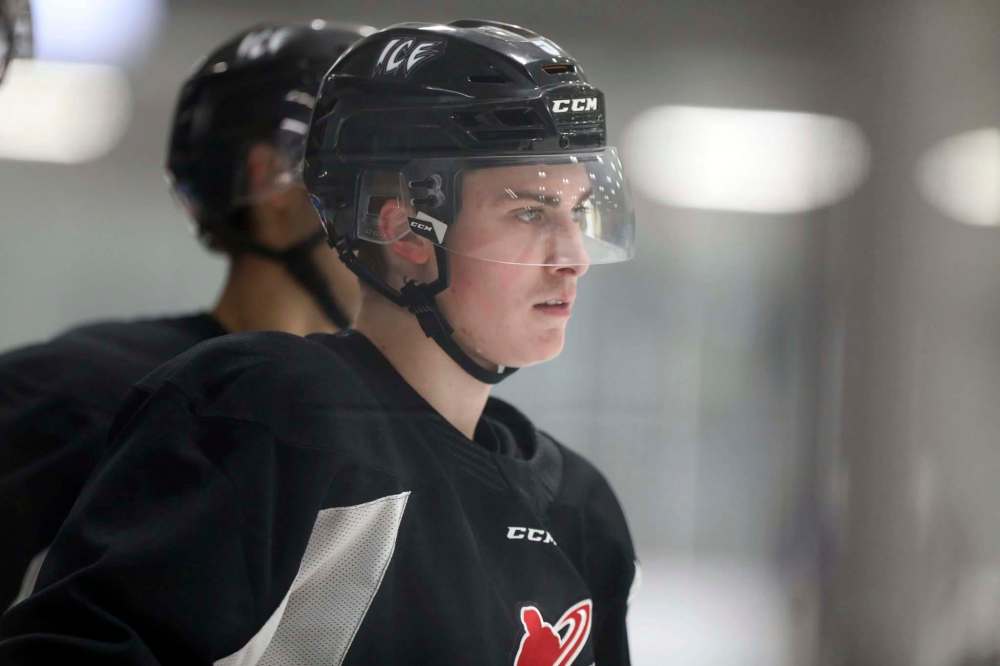
“I think our group here is having a really good attitude about it,” says veteran Winnipeg Ice defenceman Mike Ladyman. “I think we’re all just pretty grateful that we have this opportunity because some people aren’t even allowed to play hockey right now. I think we’re just taking it day by day and not taking anything for granted.”
Conceived as a way to gain approval from Saskatchewan and Manitoba health authorities to play games after months in lockdown, the hub has been operating on schedule since March 12.
As of Sunday, each of the East’s seven teams has played at least eight of their scheduled 24-game slate.
Off the ice has been a surprise, with glowing reports about the dorm facilities at the University of Regina, a 15-minute drive from the rink.
Players are living in suites of four bedrooms, with three or four players to a suite. Each suite has two bathrooms, a kitchen and living room area. There are no security guards on the dorm entrances, a testament to the month of prep work coaches and staff did with the players.
“We talked so much about trust, respect and appreciation and throughout those discussions we talked about how fortunate we are that we are allowed to be playing now and the commitment that this has taken from the league and the owners to allow this to happen,” says Ice head coach James Patrick.”I just know our guys have so bought into it.
“There aren’t any guards here but we talked about how important it is to follow the process and stick to the protocols and what’s expected of us.”
Players can leave the dorms to get some fresh air during an on-campus walk, but only when masked up and accompanied by a coach.
“There was going to have to be a whole lot of internal accountability from the players and bottom line, nobody wants to be that guy that messes it up for everybody, not just not just for your team but the whole division really,” says Moose Jaw Warriors head coach Mark O’Leary. “We’re real happy with our guys.
“They’re teenage kids so there’s all kinds of things that they’re used to being able to do but they have their own entertainment here, they’re around their buddies and the buy-in’s been great.”
Now, after a month in the hub, is cabin fever starting to creep in?
“I could see that happening but we still have a room that all the guys can hang out in and get together,” said Mateychuk. “I think that really helps. If we were totally isolated all the time and I think it would be a different story but the way it is now, I think we’ll be OK.”
Mateychuk, a 16-year-old from Dominion City, is partial to playing cards while others prefer gaming. Teams have also organized group activities to break up the monotony.
“We had a lot of questions coming in in terms of what it would look like and to be completely honest, I couldn’t ask for much more than this in terms of staying at a dorm,” says O’Leary. “It’s much better than what I expected. I think the players are really enjoying it. They’re around each other all the time and I guess it’s good for a team, certainly in the short term.”
Warriors left-winger Eric Alarie has settled right in to dorm life.
“It was a little difficult to start because we had to quarantine and we had to stay in our rooms, so that was kind of hard,” says Alarie, an 18-year-old from Winnipeg. “But we have a lounge up there and we can play cards, poker and we got a pool table and a ping pong table as well as a TV, so we were spending a lot of time together and doing all kinds of activities.”
Good chemistry with your roomies is crucial.
“You get to see some habits around the apartment, you see which guys take care of the rooms a little bit better than others,” says Ladyman. “I’m with Anderson MacDonald and Cole Muir. They’re pretty tidy guys and pretty easy to live with. Anderson’s actually a pretty good cook, too, so that’s helped a little bit. It’s almost like a little home cooking every once in a while, he’ll whip something up for us.”
Muir, an 20-year-old centre from Vista, is very popular with his teammates.
“He’s not the most talkative guy but when he gives you something, it’s usually pretty funny,” says Ladyman. “I’m not sure what it is — he seems a little shy at first but once you get to know him he opens up.”
When Patrick first heard about the league’s using dorms, he flashed back almost four decades to his spartan digs at the University of North Dakota. In 2021, he shares a four-bedroom suite with assistant coach Josh Green and they’ve brought along some creature comforts.
“This is like the penthouse of college dorms,” says Patrick. “It’s a nice sized bedroom. When I went to university, there was two of us, me and Dave Tippett, in a room this size with a shared bathroom just outside the door with another room. So we’ve got a really good here. My biggest question coming into this was, ‘What is what is it going to be like? Oh my God, I’m going to be back in the dorm.’ But it’s very comfortable.
“Josh and I both brought TVs, he brought coffeemaker, I brought a SodaStream and we’ve got a lot of food for the fridge. Every night we pull up the TV hooked it up to the computer and we’re watching NHL games and we watched some golf on the weekend. It’s not too different from being at home.”

mike.sawatzky@freepress.mb.ca
Twitter: @sawa14