

Health experts say blood clots ‘very rare’ as Canada reports its first case tied to AstraZeneca’s COVID-19 vaccine
Advertisement
Read this article for free:
or
Already have an account? Log in here »
To continue reading, please subscribe:
Digital Subscription
One year of digital access for only $1.44 a week*
- Enjoy unlimited reading on winnipegfreepress.com
- Read the E-Edition, our digital replica newspaper
- Access News Break, our award-winning app
- Play interactive puzzles
*Billed as $5.77 plus GST every four weeks. After 52 weeks, price increases to the regular rate of $19.95 plus GST every four weeks. Offer available to new and qualified returning subscribers only. Cancel any time.
To continue reading, please subscribe:
Add Free Press access to your Brandon Sun subscription for only an additional
$1 for the first 4 weeks*
- Enjoy unlimited reading on winnipegfreepress.com
- Read the E-Edition, our digital replica newspaper
- Access News Break, our award-winning app
- Play interactive puzzles
*Your next Brandon Sun subscription payment will increase by $1.00 and you will be charged $17.95 plus GST for four weeks. After four weeks, your payment will increase to $24.95 plus GST every four weeks.
Read unlimited articles for free today:
or
Already have an account? Log in here »
Hey there, time traveller!
This article was published 13/04/2021 (2016 days ago), so information in it may no longer be current.
Health officials are looking into Canada’s first reported case of a blood clot linked to the AstraZeneca vaccine as the U.S. pauses use of the Johnson & Johnson shot for similar concerns, while experts maintain the risks of COVID-19 still far outweigh those of vaccination.
The Canadian case involves a Quebec woman who received a Covishield vaccine — the brand name of the AstraZeneca vaccine made in India. She, is recovering at home, Health Canada said in a news release Tuesday, following what it described as a “very rare” adverse event.
The case will be considered as part of the regulator’s ongoing safety review of both the AstraZeneca and Covishield vaccines, according to the statement.
While this is the first such reported incident in Canada, European countries have been grappling for weeks with how to manage risk after a small number of blood clots have been connected to the AstraZeneca vaccine. The vaccine is not currently recommended for people under 55 in Canada.
However, Canadian officials stress that with more infectious variants of COVID-19 driving an increase in severe outcomes in young people, getting sick is still riskier than getting a vaccine.
“With the rising cases and increased numbers of severe outcomes in younger populations, the analysis on the impact of COVID-19 also has to be taken into account when you look at that benefits and risk analysis,” said Dr. Theresa Tam, Canada’s chief public health officer on Tuesday.
News of the Canadian case came hours after the United States announced it was pausing use of the Johnson & Johnson vaccine while health officials there investigate reports that six women between the ages of 18 and 48 had experienced blood clots days after getting the shot.
The Johnson & Johnson vaccine is currently the only single-shot vaccine approved for use in Canada and the United States.
It’s not unusual to see side effects that didn’t occur in clinical trials when a new drug is broadly distributed, said Dr. David Juurlink, a drug safety researcher and head of the division of clinical pharmacology and toxicology at the University of Toronto.
The reports warrant further investigation, Juurlink said, but it appears that the risk of blood clots is somewhere in the neighbourhood of one in 100,000, which is low.
Furthermore, Juurlink said, concerns about vaccines must be weighed against the benefits of being protected against COVID-19 — a disease which comes with its own major risks, including a chance of blood clots.
“The COVID we are seeing now is different from last year’s COVID. It is making people sick when they’re younger, it is making them sick for longer, it is making them infectious for longer,” he said.
“It is inherently a much more fearsome disease, and I think people should be mindful of that.”
While the AstraZeneca and Johnson & Johnson vaccines were created using the same method — they each use a common cold bug called an adenovirus to sneak a bit of coronavirus genetic material into your body — Juurlink said there’s no reason to think there’s an issue with the approach yet, but more investigation into the link between vaccines and clots will be required.
The U.S. has administered more than 6.8 million doses of the Johnson & Johnson vaccine. Health Canada has authorized its use, but the first delivery of 10 million doses isn’t expected until later this month.
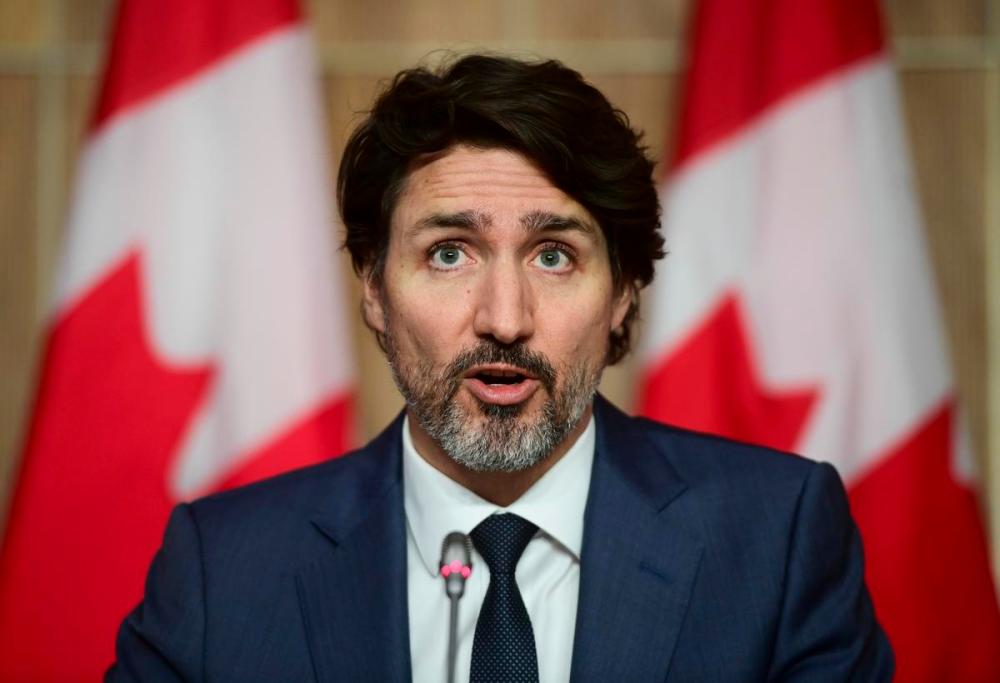
Prime Minister Justin Trudeau said his government was following developments south of the border closely.
“We can assure everyone that Health Canada will, every step of the way, put the health of Canadians first and foremost in any decisions we make around distributing vaccines,” Trudeau told a news conference Tuesday.
The Johnson & Johnson vaccine is not part of the 44 million doses that Canada is expecting to receive by the end of June in order to offer every adult in the country a first shot, Trudeau said.
Meanwhile, the third wave’s start rise in COVID-19 infections has public health officials urging Canadians to continue following restrictions.
Tam said cases are “rising along a strong resurgence trajectory” and that while vaccines have resulted in higher risk groups of people experiencing less instances of severe disease, public health restrictions should be followed as hospitals fill up.
Over the last week, there’s been a 33 per cent rise in new case counts, with an average of nearly 8,100 new cases reported every day, said Tam.
In the same period, Tam said there were about 3,000 people in hospital receiving treatment for COVID-19 each day, representing a 29 per cent jump, including 970 people in intensive care units, which is a 24 per cent rise since last week.
“Although the number of deaths has averaged around 30 each day for several weeks, there is concern that if the increase in severe illnesses persists, we could see a gradual increase in the mortality trend,” said Tam.
“This is the third big push and we’re all tired, but the benefits of applying our strongest collective effort by following public health advice and strictly maintaining individual precautions could not be greater.”
With files from The Canadian Press
Kieran Leavitt is an Edmonton-based political reporter for the Toronto Star. Follow him on Twitter: @kieranleavitt
Alex Boyd is a Calgary-based reporter for the Star. Follow her on Twitter: @alex_n_boyd
Related Articles
Doctors weigh in as U.S. pauses use of Johnson & Johnson vaccine
Advertisement Advertise With Us
Advertisement Advertise With Us