

Shevchenko’s plan for Ukraine continues to breed success at Euro 2020
Advertisement
Read this article for free:
or
Already have an account? Log in here »
To continue reading, please subscribe:

Digital Subscription
One year of digital access for only $205*
- Enjoy unlimited reading on winnipegfreepress.com
- Read the E-Edition, our digital replica newspaper
- Access News Break, our award-winning app
- Play interactive puzzles
*First annual payment billed as $205.00 + GST for one year. This annual subscription will automatically renew at $233.00 + GST every 52 weeks (10% off the regular annual price of $259.35). Offer available to new and qualified returning subscribers only. Cancel any time.
To continue reading, please subscribe:
Add Free Press access to your Brandon Sun subscription for only an additional
$1 for the first 4 weeks*
- Enjoy unlimited reading on winnipegfreepress.com
- Read the E-Edition, our digital replica newspaper
- Access News Break, our award-winning app
- Play interactive puzzles
*Your next Brandon Sun subscription payment will increase by $1.00 and you will be charged $17.95 plus GST for four weeks. After four weeks, your payment will increase to $24.95 plus GST every four weeks.
Read unlimited articles for free today:
or
Already have an account? Log in here »
Hey there, time traveller!
This article was published 02/07/2021 (1915 days ago), so information in it may no longer be current.
It was back in June of 2019 that it all started to come together.
On a mild, humid night in Lviv, Ukraine’s national football team hammered Serbia 5-0 in Euro 2020 qualifying. As the score suggests, it was a complete performance. Not only did the hosts find the back of the net with satisfying regularity, but they also dominated possession, launched 22 attempts at goal and passed the ball more than 500 times.
To watch them was to see an all-action group of highly-skilled players, both interchanging positions and completing drilled combinations. They dominated without committing a single bookable offence. Even more crucially, they enjoyed their football.
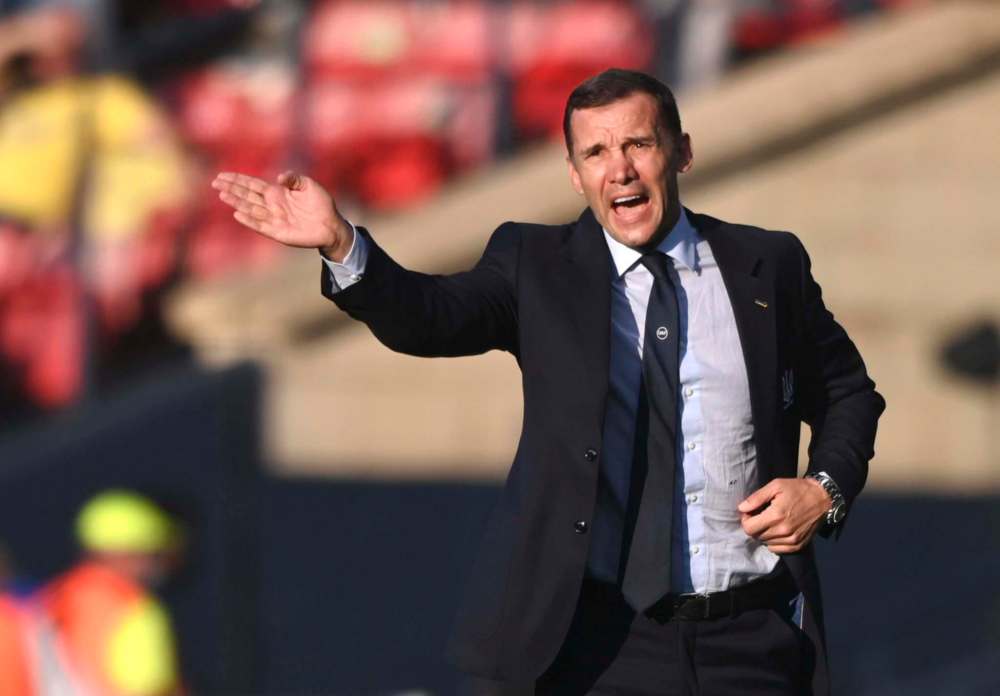
It was the culmination of Andriy Shevchenko’s vision for Ukraine, who sealed first place in their section with a memorable 2-1 win over European Champions Portugal the following October.
Saturday, at Rome’s Stadio Olimpico (2 p.m., TSN), they’ll face England in a first ever European quarterfinal. They won’t be expected to win. But, then again, Shevchenko has defied expectations just to get to this point.
It’s possible that no individual is as singularly responsible for a berth in Euro 2020’s last eight as the 44-year-old.
And his side continues to improve.
Appointed Zbirna manager following the group stage exit of Euro 2016, Shevchenko began by changing everything. Out went the submissive, counter-attacking style of predecessor Mykhaylo Fomenko; in came an assertive, flexible, passing-oriented approach reminiscent of that of his former Dynamo Kiev manager and mentor Valeriy Lobanovskyi.
One of football’s most inventive thinkers, Lobanovskyi was an early designer of “total football,” which Ajax and the Netherlands made famous under Rinus Michels. Shevchenko also played in a similar system with Lobanovskyi, the two winning three Ukrainian titles together in the late 1990s.
Early returns, however, were disappointing.
Having taken just one of six possible points from Iceland, Ukraine went into the final round of 2018 World Cup qualifying in need of a win over Croatia. They were blanked 2-0 in Kiev and finished third in their group. But Shevchenko, again like Lobanovskyi, learned from everything.
He dropped a handful of veteran internationals, including Yevhen Khacheridi, Ruslan Rotan and Yevhen Seleznyov, instead opting to call up younger players he could build around.
Three of them — Ilya Zabarnyi, Mykola Shaparenko and Roman Yaremchuk — started Tuesday’s round of 16 match against Sweden, and Arten Dovbyk, in just his third match for his country, scored the extra time winner in Glasgow.
Lobanovskyi was renowned for his psychiatric skills, and in that, too, Shevchenko mirrors his former boss.
Images abound of the 2004 Ballon d’Or winner donning a training jersey and mixing it up with his players. It’s important that the team has fun, but there’s an ulterior motive for his involvement in practice sessions.
Each of Ukraine’s players will have been personally drilled in their roles by Shevchenko, who isn’t above moving close alongside and coaching the minutiae of their movements. He will have, for example, walked Shaparenko through a wide attack while opposite winger Andriy Yarmolenko cuts inside. Asymmetry, after all, is key to his tactics.
And it’s what’s been throwing off opponents at these Euros.
It’s one thing to track or man-mark a particular player; it’s another to be forced into following him outside the bounds of your own position. Ukraine are at their best when the other team is positionally off-balance, and they’ll be hoping to have England teetering Saturday in Rome.

England’s task, then, is to keep as much of the ball as possible. It sounds straightforward, but against Ukraine it’s as much a defensive mechanism as an offensive one. They proved they could do it in their win against Germany, when Declan Rice, in particular, ran the show in the centre of the park. Kieran Trippier and Luke Shaw will also have their hands full with Ukraine’s false wingers.
At least, that’s the plan. Shevchenko’s plan.
He can draw a line from that night in Lviv to Saturday’s quarterfinal in Rome — when he’ll put what he has envisioned to the test to see if he can keep on drawing, planning, winning.
jerradpeters@gmail.com
Twitter @JerradPeters
Our newsroom depends on a growing audience of readers to power our journalism. If you are not a paid reader, please consider becoming a subscriber.
Our newsroom depends on its audience of readers to power our journalism. Thank you for your support.
Our newsroom depends on a growing audience of readers to power our journalism. If you are not a paid reader, please consider becoming a subscriber.
Our newsroom depends on its audience of readers to power our journalism. Thank you for your support.
Related Articles
Toronto FC set to leave Florida and head home








Advertisement Advertise With Us
Advertisement Advertise With Us