

Rising demand for federal inquiry into Sixties Scoop

Advertisement
Read this article for free:
or
Already have an account? Log in here »
To continue reading, please subscribe:

Digital Subscription
One year of digital access for only $205*
- Enjoy unlimited reading on winnipegfreepress.com
- Read the E-Edition, our digital replica newspaper
- Access News Break, our award-winning app
- Play interactive puzzles
*First annual payment billed as $205.00 + GST for one year. This annual subscription will automatically renew at $233.00 + GST every 52 weeks (10% off the regular annual price of $259.35). Offer available to new and qualified returning subscribers only. Cancel any time.
To continue reading, please subscribe:
Add Free Press access to your Brandon Sun subscription for only an additional
$1 for the first 4 weeks*
- Enjoy unlimited reading on winnipegfreepress.com
- Read the E-Edition, our digital replica newspaper
- Access News Break, our award-winning app
- Play interactive puzzles
*Your next Brandon Sun subscription payment will increase by $1.00 and you will be charged $17.95 plus GST for four weeks. After four weeks, your payment will increase to $24.95 plus GST every four weeks.
Read unlimited articles for free today:
or
Already have an account? Log in here »
Hey there, time traveller!
This article was published 01/11/2021 (1798 days ago), so information in it may no longer be current.
Sixties Scoop survivor Teri Starr is on a long journey of healing, grappling with the pain of being removed from family and community just months after she was born.
“It’s important for us to know that we as children were taken, and it wasn’t because our parents didn’t love us — I was told that was one of the reasons why I was taken, was because parents didn’t love me, or community didn’t love me,” Starr said at a news conference Monday. “But it was due to a policy.”
Starr, an Indigenous woman from Manitoba, was adopted at three months old by a non-Indigenous family. She counts her upbringing a “blessing,” as she was raised in a “really good home,” adding “many of the Sixties Scoop survivors cannot actually say that.”
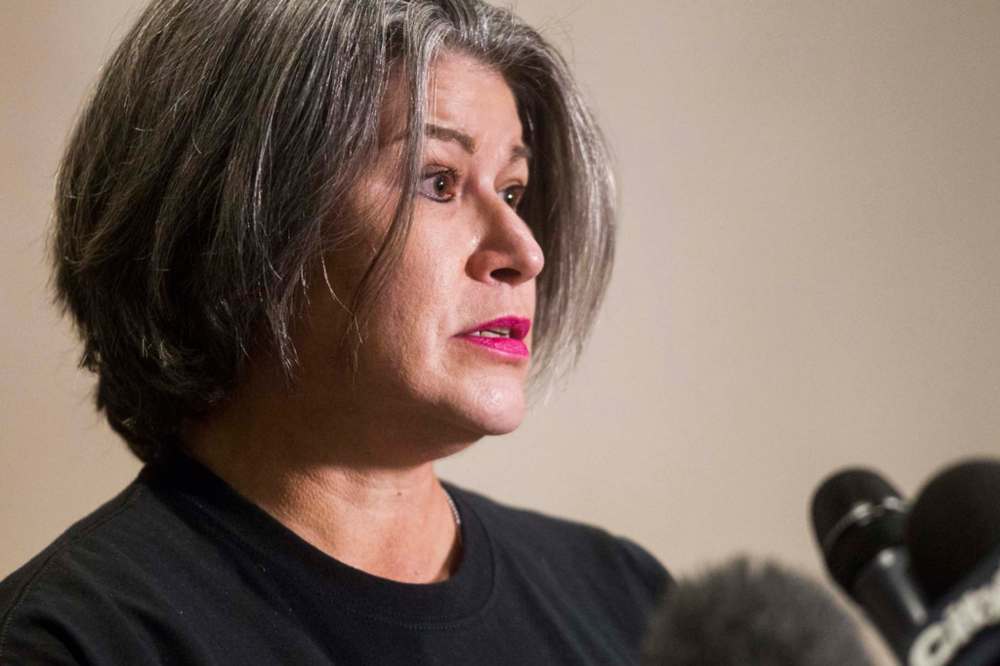
Joined by northern chiefs of the Manitoba Keewatinowi Okimakanak, Southern Chiefs’ Organization, and the director of the 60s Scoop Legacy of Canada, Starr spoke at the Canadian Museum for Human Rights to call for a survivor-led and federally-funded inquiry into the multi-generational impacts of the program.
Between approximately 1951 and 1982, at least 22,000 Indigenous children were “scooped” from their families and communities to be placed in the adoptive or foster care of non-Indigenous families.
Survivors estimate the number of children removed from their homes is significantly higher, and say many of those children have never returned home.
“For me, it’s about accountability,” said Katherine Legrange, a survivor and director of the peer support group 60s Scoop Legacy of Canada. “The Canadian government has never been accountable for the Sixties Scoop, and certainly the provincial governments have never been held responsible. But also our parents and grandparents need to know that this was not their fault.”
The group has held 19 healing gatherings across Western Canada, where survivors have repeatedly asserted the need for a national inquiry, Legrange said.
“It’s important that we dig into the Sixties Scoop and government policies of Indigenous child removal to determine how many children were taken, where they were taken to, and the long-term effects of trauma and permanent child removal,” she added.
Starr and Legrange spoke candidly of the trauma inherit in being raised disconnected from their cultures, identities and families.
“When I found out I was a Sixties Scoop, then you try and go back and learn your culture but it’s been taken away. Where do you start, where do you go, who do you ask?” said Starr, who welled up with tears as she explained her hesitation to meet her birth family.
“I’m just waiting for the right time,” she said. “Because I do not want to offend anybody in that search, but I do know that healing can come from both halves.”
Leaders are asking for an examination of the government policies and language that allowed the Sixties Scoop to happen, a reopening of applications for access to the class-action settlement for survivors announced in 2017, as well as a healing process for those affected by the trauma of the policy.
SCO Grand Chief Jerry Daniels said the Sixties Scoop forms part of an ongoing legacy of genocide towards Indigenous peoples.
“It’s important for us to understand how Sixties Scoop is a continuation of the residential school (system), how it’s a part of disenfranchisement and how it’s a part of the long-term strategic dispossession of First Nations identity and First Nations lands — the theft of our lands,” said Daniels.
“It is all a part of a larger strategy, and the… institutionalized racial discrimination that happens in this country, which is still happening today.”
Manitoba leaders said other First Nations across the country will be asked to join in the call for the inquiry, as they attempt to gain an audience with Prime Minister Justin Trudeau, and demand the federal government commission a survivor-led steering committee to spearhead an inquiry.

MKO Grand Chief Garrison Settee stressed it is “federal legislation and policy” that “damaged” thousands of Indigenous youth and families.
“An inquiry is needed — much similar to the residential school experience — this is a government-sanctioned policy that encouraged and promoted the ideas of taking Indigenous children, thinking that it was helping them, only to find out years later it caused devastation and trauma to these children,” he said.
“We cannot stand by anymore to allow policies that affect children, Indigenous children, by being removed from their communities and their culture and their language and their identity. This must stop, and it will stop.”
julia-simone.rutgers@freepress.mb.ca
Twitter: @jsrutgers
Julia-Simone Rutgers is an investigative reporter who joined the Free Press in 2020. Read more about Julia-Simone.
Every piece of reporting Julia-Simone produces is reviewed by an editing team before it is posted online or published in print — part of the Free Press‘s tradition, since 1872, of producing reliable independent journalism. Read more about Free Press’s history and mandate, and learn how our newsroom operates.
Our newsroom depends on a growing audience of readers to power our journalism. If you are not a paid reader, please consider becoming a subscriber.
Our newsroom depends on its audience of readers to power our journalism. Thank you for your support.
Julia-Simone Rutgers is an investigative reporter who joined the Free Press in 2020. Read more about Julia-Simone.
Every piece of reporting Julia-Simone produces is reviewed by an editing team before it is posted online or published in print — part of the Free Press‘s tradition, since 1872, of producing reliable independent journalism. Read more about Free Press’s history and mandate, and learn how our newsroom operates.
Our newsroom depends on a growing audience of readers to power our journalism. If you are not a paid reader, please consider becoming a subscriber.
Our newsroom depends on its audience of readers to power our journalism. Thank you for your support.
Related Articles
Feds, province urge court to toss ’60s Scoop lawsuits
Advertisement Advertise With Us
Advertisement Advertise With Us