

Cut artery fatal wound, Brandon court told
Advertisement
Read this article for free:
or
Already have an account? Log in here »
To continue reading, please subscribe:

Digital Subscription
One year of digital access for only $205*
- Enjoy unlimited reading on winnipegfreepress.com
- Read the E-Edition, our digital replica newspaper
- Access News Break, our award-winning app
- Play interactive puzzles
*First annual payment billed as $205.00 + GST for one year. This annual subscription will automatically renew at $233.00 + GST every 52 weeks (10% off the regular annual price of $259.35). Offer available to new and qualified returning subscribers only. Cancel any time.
To continue reading, please subscribe:
Add Free Press access to your Brandon Sun subscription for only an additional
$1 for the first 4 weeks*
- Enjoy unlimited reading on winnipegfreepress.com
- Read the E-Edition, our digital replica newspaper
- Access News Break, our award-winning app
- Play interactive puzzles
*Your next Brandon Sun subscription payment will increase by $1.00 and you will be charged $17.95 plus GST for four weeks. After four weeks, your payment will increase to $24.95 plus GST every four weeks.
Read unlimited articles for free today:
or
Already have an account? Log in here »
Hey there, time traveller!
This article was published 01/12/2021 (1717 days ago), so information in it may no longer be current.
BRANDON — A woman allegedly killed by her husband before their house exploded died of blood loss after an artery near her face was cut, court heard Wednesday.
Forensic pathologist Dr. Dennis Rhee testified via video about the autopsy of Betty Hughes, 63.
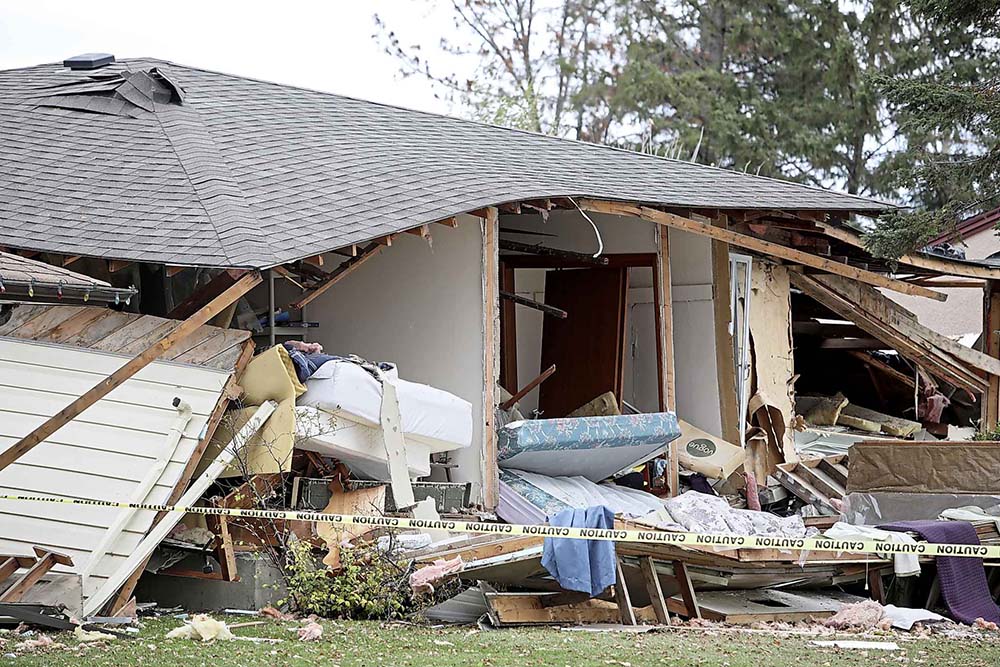
She was allegedly killed by her husband, Robert Hughes, on Oct. 22, 2019. He pleaded not guilty to second-degree murder on the first day of his trial in the Brandon Court of Queen’s Bench.
While Betty had more than a dozen injuries, the ultimate cause of death was blood loss from an 11.7-centimetre wound that extended from her eyebrow across her temple and into her ear, Rhee said under questioning from Crown attorney Christian Vanderhooft during the third day of the trial.
“This wound injured the underlying soft tissue, penetrating the cartilage of the ear,” he said.
“From that, you would have (blood loss) if that injury is not treated medically, if the artery is not tied off. With continuous beating of the heart, you would have continuous bleeding from that artery.”
Rhee estimated Betty would have died of blood loss minutes after the cut. He was unable to tell where the person who inflicted the wound was standing, just that it was caused by a “weapon.”
She had other injuries, too, Rhee said, including a long cut on her jaw, cuts to her forehead and body, various bruising on her head and upper body, and several fractured ribs.
Rhee told Vanderhooft he didn’t find any injuries that suggested defensive wounds.
During a tense cross-examination, defence lawyer Saul Simmonds raised the possibility there was a struggle between the married couple. The lawyer suggested it was possible she was holding the knife in her hand and there was a fight over it.
“All you can tell this jury is that somehow a blade passes through this area… Whether or not that blade is in the hand of someone other than Ms. Hughes would be unknown to you,” Simmonds said to Rhee during cross-examination.
“It would be unlikely, in my opinion,” the doctor responded.
Simmonds also said the autopsy does not point to how Betty was moving at the time of her death nor where wounds to her temple came from.
Forensic specialist Carol Ng also testified via video about DNA testing done on items recovered from the scene, including two knives, coveralls from Hughes and swabs from both the home’s hot water tank and gas pipe.
She said DNA taken from multiple locations on a knife, including the handle near the blade, the end of the handle and the entire blade, matched the profiles from both Betty and Hughes.
Swabs taken from the gas pipe were from two people, one of them possibly matching Hughes, who was 63 when he was charged.
Simmonds questioned Ng while holding the yellow knife in question in a black-gloved left hand.

“When the whole handle is examined, what’s very clear to you is that you get a mixed sample — so more than one person’s cells… is now on that handle,” Simmonds said.
“From your perspective, you can’t tell us when DNA gets there, but we do know the DNA is consistent with being held by — as we’re going to get to — more than one person.”
Ng agreed.
The trial is scheduled to last approximately three weeks.
— Brandon Sun
Related Articles
Woman felt 'worthless' in marriage, court told


Advertisement Advertise With Us
Advertisement Advertise With Us
History
Updated on Thursday, December 2, 2021 6:18 AM CST: Adds photo