

‘Tragic misalignment of circumstances’: two women acquitted in fatal 2019 stabbing

Advertisement
Read this article for free:
or
Already have an account? Log in here »
To continue reading, please subscribe:

Digital Subscription
One year of digital access for only $205*
- Enjoy unlimited reading on winnipegfreepress.com
- Read the E-Edition, our digital replica newspaper
- Access News Break, our award-winning app
- Play interactive puzzles
*First annual payment billed as $205.00 + GST for one year. This annual subscription will automatically renew at $233.00 + GST every 52 weeks (10% off the regular annual price of $259.35). Offer available to new and qualified returning subscribers only. Cancel any time.
To continue reading, please subscribe:
Add Free Press access to your Brandon Sun subscription for only an additional
$1 for the first 4 weeks*
- Enjoy unlimited reading on winnipegfreepress.com
- Read the E-Edition, our digital replica newspaper
- Access News Break, our award-winning app
- Play interactive puzzles
*Your next Brandon Sun subscription payment will increase by $1.00 and you will be charged $17.95 plus GST for four weeks. After four weeks, your payment will increase to $24.95 plus GST every four weeks.
Read unlimited articles for free today:
or
Already have an account? Log in here »
Hey there, time traveller!
This article was published 22/12/2021 (1746 days ago), so information in it may no longer be current.
A judge has acquitted two Winnipeg women of second-degree murder in the stabbing death of 25-year-old mother of four Shaylynne Hunter, calling the case a “tragic misalignment of circumstances.”
Hunter died May 25, 2019, after she was stabbed 21 times outside her Simcoe Street home.
Diane Tamara King, 20, and Tasha Laquette, 24, stood trial earlier this year.
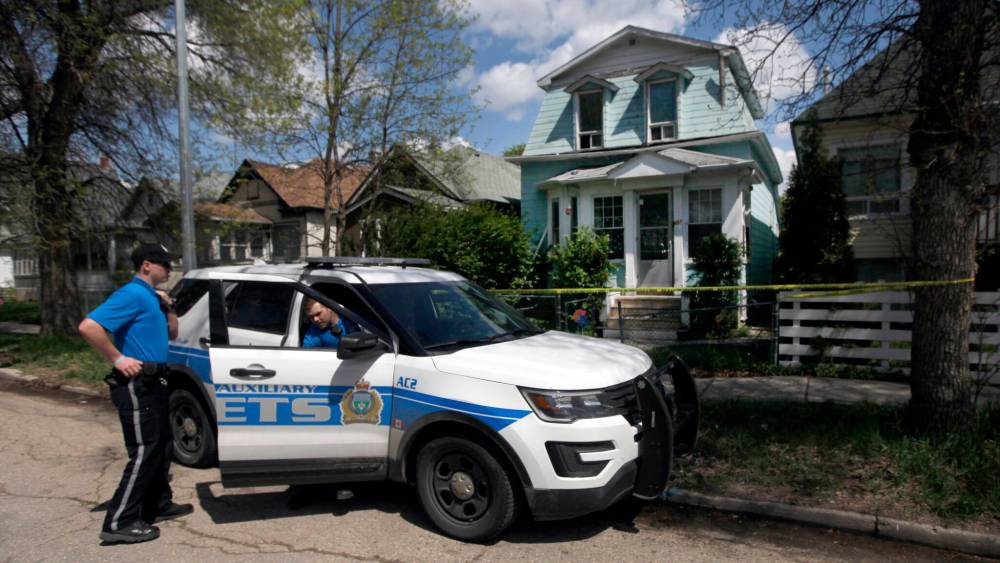
The trial heard evidence Hunter and King had been involved in a heated dispute inside the house when Hunter attacked the two accused outside with a metal pipe.
In a decision delivered Tuesday, Court of Queen’s Bench Justice Joan McKelvey said she was satisfied King was acting in defence of herself and Laquette when she stabbed Hunter and that Laquette was not a party to the killing.
In a lengthy Winnipeg Police Service video interview recorded three days after the killing, King said she and Laquette were leaving the house party when Hunter came up behind her and struck her with a metal pipe without warning.
“I don’t know what it was about, but Shaylynne hit me first,” she told investigators.
King said Laquette tried to protect her and was struck in the head with the pipe. As Laquette dropped to the ground, King saw Hunter drop a knife, she said.
“I thought Shaylynne was going to pick up that knife,” she said. “My first reaction was to pick it up. And as she was swinging the pole, I must have just swung it once without even looking and I must have hit her.
“It was either me or my friend going to die… or her, and it turned out to be her.”
Later in the interview, King estimated she swung the knife at Hunter “three or four times.”
“This makes me feel sh—ty,” she said. “Someone’s mom really got taken away from the kids, just like how I’m getting taken away from mine… (Hunter’s children) are never going to get to see their mom. My kid might even have a chance to see me, and that’s what makes me feel f—-ing sh—ty.”
Asked if she knew how many times Hunter had been stabbed, King said she didn’t want to know.
“It’s just going to make it worse for me right now,” she said. “Like just hearing this just like f—-ing kills me. Like, it wasn’t supposed to be this way. Nothing was.”
A toxicology report revealed Hunter had a blood-alcohol reading of .190 when she died, more than twice the legal limit for driving, and had consumed cocaine.
Family members present at the party, as well as Hunter’s common-law partner, testified Hunter could become violent and uncontrollable when she had consumed cocaine.
Court heard conflicting evidence as to who had the knife first, with one witness testifying they saw a knife earlier in King’s purse.
McKelvey said whether King was armed prior to the attack was not relevant to her finding King acted in self-defence.
Prosecutors argued the number of stab or slashing wounds belied King’s claim she was acting in self-defence, but McKelvey noted all but a couple of the ultimately fatal wounds were superficial and said it was possible King inflicted multiple wounds with a single slash of the knife.

“The response to an attack cannot be evaluated with a precise formulation of weight,” she said. “A reasonable person cannot be expected to know exactly how to respond to an adverse situation or know how much force is necessary to defend one’s self or another person.”
McKelvey said wounds to King’s back and Laquette’s hair on the pipe supported their version of events.
Laquette provided a video statement to police, but McKelvey ruled at trial it was not admissible as evidence.
In comments immediately after her arrest, Laquette told police she had been friends with Hunter for seven years and described the incident as “a drunken mess.”
dean.pritchard@freepress.mb.ca
Dean Pritchard is courts reporter for the Free Press. He has covered the justice system since 1999, working for the Brandon Sun and Winnipeg Sun before joining the Free Press in 2019. Read more about Dean.
Every piece of reporting Dean produces is reviewed by an editing team before it is posted online or published in print — part of the Free Press‘s tradition, since 1872, of producing reliable independent journalism. Read more about Free Press’s history and mandate, and learn how our newsroom operates.
Our newsroom depends on a growing audience of readers to power our journalism. If you are not a paid reader, please consider becoming a subscriber.
Our newsroom depends on its audience of readers to power our journalism. Thank you for your support.
Dean Pritchard is courts reporter for the Free Press. He has covered the justice system since 1999, working for the Brandon Sun and Winnipeg Sun before joining the Free Press in 2019. Read more about Dean.
Every piece of reporting Dean produces is reviewed by an editing team before it is posted online or published in print — part of the Free Press‘s tradition, since 1872, of producing reliable independent journalism. Read more about Free Press’s history and mandate, and learn how our newsroom operates.
Our newsroom depends on a growing audience of readers to power our journalism. If you are not a paid reader, please consider becoming a subscriber.
Our newsroom depends on its audience of readers to power our journalism. Thank you for your support.
Related Articles
Court of appeal upholds acquittal in 2019 stabbing death
Advertisement Advertise With Us
Advertisement Advertise With Us