

Manitoba MP seeks public peek at internet provider data
Advertisement
Read this article for free:
or
Already have an account? Log in here »
To continue reading, please subscribe:

Digital Subscription
One year of digital access for only $205*
- Enjoy unlimited reading on winnipegfreepress.com
- Read the E-Edition, our digital replica newspaper
- Access News Break, our award-winning app
- Play interactive puzzles
*First annual payment billed as $205.00 + GST for one year. This annual subscription will automatically renew at $233.00 + GST every 52 weeks (10% off the regular annual price of $259.35). Offer available to new and qualified returning subscribers only. Cancel any time.
To continue reading, please subscribe:
Add Free Press access to your Brandon Sun subscription for only an additional
$1 for the first 4 weeks*
- Enjoy unlimited reading on winnipegfreepress.com
- Read the E-Edition, our digital replica newspaper
- Access News Break, our award-winning app
- Play interactive puzzles
*Your next Brandon Sun subscription payment will increase by $1.00 and you will be charged $17.95 plus GST for four weeks. After four weeks, your payment will increase to $24.95 plus GST every four weeks.
Read unlimited articles for free today:
or
Already have an account? Log in here »
Hey there, time traveller!
This article was published 25/07/2022 (1499 days ago), so information in it may no longer be current.
OTTAWA — A Manitoba MP is on a mission to get internet providers to tell Canadians what level of service they’re actually offering.
“At least you’d know what you’re paying for,” said Conservative MP Dan Mazier, who represents Dauphin—Swan River—Neepawa.
Last month, he tabled a private member’s bill that would direct the Canadian Radio-television and Telecommunications Commission to have internet service providers publish “service quality metrics during peak periods” and “typical download and upload speeds during peak periods.”
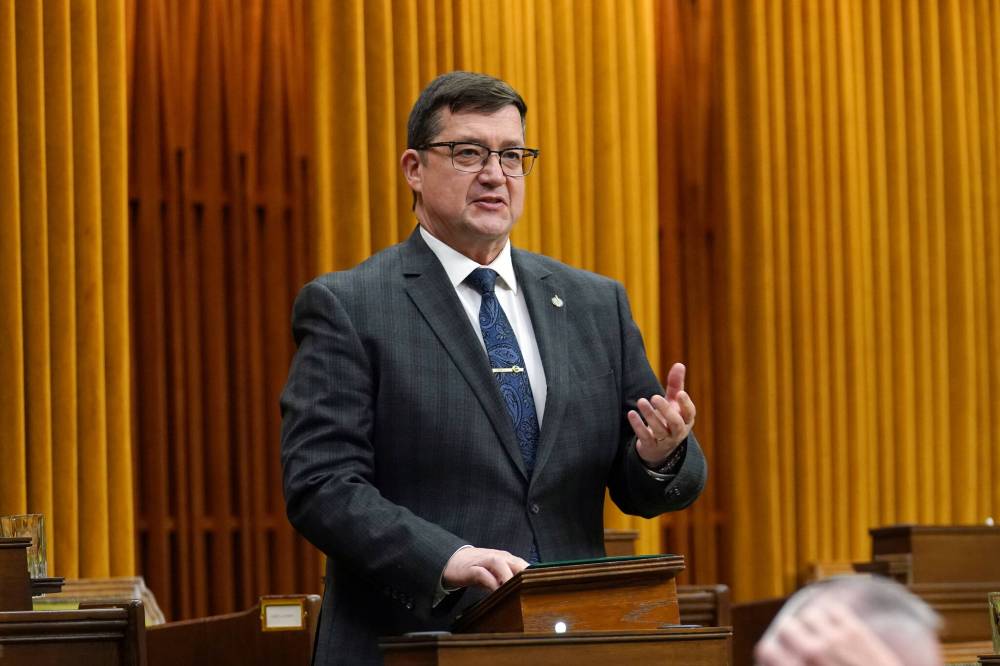
The Brandon Sun Files
“At least you’d know what you’re paying for,” said Conservative MP Dan Mazier, who represents Dauphin—Swan River—Neepawa.
Mazier said that information would be far more helpful than having companies advertise “theoretical speeds” of the maximum amount that is possible but rarely available.
It’s not a new idea. The House industry committee recommended this change in March. Mazier actually tabled a proposal a year ago, in the last sitting weeks before the fall 2021 election.
He said many Canadians experienced download lags during the COVID-19 pandemic. “The pipeline is just not big enough to get everybody at that time of usage.”
Mazier believes more honest rates might put more expensive providers on par with smaller, cheaper companies offering comparable service.
“It’s better for the consumer and it’s holding businesses to account, as far as a more transparent process,” Mazier said. “This is a non-partisan bill; I don’t know why anyone would say no to this.”
Ben Klass, a PhD candidate at Carleton University in Ottawa, agrees.
“It’s kind of a no-brainer,” said Klass, who researches the evolution of Canada’s communications industries in the internet age. “We need to have more some more standards in how people are provided information about these types of services.”
Klass, who is from Manitoba, said the issue is particularly bad for rural Canadians, who often have no choice of provider. He said rural Manitobans using satellite and fixed-wireless services get contracts that claim to offer certain speeds, with the fine print outlining numerous caveats.
That often makes it impossible for rural Canadians to work from home, he said.
“It’s like a game of chicken,” Klass said of internet carriers. “They want to spend as little as they can on capacity, but as much as they need to make sure their customers don’t notice the service doesn’t always deliver the speed that they promise.”
The CRTC has studied internet speeds in recent years, such as a 2015 project where it mailed out modems to 6,200 volunteers, to report on how their internet speeds compare with advertised rates.
Klass said the CRTC likely has the powers to undertake what Mazier’s Bill C-288 proposes, and it might even be possible through a government regulation instead of an act of Parliament.
He also suggested the legislation be limited to companies making more than a certain amount of revenue, so it doesn’t add costs to smaller, upstart providers.
Mazier said he’ll try to meet with Liberal MPs about the bill before a vote to send it for committee study, likely in November.
The office of Industry Minister François-Philippe Champagne had no comment on Mazier’s bill, but noted a proposal announced in May to eventually have the CRTC “implement mandatory broadband performance testing and other consumer transparency requirements,” if Parliament agrees.

“Our government is making every effort to ensure that telecommunications services are fast, reliable and — most crucially — affordable,” wrote spokeswoman Laurie Bouchard.
Yet, a report last month by Wall Communications Inc. found Canada has the highest average home internet prices among G7 countries, with prices of almost all Internet package rising between 2019 and 2021.
Mazier said the Trudeau government has made some impact on internet speeds and prices, but nowhere near what it has promised, particularly in rural Manitoba.
“There’s been a lot of talk, a lot of bluster, but as for delivering to some of these communities that really do need it… they’re not engaging the communities where those needs are, so they’ve really fallen short.”
dylan.robertson@freepress.mb.ca