

MPI helps drive brain injury research funding

Advertisement
Read this article for free:
or
Already have an account? Log in here »
To continue reading, please subscribe:

Digital Subscription
One year of digital access for only $205*
- Enjoy unlimited reading on winnipegfreepress.com
- Read the E-Edition, our digital replica newspaper
- Access News Break, our award-winning app
- Play interactive puzzles
*First annual payment billed as $205.00 + GST for one year. This annual subscription will automatically renew at $233.00 + GST every 52 weeks (10% off the regular annual price of $259.35). Offer available to new and qualified returning subscribers only. Cancel any time.
To continue reading, please subscribe:
Add Free Press access to your Brandon Sun subscription for only an additional
$1 for the first 4 weeks*
- Enjoy unlimited reading on winnipegfreepress.com
- Read the E-Edition, our digital replica newspaper
- Access News Break, our award-winning app
- Play interactive puzzles
*Your next Brandon Sun subscription payment will increase by $1.00 and you will be charged $17.95 plus GST for four weeks. After four weeks, your payment will increase to $24.95 plus GST every four weeks.
Read unlimited articles for free today:
or
Already have an account? Log in here »
Hey there, time traveller!
This article was published 05/10/2022 (1471 days ago), so information in it may no longer be current.
A portion of Manitobans’ auto-insurance premiums are being used to further fund research into traumatic brain injuries.
Manitoba Public Insurance and the University of Manitoba announced Wednesday they are contributing a joint $3.5 million into an endowed fund that will expand the lab helmed by Dr. Frederick Zeiler.
Zeiler, a neurosurgeon and global leader in brain injury research, was born and raised in Beausejour and works as a clinician-scientist for Health Sciences Centre and the U of M. He said he’s working toward personalized treatment for each of the roughly 400 Manitobans admitted to HSC every year with moderate to severe brain injuries.
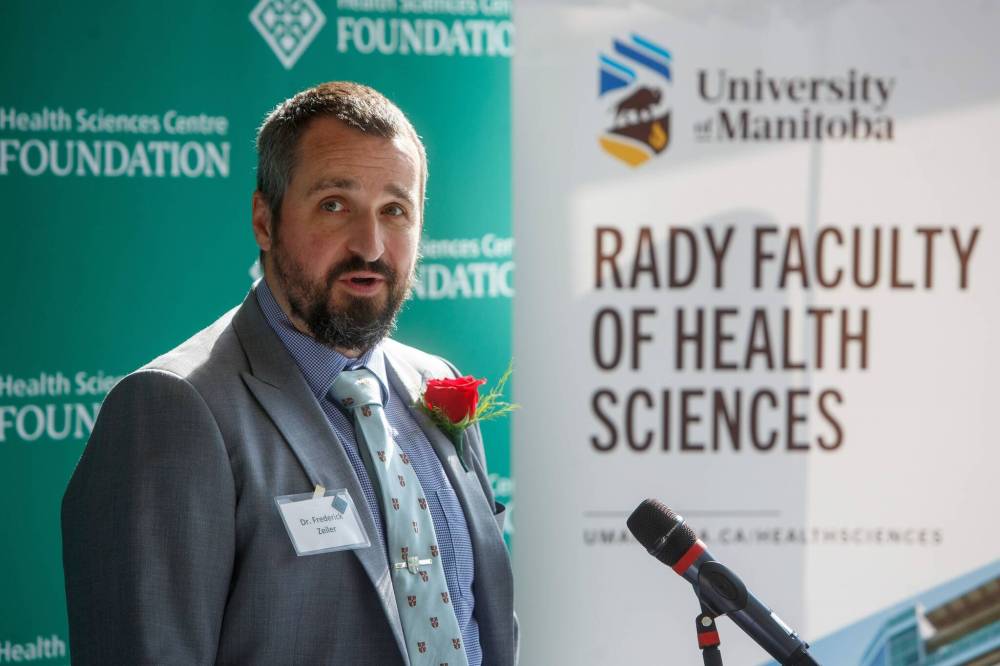
MIKE DEAL / WINNIPEG FREE PRESS
Dr. Frederick Zeiler, a Neurotrauma Neurosurgeon, during an announcement that the Health Sciences Centre Foundation, along with Manitoba Public Insurance and the University of Manitoba, will be committing $3.5 million in combined support towards research into severe traumatic brain injuries.
“This is a moment that a Canadian researcher can truly celebrate,” Zeiler said, expressing his gratitude for the additional funding during a news conference Wednesday.
“This means we’ll be able to learn more, learn faster, and be in a better position to make important observations and recommendations for treating patients who suffer severe, traumatic brain injury.”
Car crashes are one of the leading causes of brain injuries, and claims to the Crown auto insurer that involve injuries often include brain damage, MPI president and chief executive officer Eric Herbelin said.
He didn’t provide figures to show how much MPI spends on claims involving brain injuries, but Herbelin said it makes sense to invest in a fund that could advance treatment and, ultimately, lower claims. Survivors of traumatic brain injuries often have lifelong deficits that make them unable to work or live independently.
“It’s our way to contribute to society, do what is good. There is also a business case behind that, in that we expect the claims that arise out of traumatic brain injuries will be mitigated through the support of the HSC Foundation,” Herbelin said.
The HSC Foundation first worked with MPI about a decade ago to establish a $1-million professorship fund, which later grew to $1.5 million, supporting Zeiler’s research. An additional $2 million from MPI and $1.5 million from the U of M now bring the total to $5 million.

Interest generated from the fund will be put toward buying complex new equipment, hiring staff, and expanding physical lab space. Representatives from the university and the hospital foundation described Zeiler’s work as visionary and said the fund is expected to act as an “accelerator” to attract top-tier researchers and pave the way for additional federal research grants.
Personalized treatment is the future of healing brain injuries, Zeiler said. He noted mortality rates for patients with traumatic brain injuries are about 30 per cent, and have remained “relatively frozen” for the past three decades. That’s because a “one-size-fits-all” approach to treatment doesn’t work, he said.
The lab’s research involves analyzing all kinds of patient data, blood work, and past medical histories for brain injury patients admitted to HSC’s intensive care unit.
Traditionally, brain injury treatment relies mainly on a single pressure monitor placed inside the skull while the patient is on a ventilator, but that approach doesn’t work for everyone and future research needs to focus on tailored treatment, Zeiler said. The hope is, he said, they’ll be able to harness the data to develop new treatments.
katie.may@freepress.mb.ca
Katie May is a multimedia producer for the Free Press.
Our newsroom depends on a growing audience of readers to power our journalism. If you are not a paid reader, please consider becoming a subscriber.
Our newsroom depends on its audience of readers to power our journalism. Thank you for your support.
Katie May is a multimedia producer for the Free Press.
Our newsroom depends on a growing audience of readers to power our journalism. If you are not a paid reader, please consider becoming a subscriber.
Our newsroom depends on its audience of readers to power our journalism. Thank you for your support.
Related Articles
MPI still lacking brain injury expert
Advertisement Advertise With Us
Advertisement Advertise With Us