

Rising HIV infections ‘creating havoc on the front lines’
Advertisement
Read this article for free:
or
Already have an account? Log in here »
To continue reading, please subscribe:

Digital Subscription
One year of digital access for only $205*
- Enjoy unlimited reading on winnipegfreepress.com
- Read the E-Edition, our digital replica newspaper
- Access News Break, our award-winning app
- Play interactive puzzles
*First annual payment billed as $205.00 + GST for one year. This annual subscription will automatically renew at $233.00 + GST every 52 weeks (10% off the regular annual price of $259.35). Offer available to new and qualified returning subscribers only. Cancel any time.
To continue reading, please subscribe:
Add Free Press access to your Brandon Sun subscription for only an additional
$1 for the first 4 weeks*
- Enjoy unlimited reading on winnipegfreepress.com
- Read the E-Edition, our digital replica newspaper
- Access News Break, our award-winning app
- Play interactive puzzles
*Your next Brandon Sun subscription payment will increase by $1.00 and you will be charged $17.95 plus GST for four weeks. After four weeks, your payment will increase to $24.95 plus GST every four weeks.
Read unlimited articles for free today:
or
Already have an account? Log in here »
Hey there, time traveller!
This article was published 13/04/2023 (1275 days ago), so information in it may no longer be current.
A troubling increase in the number of new HIV infections reported in Manitoba has front-line service providers racing to connect people with treatment and testing, as spread of the virus approaches a crisis level.
Nine Circles Community Health Centre executive director Mike Payne said infection rates for human immunodeficiency virus are continuing to trend in the wrong direction in Manitoba, owing to a multitude of factors that include systemic racism, the legacy of colonialism, homelessness, injection drug and methamphetamine use.
“In every part of our programming, I think people would agree that it feels like a crisis,” Payne said Wednesday.
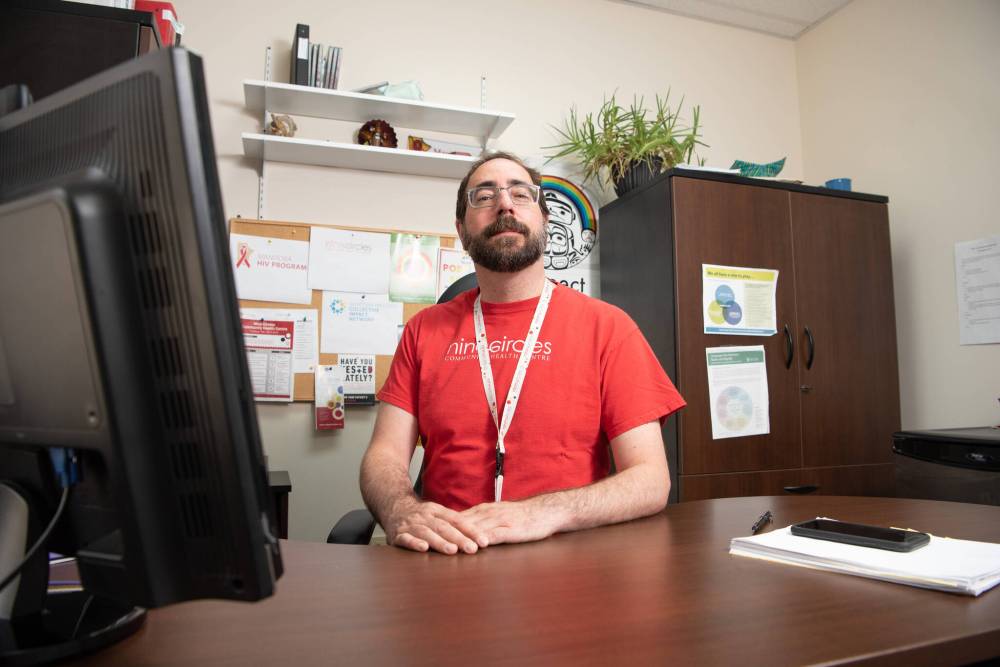
ALEX LUPUL / WINNIPEG FREE PRESS
“In every part of our programming, I think people would agree that it feels like a crisis,” said Mike Payne, executive director of Nine Circles Community Health Centre.
Every year since 2018, Manitoba has reported an increase in new infections, Payne said, representing a 52 per cent increase in the number of people living with HIV at the end of 2021.
Manitoba reported 108 new HIV cases between Jan. 1 and June 30, 2022, and Payne said that number was expected to continue to rise through 2023.
The huge spike in infections has left health and service providers desperate for resources to meet demand while navigating a concurrent overdose crisis, Payne said.
Heterosexual sex and injection drug use remain the main modes of transmission, he noted.
“That perfect storm at an epidemiological level is creating havoc on the front lines and a really urgent need to expand the resources that are available to us in primary care, in outreach and in prevention work.”
On Wednesday, NDP health critic Uzoma Asagwara described the increase in new HIV cases as a public health crisis.
Numbers obtained by the NDP indicate 74 new HIV cases were diagnosed in 2023, the MLA for Union Station said during question period.
The increased infection rate puts the province on track to exceed the 280 new cases reported in 2022, Asagwara said.
Manitoba Public Health has not released the total number of new HIV cases reported in 2022.
On Wednesday, the province said the most up-to-date data it could provide was from June 30, 2022. The Free Press was not able to independently confirm the numbers provided by the NDP on Wednesday.
“This is an incredibly alarming trend and it cannot be allowed to continue,” Asagwara said, while accusing the Progressive Conservative government of failing to take action as infections skyrocket.
“People with HIV are not being connected to the treatment that they need.”
Health Minister Audrey Gordon said the government takes HIV and acquired immunodeficiency syndrome (AIDS) seriously, and has committed to spend $2.3 million over three years to establish an Indigenous-led sexually transmitted and blood-borne infections testing and contacting tracing strategy.
It will also fund a $632,000, two-year plan to add lab assistants and nurses for clinical HIV-AIDS services.
HIV pre-exposure prophylaxis has also been added to the provincial formulary and the government is working to expand and enhance coverage for treatment, the health minister said.
“We are actively working with public health to improve the prevention and treatment of HIV and AIDS,” Gordon said in the chamber.
Asagwara said the government could go farther and support Sunshine House and its mobile overdose prevention site. The Winnipeg drop-in and resource centre has distributed about 200 free rapid HIV testing kits in the community over the past four months, as part of a federal pilot program.
Helina Zegeye, Sunshine House’s Gizhiwenimin co-ordinator, said the rapid-test program gives people control of their health amid increasing risk of contracting the virus in the community.
“There is also an option for folks who feel stigmatized by the traditional clinical model where coming into these spaces may not feel welcoming.”
Sunshine House is not aware of any positive results from tests it has distributed, Zegeye said, but it is positioned to connect people with the appropriate care programs and provide patient advocacy, if needed.

Zegeye said access to testing was limited during the heights of the COVID-19 pandemic and data is only starting to catch up now. The increased cost and demand on the health system will be significant and prevention will be key to getting a handle on the crisis, Zegeye said.
“Although we’ve had great feedback from the community about this service we’re providing, we’re financially limited in what we can do.”
Payne echoed the need for health regions and governments to fund programs brought forward by health and social service providers to support people recently diagnosed with HIV in a timely way and to connect them with trusted services.
“Last year is when we needed them, and we’re still asking for them,” Payne said. “It needs to be urgently addressed now.”
danielle.dasilva@freepress.mb.ca
Related Articles
STDs are on the rise. This morning-after-style pill may help
Advertisement Advertise With Us
Advertisement Advertise With Us