

City launches annual mosquito control offensive

Advertisement
Read this article for free:
or
Already have an account? Log in here »
To continue reading, please subscribe:

Digital Subscription
One year of digital access for only $205*
- Enjoy unlimited reading on winnipegfreepress.com
- Read the E-Edition, our digital replica newspaper
- Access News Break, our award-winning app
- Play interactive puzzles
*First annual payment billed as $205.00 + GST for one year. This annual subscription will automatically renew at $233.00 + GST every 52 weeks (10% off the regular annual price of $259.35). Offer available to new and qualified returning subscribers only. Cancel any time.
To continue reading, please subscribe:
Add Free Press access to your Brandon Sun subscription for only an additional
$1 for the first 4 weeks*
- Enjoy unlimited reading on winnipegfreepress.com
- Read the E-Edition, our digital replica newspaper
- Access News Break, our award-winning app
- Play interactive puzzles
*Your next Brandon Sun subscription payment will increase by $1.00 and you will be charged $17.95 plus GST for four weeks. After four weeks, your payment will increase to $24.95 plus GST every four weeks.
Read unlimited articles for free today:
or
Already have an account? Log in here »
Hey there, time traveller!
This article was published 03/05/2023 (1229 days ago), so information in it may no longer be current.
For many Winnipeggers, the long-awaited arrival of sunny and warm spring weather has signalled the inevitable return of one of their biggest foes: mosquitoes.
There was good news on that front Wednesday, when the city launched its annual mosquito control program and offered a prediction on what to expect in the short-term.
“Our spring population should be low, and our spring and early summer is looking favourable,” said David Wade, superintendent of insect control. “Beyond that, I can’t predict with certainty.”

City crews will be spraying larvicide on standing water in ditches and low-lying areas to help control the mosquito population. (Chris Kitching / Winnipeg Free Press)
Wade said the city can only look two weeks in advance with certainty because Winnipeg’s weather is “quite unpredictable.”
Frequent and heavy rainfall, which results in standing water, can lead to more of the blood-sucking pests.
“We have drier conditions now than a year ago, so we’re starting off good,” Wade told reporters at the insect control heliport on Tyne Avenue in East Elmwood.
The city’s biorational (environmentally friendly) larviciding program is underway while spring mosquitoes hatch in standing water in ditches and low-lying areas.
The mosquito control program is starting at its normal time of year, said Wade.
Below average winter precipitation and a slow spring melt have produced favourable conditions for the city, which is using ground crews and four helicopters to curb the mosquito population.
Until mid-September, crews will be monitoring and treating more than 69,000 acres of water area, based on weather conditions.
They are using two types of larvicides which target larvae in the aquatic stage to prevent them from becoming adults.
“They’re out in the water now, and we’re going around… those sites using the most environmentally-friendly way of targeting the mosquito population,” said Wade.
The city uses Bti, or Bacillus thuringiensis israelensis, which is a bacteria that only targets mosquito larvae. It also uses methoprene, a juvenile growth regulator.
Fogging for adult mosquitoes will only take place as a last resort, when certain conditions are met, according to the city.
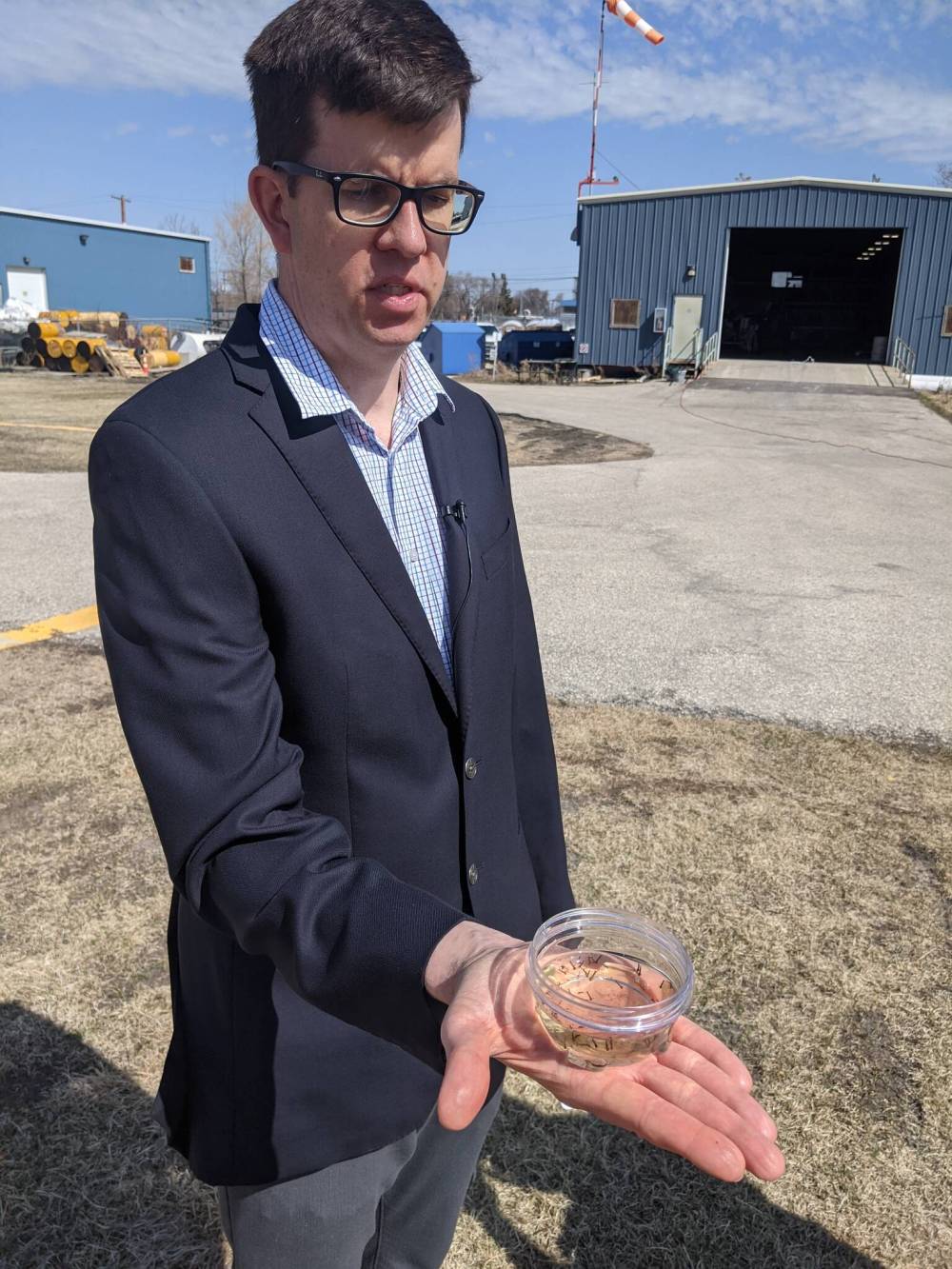
CHRIS KITCHING / WINNIPEG FREE PRESS
David Wade, the city's superintendent of insect control, holds a dish containing mosquito larvae.
The adulticiding factor analysis (a type of mosquito risk assessment) must be high, the city-wide average trap count must be at least 25 female mosquitoes for two consecutive nights, and at least one quadrant must be in the range of 100 female adult mosquitoes.
The city uses the insecticide DeltaGard 20EW.
Residents who don’t want their property to be fogged can apply for a 90-metre buffer zone.
Winnipeg’s mosquito traps are being switched on Thursday. The first counts will be posted on the city’s website Monday.
This year’s budget for mosquito control is almost $10 million.
Property owners can also play a part in helping to reduce the city’s mosquito population. Wade encouraged people to dump or drain any standing water in their yards throughout mosquito season.
The city also suggests residents cover containers that collect rain water, fill low-lying areas to prevent standing water, and use biological larvicide.
With the 2023 season underway, Wade’s fingers are crossed for weather conditions that work in the city’s favour.
An ideal situation would be comparable to 2021, when heavy downpours were minimal, he said.
“Our main nuisance species, aedes vexans, requires those summer rainfall events,” said Wade. “We can handle some rain, just not a lot of heavy rains.”
Monitoring of West Nile virus, which is spread to humans through the bite of an infected mosquito, usually begins around May long weekend, said Wade. The surveillance program lasts into September.
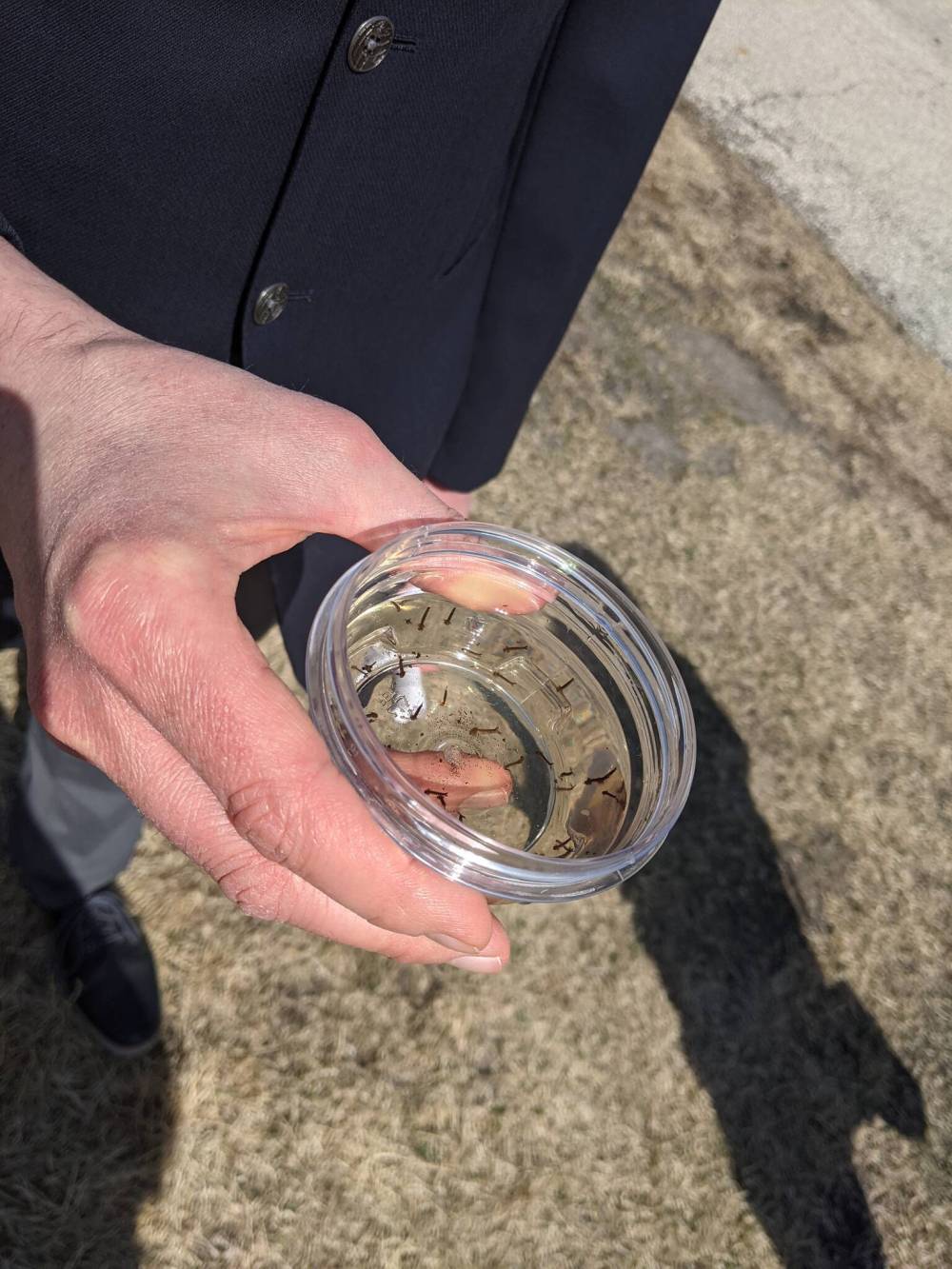
The city is using two types of larvicides to target larvae in the aquatic stage to prevent them from becoming adults.(Chris Kitching / Winnipeg Free Press)
Mosquitoes aren’t the only insects the city will be keeping an eye on during the warmer months.
Tree pest caterpillar surveillance started this week. Wade said caterpillars haven’t hatched yet, so crews are monitoring egg masses.
A control program usually starts around May long weekend.
The city’s programs for emerald ash borers and elm bark beetles typically begin in June and around the end of August, respectively.
chris.kitching@freepress.mb.ca
Twitter: @chriskitching

Chris Kitching is a general assignment reporter at the Free Press. He began his newspaper career in 2001, with stops in Winnipeg, Toronto and London, England, along the way. After returning to Winnipeg, he joined the Free Press in 2021, and now covers a little bit of everything for the newspaper. Read more about Chris.
Every piece of reporting Chris produces is reviewed by an editing team before it is posted online or published in print — part of the Free Press‘s tradition, since 1872, of producing reliable independent journalism. Read more about Free Press’s history and mandate, and learn how our newsroom operates.
Our newsroom depends on a growing audience of readers to power our journalism. If you are not a paid reader, please consider becoming a subscriber.
Our newsroom depends on its audience of readers to power our journalism. Thank you for your support.
Chris Kitching is a general assignment reporter at the Free Press. He began his newspaper career in 2001, with stops in Winnipeg, Toronto and London, England, along the way. After returning to Winnipeg, he joined the Free Press in 2021, and now covers a little bit of everything for the newspaper. Read more about Chris.
Every piece of reporting Chris produces is reviewed by an editing team before it is posted online or published in print — part of the Free Press‘s tradition, since 1872, of producing reliable independent journalism. Read more about Free Press’s history and mandate, and learn how our newsroom operates.
Our newsroom depends on a growing audience of readers to power our journalism. If you are not a paid reader, please consider becoming a subscriber.
Our newsroom depends on its audience of readers to power our journalism. Thank you for your support.
Related Articles
Insecticide used to fight skeeters no longer on market: city
Advertisement Advertise With Us
Advertisement Advertise With Us