

Guitar education creates community bond, ‘life pods’
Advertisement
Read this article for free:
or
Already have an account? Log in here »
To continue reading, please subscribe:

Digital Subscription
One year of digital access for only $205*
- Enjoy unlimited reading on winnipegfreepress.com
- Read the E-Edition, our digital replica newspaper
- Access News Break, our award-winning app
- Play interactive puzzles
*First annual payment billed as $205.00 + GST for one year. This annual subscription will automatically renew at $233.00 + GST every 52 weeks (10% off the regular annual price of $259.35). Offer available to new and qualified returning subscribers only. Cancel any time.
To continue reading, please subscribe:
Add Free Press access to your Brandon Sun subscription for only an additional
$1 for the first 4 weeks*
- Enjoy unlimited reading on winnipegfreepress.com
- Read the E-Edition, our digital replica newspaper
- Access News Break, our award-winning app
- Play interactive puzzles
*Your next Brandon Sun subscription payment will increase by $1.00 and you will be charged $17.95 plus GST for four weeks. After four weeks, your payment will increase to $24.95 plus GST every four weeks.
Read unlimited articles for free today:
or
Already have an account? Log in here »
Hey there, time traveller!
This article was published 25/06/2023 (1179 days ago), so information in it may no longer be current.
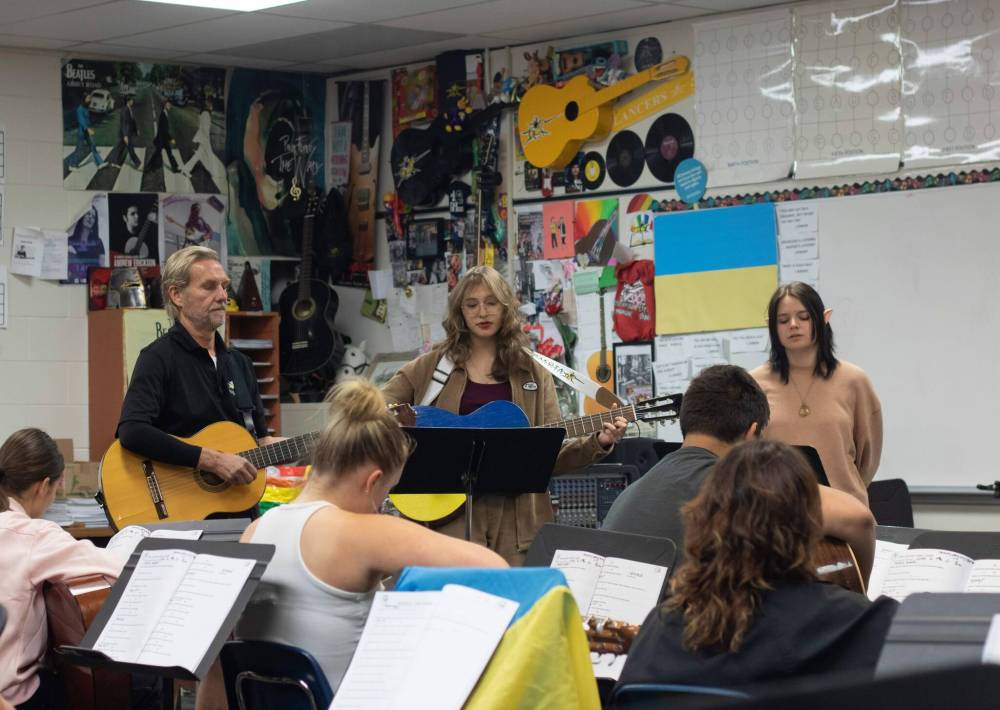
Two Dakota Collegiate students stand at the front of their guitar classroom, performing a tune from their homeland, Places of Happy People, by Ukrainian band Skryabin.
Nika Borys, a Grade 10 student, sang with the Ukraine flag draped across her shoulders; Diana Risil, a Grade 11 student, strummed a blue-and-yellow guitar.
They performed the song among 19 of their classmates, surrounded by 30 guitars hanging on a wall, adjacent to a few Beatles posters plastered above a desk.
MIKE THIESSEN / WINNIPEG FREE PRESS
Guitar teacher Ric Schulz (left), Grade 11 student Diana Risil (centre), and Grade 10 student Nika Borys lead the Dakota Collegiate guitar ensemble in a Ukrainian song.
“Guitar class is my comfort place,” said Borys, who had to leave her own guitar behind in Kyiv when she moved to Canada in September to escape the ongoing war with Russia.
Earlier this year, Borys’s music teacher in Ukraine was killed in the war.
Ric Schulz, who’s been teaching guitar education for 43 years, teared up while he described how devastating it was to see a picture of his now-deceased counterpart on Borys’s phone.
That’s why he tries to make Classroom 109 at the Winnipeg public school a safe and inclusive space for all students to learn guitar.
“Those six strings are always your friend,” said Schulz. “Guitar has so many uses in your life, and it gives you so much joy… It’s that little escape.”
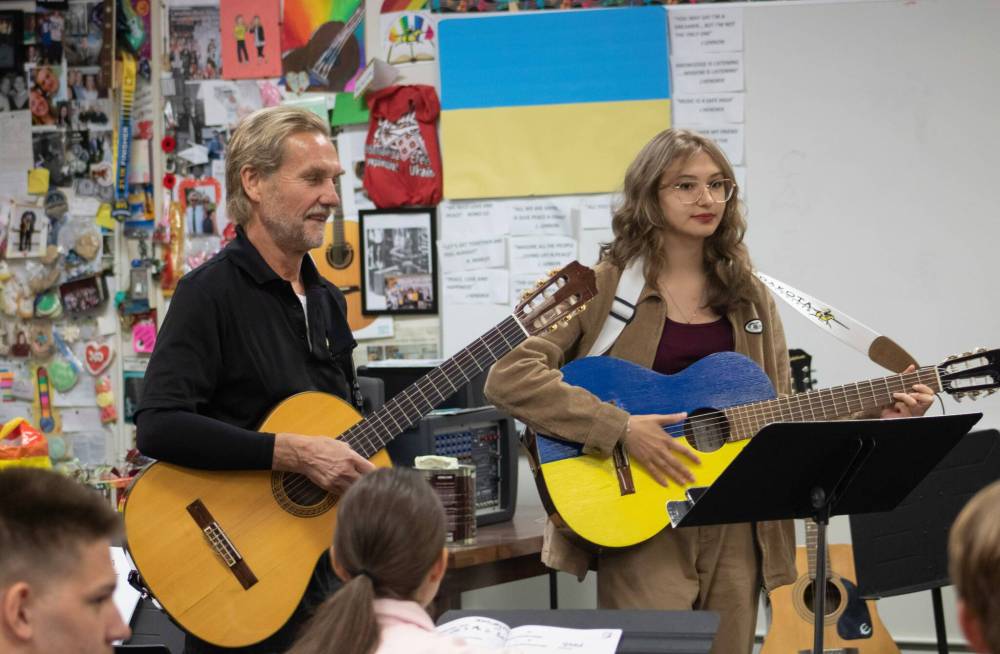
Schulz regularly tells his students about the idea of building positive and fulfilling “life pods.” He reminds students facing adversity playing guitar can be a positive “pod” that’s always waiting for them.
“It takes a lot of guts to get up here and sing,” he said, while pointing to a group of students practising Otherside by Red Hot Chili Peppers. “It’s not just music here. I am building up their confidence and self-esteem.”
The elective guitar course is designed to accommodate beginner and advanced students learn music theory, chords and songs from every genre. The instructor arranges multiple skilled parts to make sure every student can follow along and learn at their own pace.
Justin Fraser, who teaches guitar and volunteers with the Manitoba Classroom Guitar Association, said having the course in schools is meaningful and relevant. Each lesson is tailored to students’ interests and preferences, which increases classroom engagement and critical and creative thinking.
MCGA is a non-profit organization that advocates on behalf of music educators and classroom guitar education in Manitoba.
Fraser said students who have never cradled a guitar before have the opportunity to join a lesson and learn how to play a few chords from a hit song by the end of class.
“It’s relatively easy to start making music on Day 1,” he said. “With guitar education, we try to centre creativity, because you teach a kid a few chords and right away, they’re off creating their own songs, which is phenomenal.”
Through the history of music, guitar education allows students to learn about social, cultural and political issues, said Fraser.
Learning traditional and modern songs has been a catalyst for conversations about colonialism, truth and reconciliation, racism, police brutality, the climate crisis and more, he added.
MIKE THIESSEN / WINNIPEG FREE PRESS
Ric Schulz (left), with Grade 11 student Diana Risil, regularly tells his students about the idea of building positive and fulfilling ‘life pods.’ He reminds students facing adversity playing guitar can be a positive ‘pod’ that’s always waiting for them.
“We dig into social justice themes because it’s meaningful, relevant and authentic.”
Guitar education inspires and transforms students while working toward social change and creating a sense of community, the educators said.
Students within the Louis Riel School Division said guitar education provides a mental health break from other courses and issues beyond their control.
A few students at Dakota Collegiate raised their hands to explain to a reporter how playing guitar with their peers feels more like a family band practice than schoolwork.
Over the last 20 years, guitar education has exploded in the province with more than 100 programs in select schools.

While Fraser said he’s happy the course is reaching students in various communities, he would like the province to eliminate systemic barriers related to the chronic underfunding of public education and music devaluation.
It costs $6,000 to fill a classroom with 30 guitars, compared to purchasing one tuba at nearly double the price.
Fraser said guitar education is accessible, relatively cheap and immensely successful when and where the programs are implemented.
Not every student can afford to buy their own guitar or go to lessons, which makes these classes pivotal in building community, providing access to music education, and for some students, the beginning of a new hobby or career, he said.
tessa.adamski@freepress.mb.ca