

Students chase tornadoes for credit in atmospheric science program
Advertisement
Read this article for free:
or
Already have an account? Log in here »
To continue reading, please subscribe:

Digital Subscription
One year of digital access for only $205*
- Enjoy unlimited reading on winnipegfreepress.com
- Read the E-Edition, our digital replica newspaper
- Access News Break, our award-winning app
- Play interactive puzzles
*First annual payment billed as $205.00 + GST for one year. This annual subscription will automatically renew at $233.00 + GST every 52 weeks (10% off the regular annual price of $259.35). Offer available to new and qualified returning subscribers only. Cancel any time.
To continue reading, please subscribe:
Add Free Press access to your Brandon Sun subscription for only an additional
$1 for the first 4 weeks*
- Enjoy unlimited reading on winnipegfreepress.com
- Read the E-Edition, our digital replica newspaper
- Access News Break, our award-winning app
- Play interactive puzzles
*Your next Brandon Sun subscription payment will increase by $1.00 and you will be charged $17.95 plus GST for four weeks. After four weeks, your payment will increase to $24.95 plus GST every four weeks.
Read unlimited articles for free today:
or
Already have an account? Log in here »
Hey there, time traveller!
This article was published 10/07/2023 (1147 days ago), so information in it may no longer be current.
ERIC Zwarich is chasing his professional dream.
The undergraduate student in atmospheric science at the University of Manitoba recently participated in a week-long course in which he and a group of four other students and three instructors chased seven tornadoes over an expanse of 6,000 kilometres through Canada and the United States.
“It was thrilling,” said Zwarich, who had never even seen a tornado up close before. “It was crazy to see how the tornado comes down, how close we were.”
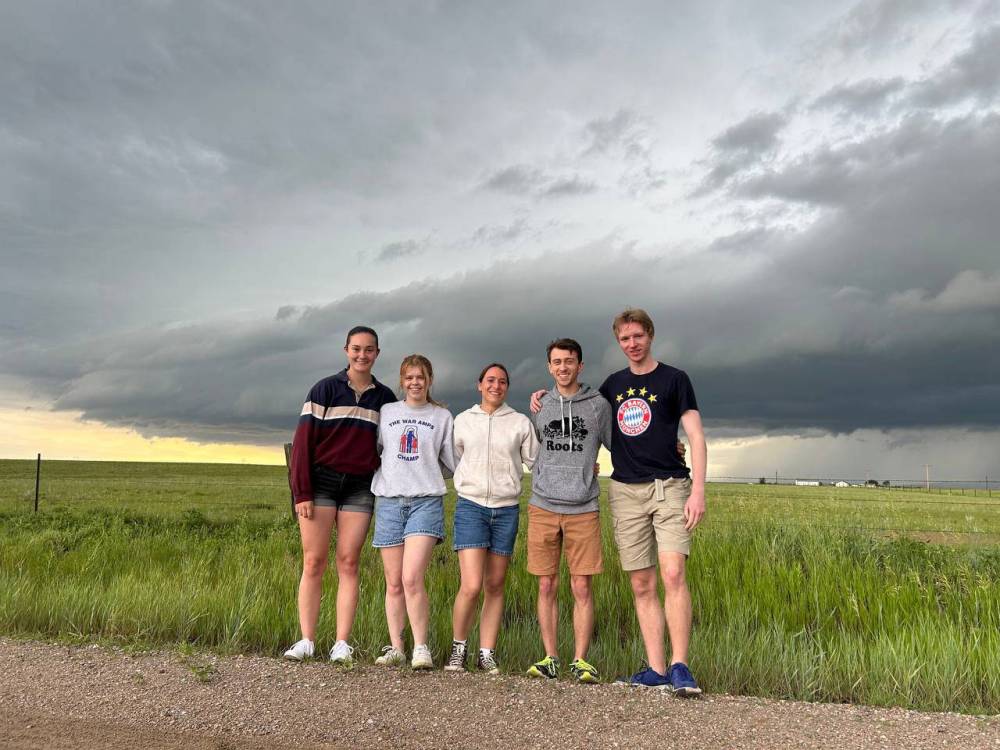
SUPPLIED
L-R: Maya Desrochers, Jordana Dwornick, Shayla Trippier, Eric Zwarich and Sergiyy Myastkivskyy took part in a field trip during which they chased tornadoes over an expanse of 6,000 kilometres.
A desire to chase storms as a child was what inspired him to try to become a meteorologist, Zwarich said.
The field trip began in Brandon. From there, the group followed potential tornado-brewing weather in two minivans, predicting storm movements as they went.
The group ended up travelling through seven U.S. states (North Dakota, South Dakota, Minnesota, Nebraska, Wyoming, Colorado and Iowa). On the way, the group encountered some 100 other storm-chasing vehicles, Zwarich said.
In Wyoming and Nebraska, they achieved their goal.
“There was only that one day that we saw the tornadoes. Every day, they had active weather. There were a few days where there were tornadoes active in the area but we just weren’t able to get to them,” Zwarich said.
Patrick McCarthy, one of the instructors present on the course and a retired meteorologist with Environment and Climate Change Canada, said it’s vital for students to get out into the field.
“It’s something you have to experience,” McCarthy said, “(otherwise) you’re only getting part of the experience.”
McCarthy added fieldwork provides students with a unique sense of pride, since it’s their decisions that guide the course of the journey.
When the group returned to Winnipeg, they arrived feeling both exhilarated and exhausted from the experience.
“Not a lot of classes go into… thunderstorms and tornadoes and forecasting for them, and this class does a really good job of that,” Zwarich said. “Each day, we would have to analyze and, as a group, come up with a certain point to go chase that day.”
McCarthy said most universities don’t place much emphasis on teaching aspiring meteorologists about severe storms, with most training in the profession taking place on the job at the office level.
Due to the harsh weather the group faced, which included rain, hail and lightning, precautions were taken to ensure safety.
Some were common sense, such as driving according to the conditions and not speeding; others include attaching warning flashers to the roofs of the minivans and providing participants with safety jackets.

A class prior to setting off was dedicated to safety procedures, such as how to protect themselves from lightning.
The drivers of the two minivans were both U of M atmospheric science graduates.
The storm-chasing program began in 2005, and since its inception, 18 graduates have gone on to become professional meteorologists.
McCarthy said the course runs bi-annually, and participants have seen tornadoes four times out of the last 10 trips.
graham.mcdonald@freepress.mb.ca