Strike-affected Manitobans driving in order to drink
Read this article for free:
or
Already have an account? Log in here »
To continue reading, please subscribe:

Digital Subscription
One year of digital access for only $205*
- Enjoy unlimited reading on winnipegfreepress.com
- Read the E-Edition, our digital replica newspaper
- Access News Break, our award-winning app
- Play interactive puzzles
*First annual payment billed as $205.00 + GST for one year. This annual subscription will automatically renew at $233.00 + GST every 52 weeks (10% off the regular annual price of $259.35). Offer available to new and qualified returning subscribers only. Cancel any time.
To continue reading, please subscribe:
Add Free Press access to your Brandon Sun subscription for only an additional
$1 for the first 4 weeks*
- Enjoy unlimited reading on winnipegfreepress.com
- Read the E-Edition, our digital replica newspaper
- Access News Break, our award-winning app
- Play interactive puzzles
*Your next Brandon Sun subscription payment will increase by $1.00 and you will be charged $17.95 plus GST for four weeks. After four weeks, your payment will increase to $24.95 plus GST every four weeks.
Read unlimited articles for free today:
or
Already have an account? Log in here »
Hey there, time traveller!
This article was published 10/08/2023 (1135 days ago), so information in it may no longer be current.
In the small town of Churchbridge, Sask., Barb McIvor’s general store has suddenly found a new customer base: Manitobans seeking relief from the provincewide Liquor Mart strike.
“In the summertime, we get to see lots of different people. And this summer in particular, even more,” McIvor, the owner of BB Liquor and Variety on Highway 16, said Thursday.
The strike by 1,400 workers entered its third full day Thursday after several weeks of rotating strikes and distribution disruptions. All but five Winnipeg stores and one each in Brandon and Thompson — which are operating at reduced hours — are shuttered indefinitely, leaving private vendors scrambling for stock.
Now, some Manitobans are crossing the border to get their favourite brands of booze. McIvor said her store — which is a half-hour drive from the town of Russell, and sells everything from ice cream to vodka — has seen more Manitobans coming in and stocking up.
“I have had people bulk buying, so they don’t need to come too often. Because even from Russell, we’re 45 kilometres (away),” she said. “Which isn’t astronomical, in the Prairies, we’re used to having to travel everywhere.”
“I have had people bulk buying, so they don’t need to come too often. Because even from Russell, we’re 45 kilometres (away).”–Barb McIvor
The store, which McIvor has owned for six years, typically serves Churchbridge’s population of about 800. She said she’ll offer specialty product ordering to Manitoba customers who might be looking for a specific brand she doesn’t stock.
She’s even fielded questions from Manitobans asking why their favourite drink is a dollar or two more in Saskatchewan and explained it’s due to the province’s 10 per cent liquor tax.
The strike has brought her new business from Western Canada.
“Just the other day, I had a couple, they were actually from B.C., and they were going camping in Clear Lake. But they knew that the strike was on, so they stopped here for liquor before going into Manitoba,” she said. “So it’s coming from both sides.”
Retailers south of the border are serving thirsty Manitobans, as well.
“I definitely have noticed a few more customers coming in from our neighbour up north,” said Jamie Kalash, owner of The Rock Bottle Shop in Grand Forks.
Related Articles
Union slams Crown executives’ pay raises while liquor workers got little under Tory austerity measures








Kalash said she wasn’t aware of the strike, and said it’s possible the increased sales over the past few weeks have been influenced by Manitobans heading to the States to do some back-to-school shopping taking advantage of liquor availability at the same time.
“Being from Grand Forks, we’re always just so used to having Canadian residents up here shopping and part of our community,” she said.
While McIvor said she’s enjoying the influx of customers, she’s watching the strike closely. All provincially-run liquor stores in Saskatchewan closed earlier this year; the government privatized retail sales and offered severance packages to Saskatchewan Liquor and Gaming Authority employees.
“It’s really hard to strike,” she said. “It’s really hard on families that are trying to make a living, and strike pay is not your regular pay.”
Meanwhile, one Liquor Mart employee on the Manitoba Government and General Employees’ Union picket line Thursday said she’s weighing her options should the strike stretch on.
“I have reached out to family for support, in that aspect,” said the 34-year-old woman who didn’t want her name published.
“We don’t all have family that’s willing to help, but I’m hoping that I can get support…. I come from a community, also, that has (people who have) been on strike.”
The strike by some 1,400 workers entered its third full day Thursday after several weeks of rotating strikes and distribution disruptions. 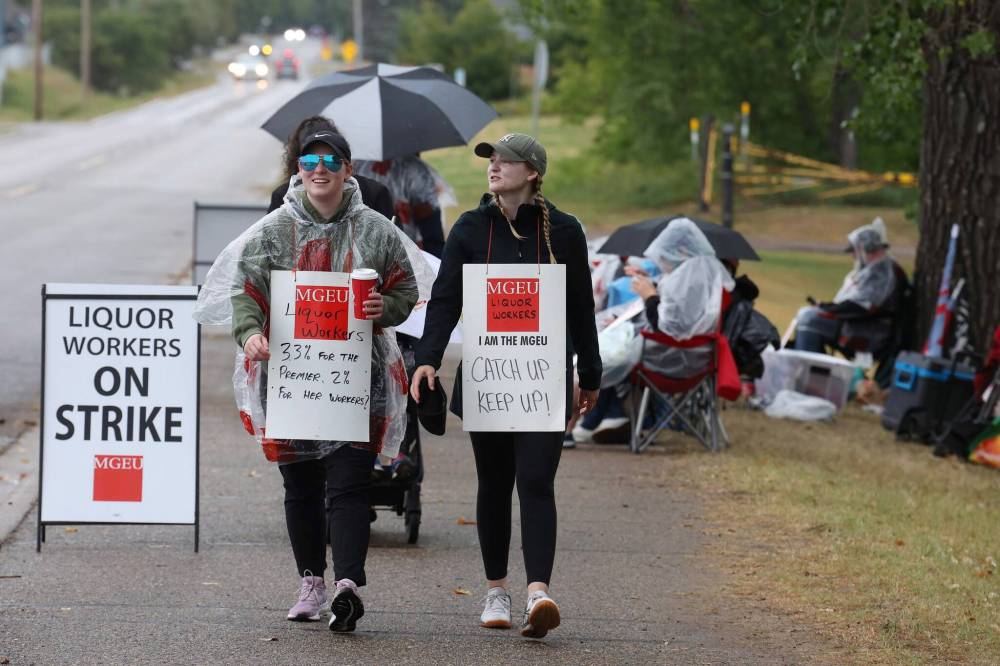
Striking MGEU workers are receiving 70% of their regular gross pay up to $500 in non-taxable income weekly.
The woman said she has four kids ranging in age from five to 16 years old. When she became a casual part-time employee at a rural Liquor Mart several years ago, she knew she would have to also receive unemployment benefits to get by.
“Paying bills, groceries, gas, food, I have children, all of those things were not attainable with a wage at $14.91 (per hour),” she said.
Part of her resolve to strike comes from working with full-time staff who struggle to live on their hourly wage, she said.
“It was just hard to accept the fact that the wages were so low and to think that other people were actually trying to survive off those wages, and not having the unemployment as an option to offset it when they weren’t getting hours or weren’t at work,” she said.
NDP Leader Wab Kinew wouldn’t say whether the province would get involved in negotiations and collective bargaining between the Crown corporation and MGEU if the party is elected in October, but said the Tories had a history of governing over “labour unrest.”
“How many nurses, how many electricians, how many working people? Now it’s the people in the Liquor Marts (who) have had to go on strike just to fight to get a little help to get by during a time of high inflation,” he said.
— With files from Carol Sanders
malak.abas@freepress.mb.ca

Malak Abas is a city reporter at the Free Press. Born and raised in Winnipeg’s North End, she led the campus paper at the University of Manitoba before joining the Free Press in 2020. Read more about Malak.
Every piece of reporting Malak produces is reviewed by an editing team before it is posted online or published in print — part of the Free Press‘s tradition, since 1872, of producing reliable independent journalism. Read more about Free Press’s history and mandate, and learn how our newsroom operates.
Our newsroom depends on a growing audience of readers to power our journalism. If you are not a paid reader, please consider becoming a subscriber.
Our newsroom depends on its audience of readers to power our journalism. Thank you for your support.
History
Updated on Thursday, August 10, 2023 9:07 PM CDT: Clarifies striking workers are receiving 70% of their regular gross pay up to $500 in non-taxable income weekly.